Marketing teams in 2026 are spoiled for choice when it comes to AI writing tools, and the differences between them matter more than the marketing copy on their homepages. Some are built around brand governance and enterprise context. Some focus on go-to-market workflows. Others specialize in ecommerce catalogs or AI search visibility. This list is not a ranking of quality. It is a set of seven tools worth knowing, each described by what it actually does and who it tends to suit, based only on what each company publishes about itself.
How We Picked These Tools
These tools were chosen because each one publicly describes a distinct approach to AI-assisted writing for marketing work: brand context and governance, go-to-market workflows, enterprise agent orchestration, everyday editing and tone, AI search visibility, performance prediction, and ecommerce product content. Every fact below is drawn from the company's own homepage, and no tool is presented as better than another. Prices appear only where the company publishes them.
| Provider | Best For |
|---|---|
| Jasper | Marketing organizations that want governed, workflow-based AI |
| Copy.ai | Go-to-market teams unifying AI across functions |
| Writer | Enterprises that need governance and brand control |
| Grammarly | Everyday editing, tone, and clarity support |
| Writesonic | Teams focused on AI search visibility |
| Anyword | Teams prioritizing content performance prediction |
| Hypotenuse AI | Ecommerce teams managing large product catalogs |
The 7 Tools in Focus
#1 Jasper
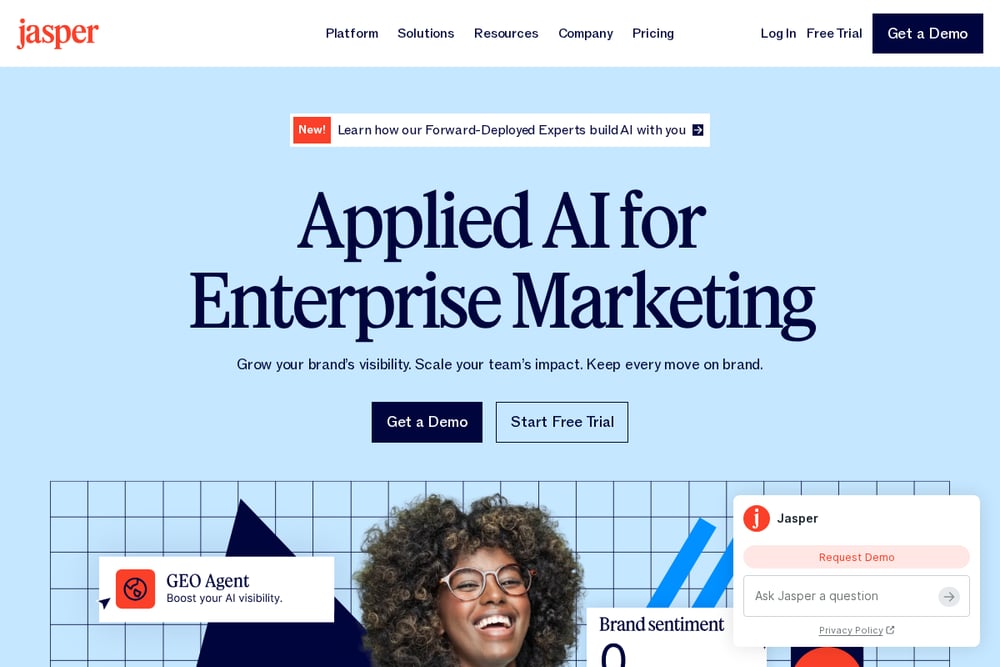 A screenshot of the Jasper website.
Jasper positions itself as a platform that combines forward-deployed experts, context, governance, and agents in one system for marketing organizations. Its Context layer, including Brand IQ and Brand Voice, is designed to turn a company's brand, products, and audiences into context that governs every output. Purpose-built agents execute end-to-end marketing workflows, and the platform also covers GEO and AI optimization so teams can measure brand performance across AI answer engines. It suits marketing organizations that want AI workflows tied to brand governance rather than isolated task-level wins.
#2 Copy.ai
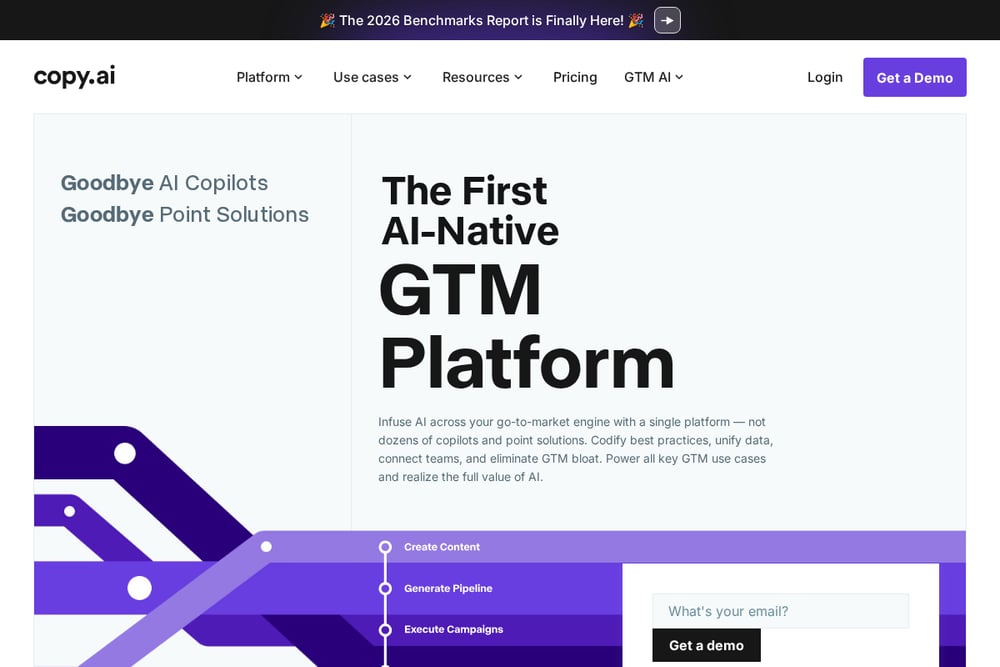 A screenshot of the Copy.ai website.
Copy.ai describes itself as an AI-native go-to-market platform rather than a collection of point solutions. It organizes work around Workflows, Actions, Agents, Tables, and Chat, with a Brand Voice component and use cases spanning content creation, account based marketing, translation and localization, and inbound lead processing. The platform is aimed at teams that want to codify go-to-market processes and connect marketing, sales, and operations. It suits go-to-market teams looking to unify AI work across functions.
#3 Writer
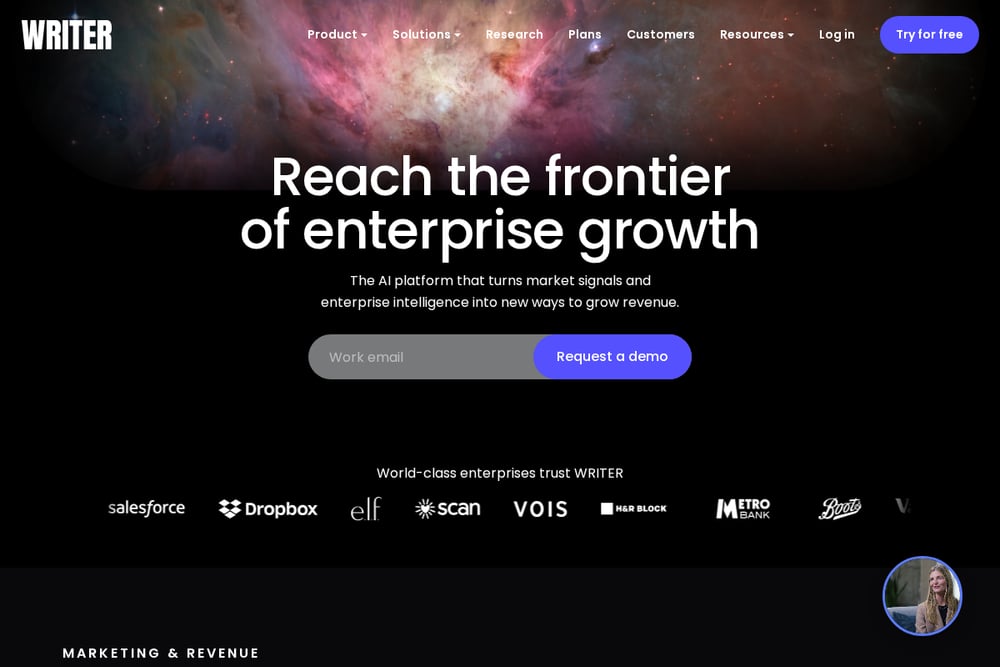 A screenshot of the Writer website.
Writer offers an AI platform built around an agent that executes complex work across systems, with playbooks for multi-step workflows and connectors to business apps. Its Enterprise Brain grounds agents in team decisions, brand guidelines, and compliance, and the company emphasizes governance, security, and control over data. Writer positions the platform for marketing and revenue teams that want to operationalize best practices and scale agents with oversight. It suits enterprises that prioritize governance and brand consistency in AI writing work.
#4 Grammarly
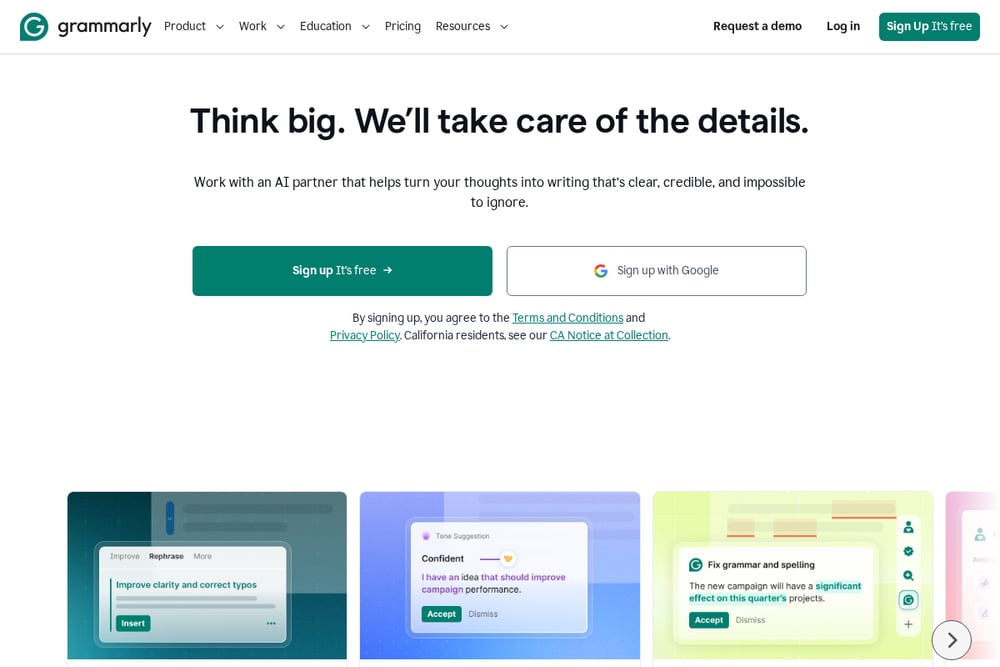 A screenshot of the Grammarly website.
Grammarly focuses on writing improvement and assistance, offering paragraph rewrites, tone suggestions, proofreading, and agents such as a Humanizer and an AI Detector. It works across apps and browsers, and its plans include features like brand style guide suggestions and generative AI prompts. The company states it does not sell or monetize user content. It suits marketing teams and individuals who want everyday editing, tone, and clarity support layered onto their existing writing tools.
#5 Writesonic
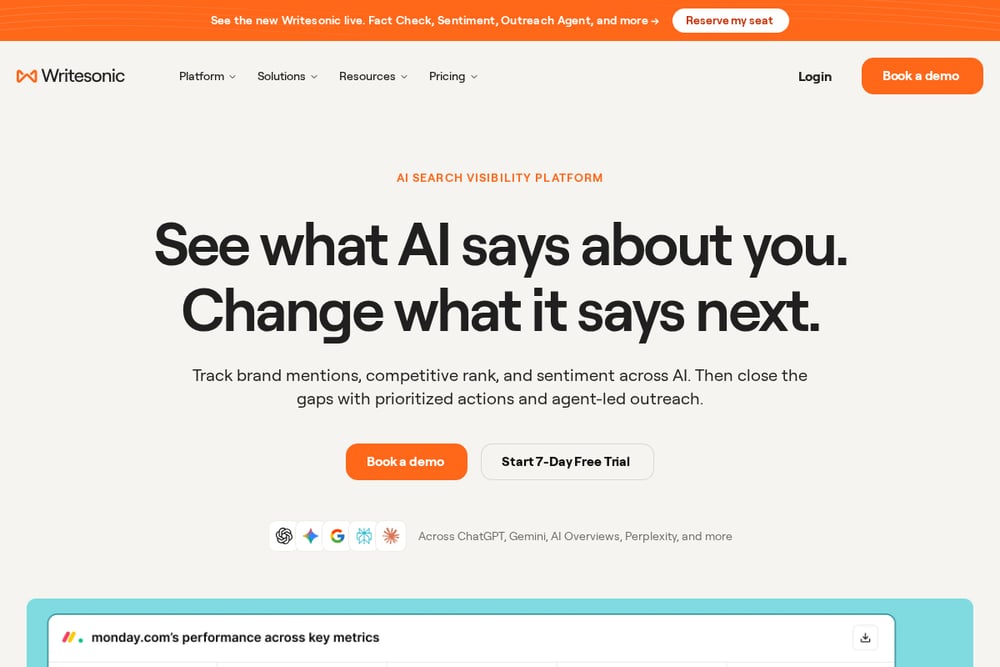 A screenshot of the Writesonic website.
Writesonic centers on AI search visibility, framing its approach as an AI Search Loop of tracking, prioritizing, acting, and measuring. It monitors brand mentions, competitive rank, and sentiment across AI platforms, then offers an Action Center and AI agents to help close content and citation gaps. The platform also includes an AI Article Writer and AI Content Agent. It suits marketing teams and agencies that want to understand and improve how brands appear in AI-generated answers.
#6 Anyword
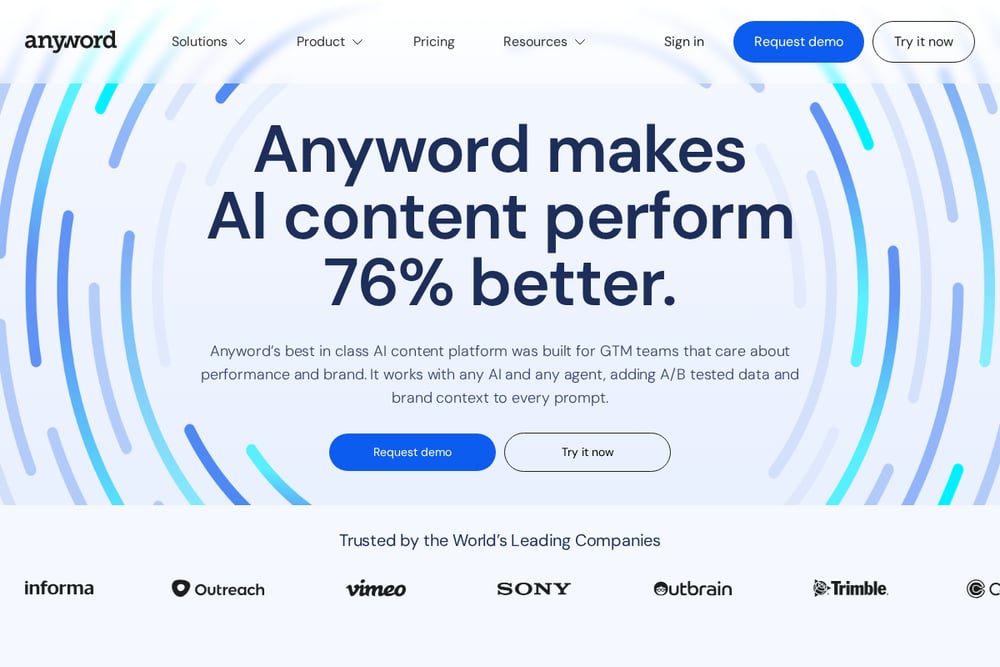 A screenshot of the Anyword website.
Anyword describes itself as a gen-AI content platform backed by A/B-tested data and built for enterprise go-to-market teams. It emphasizes performance prediction, claiming its AI can determine which of two content variations will perform better based on audience, business goal, and channel. The platform includes a data-driven editor, a Blog Wizard, website automation, and a Chrome Extension. It suits marketing teams that care about content performance and brand consistency across channels.
#7 Hypotenuse AI
 A screenshot of the Hypotenuse AI website.
Hypotenuse AI describes itself as an AI-first PIM for ecommerce, running product data enrichment across a catalog and writing on-brand descriptions. It generates product descriptions in a brand voice, localizes content for global markets, and enhances product images with AI. The platform also tracks product performance and offers SEO and GEO optimization for product pages. It suits ecommerce marketing teams managing large product catalogs across channels and marketplaces.
Which One Should You Choose?
Start with the work your team actually does. If brand governance and repeatable marketing workflows are the priority, look at platforms built around context and agents. If you need AI work connected across marketing, sales, and operations, a go-to-market platform may fit better. Enterprises with heavy compliance needs should weigh governance and data-control features. For everyday editing and tone, a writing assistant that works inside existing tools is often enough. Teams worried about how their brand appears in AI answers should consider tools built around AI search visibility. If content performance prediction matters, look for platforms that emphasize testing and scoring. Ecommerce teams with large catalogs should prioritize product data enrichment and bulk description generation. Compare published pricing and features directly, and run a trial against your own workflows before committing.
Final Thoughts
There is no single right answer here, and none of these tools is being called the best. Each one approaches AI writing for marketing from a different angle: Jasper around governed workflows, Copy.ai around go-to-market processes, Writer around enterprise agents and control, Grammarly around everyday editing, Writesonic around AI search visibility, Anyword around performance prediction, and Hypotenuse AI around ecommerce product content. The useful move is to match the tool's center of gravity to the work your team does most, then test it on real briefs before you scale it.
Know a company that belongs on this list? Email us at editorial@peekwire.com.