Small security teams are asked to cover a lot of ground with limited time. The scanners below each approach that problem differently, from broad exposure platforms to tools built around automation and hacker-driven research. This list describes what each one does and who it tends to suit, so you can match a tool to how your team actually works.
How We Picked These Tools
These tools were picked because their public materials speak directly to stretched or resource-limited teams, and because each offers a distinct way to reduce manual scanning work. Every claim below is drawn from the companies' own pages, with quotes kept verbatim. The order is a plain list, not a quality ranking.
| Provider | Best For |
|---|---|
| Tenable | Teams consolidating exposure data across many environments |
| Qualys | Teams wanting risk measurement and remediation in one platform |
| Intruder | Stretched teams that want continuous scanning with clear fixes |
| Detectify | Resource-limited programs that need broad attack surface testing |
| Probely | Teams focused on web app and API security testing |
The 5 Tools in Focus
#1 Tenable
 A screenshot of the Tenable website.
Tenable presents an exposure management platform that pulls native signals, exposure intelligence, and third-party data into a single view of the attack surface. Its scope spans infrastructure, cloud, identity, OT, third-party applications, and AI. The company also offers agentic orchestration through Tenable Hexa AI, aimed at shortening the time from detection to resolution. It suits teams that want one platform to find, prioritize, and act on exposures across many environments.
#2 Qualys
 A screenshot of the Qualys website.
Qualys frames its Enterprise TruRisk Platform as a place to measure, manage, and reduce cyber risk. The platform bundles vulnerability and configuration management, compliance, asset management, and threat detection and response. It also offers agentic AI capabilities and a free service to help organizations find where they are exposed to a specific threat. It suits teams that want risk measurement and remediation workflows in one place.
#3 Intruder
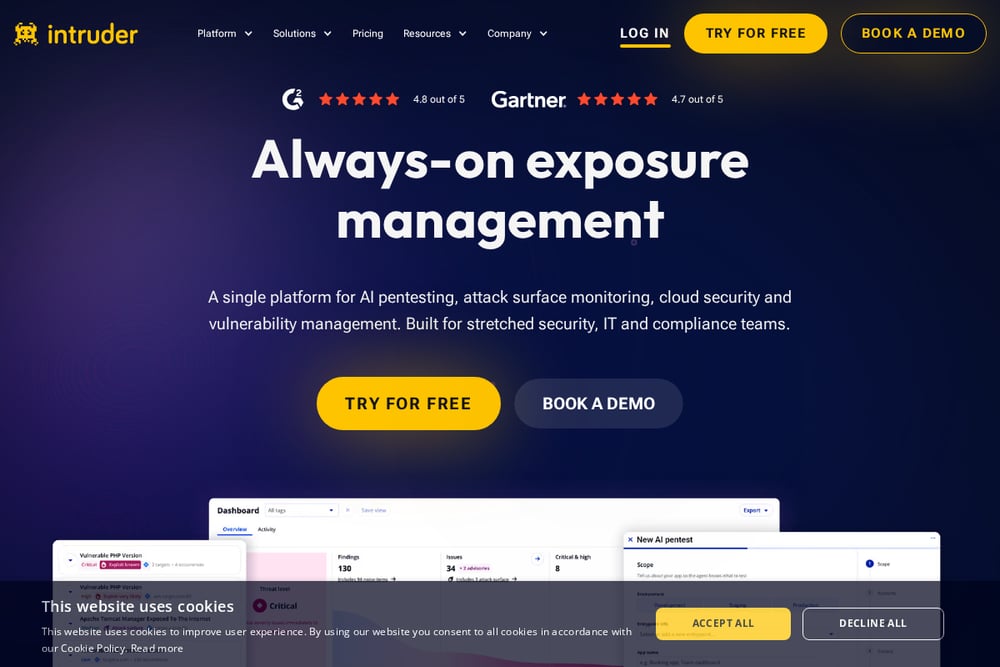 A screenshot of the Intruder website.
Intruder describes itself as an always-on exposure management platform built for stretched security, IT, and compliance teams. It combines AI pentesting, attack surface monitoring, cloud security, and continuous vulnerability management in a single platform. Emerging threat scans run shortly after new critical vulnerabilities go public, and results come with remediation advice. It suits small teams that want continuous scanning with clear next steps rather than raw alert volume.
#4 Detectify
 A screenshot of the Detectify website.
Detectify combines continuous attack surface discovery with application security testing informed by ethical hacker research. Its products cover API scanning, surface monitoring, and authenticated application scanning, plus internal scanning and PCI ASV scanning. The company also offers agentic tooling that lets AI agents verify suspected findings with evidence recorded in a Security Ledger. It suits teams that want to scale testing across a broad attack surface without expanding headcount.
#5 Probely
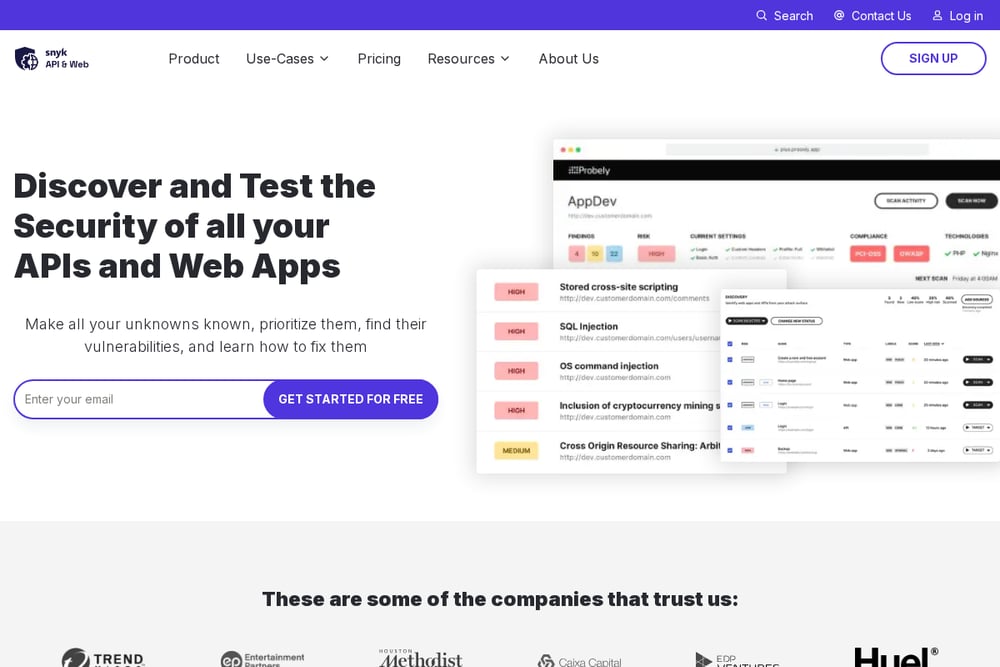 A screenshot of the Probely website.
Probely focuses on discovering and testing the security of APIs and web apps. Its stated goal is to make unknowns known, prioritize them, find their vulnerabilities, and explain how to fix them. The site lists use cases for developers, security teams, DevOps, management, and compliance. It suits teams that want a focused web and API testing tool with guidance on remediation.
Which One Should You Choose?
Start with the shape of your environment. If exposures are spread across cloud, identity, OT, and on-premises systems, a broad exposure platform may fit better than a web-focused scanner. If your main gap is continuous coverage of external assets and web apps, look at tools built around discovery and testing. Consider how much triage your team can absorb: some tools emphasize prioritization and remediation advice, while others emphasize research-driven detection. Also check how quickly a tool can be connected to your existing accounts and workflows, since implementation effort matters when staff time is scarce.
Final Thoughts
Each of these scanners reduces manual work in a different way: unified exposure data, consolidated risk measurement, continuous scanning with fix guidance, hacker-driven testing at scale, or focused API and web app coverage. None of them is presented here as better than the others. The right fit depends on where your exposures live, how much triage capacity you have, and how quickly you need coverage to start.
Know a company that belongs on this list? Email us at editorial@peekwire.com.