
If you're tired of boring worksheets and want your child to actually enjoy math, you're in the right place. These five specialized programs ditch the drill-and-kill approach for something far more engaging: games, puzzles, symbols, and hands-on manipulatives. Each one
The Rise of Niche Math Curricula
The elementary math curriculum market is dominated by big publishers like McGraw-Hill and Pearson, but a growing number of parents and teachers are turning to small, specialized programs. These niche curricula use unique approaches — chess symbols, abacuses, comic books, or gamified apps — to engage students who don't respond to traditional methods. They're often created by small teams or family-run businesses, and they prioritize deep understanding over rote memorization. If you're looking for something that sparks genuine curiosity, these five programs represent the best of what's available.
How We Ranked These Programs
We evaluated each curriculum based on four factors: engagement (how much kids actually want to use it), uniqueness (does it offer something different from standard textbooks?), educational value (does it build real math skills?), and accessibility (is it easy for parents to implement?). We also considered alignment with Common Core standards and the size of the target age range. The result is a list that balances proven effectiveness with creative flair.
Here's a quick comparison of the five programs to help you narrow down your options.
| Provider | Best For | Pricing |
|---|---|---|
| Beast Academy | Advanced elementary students who love puzzles and stories | ~$96/year (online subscription) or ~$150–$200 per book set |
| Math-U-See | Homeschool families wanting a structured, mastery-based approach | ~$100–$200 per level (student kits + manipulatives) |
| RightStart Math | Visual and kinesthetic learners who need a strong number sense foundation | ~$100–$200 per level (books + manipulatives kits) |
| Chess 4 Math | 3rd graders who enjoy chess, puzzles, and code-breaking | Contact vendor for pricing (likely one-time purchase or subscription) |
| Elephant Learning | Elementary students who need a self-paced, game-based supplement | ~$35/month or ~$249/year subscription |
Detailed Reviews of Each Program
#1 Beast Academy
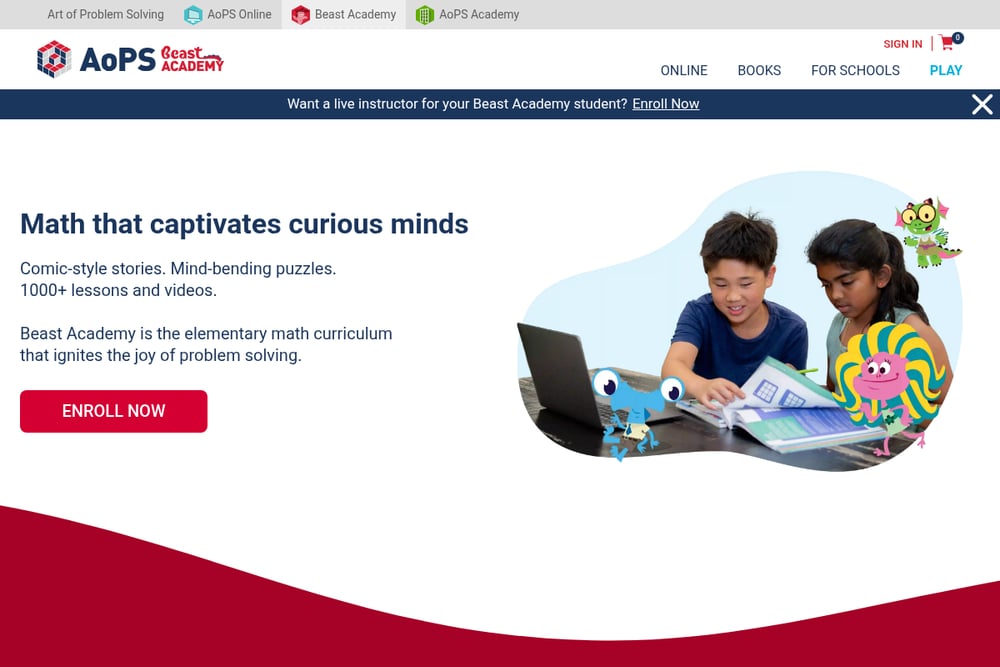 A screenshot of the Beast Academy website.
Beast Academy turns math into a comic-book adventure. Created by Art of Problem Solving, it covers grades 1–5 with over 20,000 problems and puzzles wrapped in a story-driven format. Your child follows characters through a fantasy world while mastering advanced concepts like fractions, decimals, and logic. The online subscription gives you interactive lessons, while the books offer a screen-free option. It's rigorous but so fun that kids often beg for more. As noted on their site, the program builds deep problem-solving skills that go far beyond standard curriculum.
At a Glance:
- Pro: Extremely engaging comic format that makes challenging math feel like a game
- Con: Can be too advanced for struggling students; requires strong reading skills
- Pricing: ~$96/year (online subscription) or ~$150–$200 per book set
#2 Math-U-See
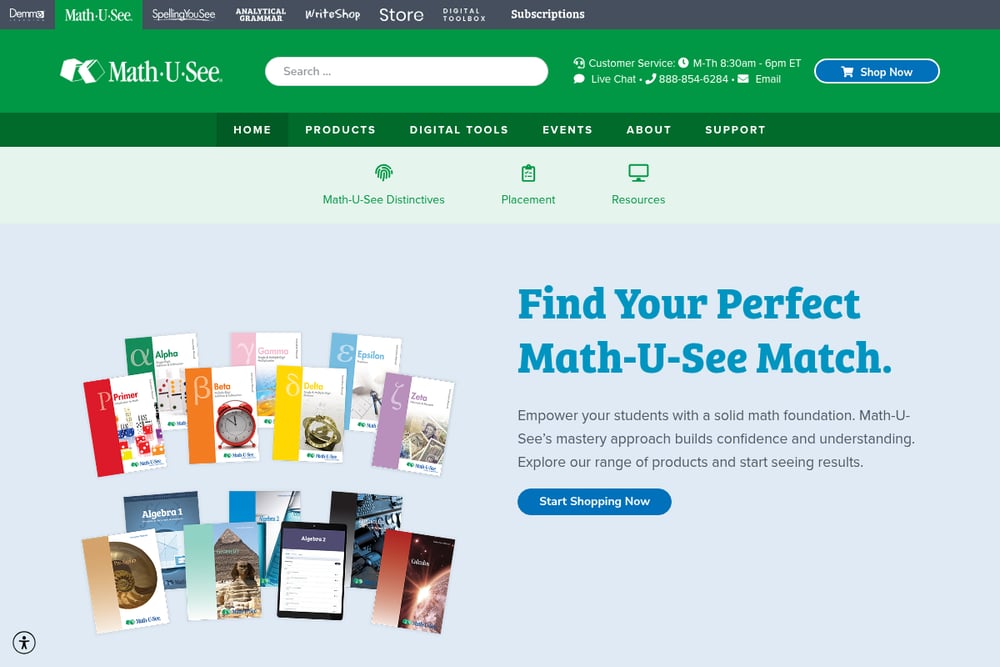 A screenshot of the Math-U-See website.
Math-U-See is a mastery-based curriculum that uses physical manipulatives to help students 'see' math concepts. Published by Demme Learning since 1990, it covers K–12 with a focus on building solid foundations. Each level introduces one major concept at a time, using integer blocks, fraction overlays, and algebra inserts. The program includes video lessons, workbooks, and tests. It's especially popular in homeschool circles because it's straightforward and parent-friendly. The hands-on approach works well for kinesthetic learners who need to touch and move objects to understand abstract ideas.
At a Glance:
- Pro: Clear, sequential mastery with excellent manipulatives that make abstract concepts concrete
- Con: Can feel repetitive for quick learners; initial kit cost is high
- Pricing: ~$100–$200 per level (student kits + manipulatives)
#3 RightStart Math
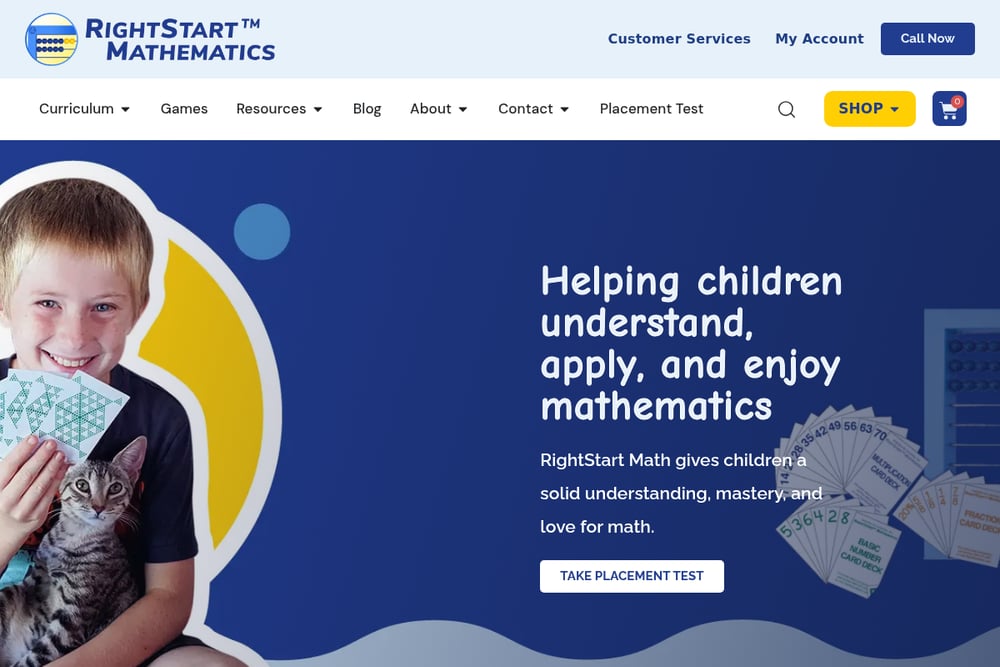 A screenshot of the RightStart Math website.
RightStart Math takes a visual, abacus-based approach that de-emphasizes counting and builds number sense. Developed by Dr. Joan Cotter, this small family-run business offers levels from kindergarten through middle school. The program uses games, card activities, and a unique abacus to teach place value, addition, and multiplication. It's aligned with Common Core and designed to reduce reliance on rote memorization. Many parents report that their children develop a strong intuitive understanding of numbers after using RightStart. The hands-on games keep kids engaged without feeling like schoolwork.
At a Glance:
- Pro: Builds deep number sense through visualization and games, not memorization
- Con: Requires significant parent involvement; manipulatives can be messy
- Pricing: ~$100–$200 per level (books + manipulatives kits)
#4 Chess 4 Math
 A screenshot of the Chess 4 Math website.
Chess 4 Math is a third-grade math curriculum that uses chess piece icons to represent digits 0–9. Students decode symbols, solve problems, and verify answers in a play-based learning adventure aligned with Common Core. As highlighted in a ChessBase article, the program turns math into a puzzle where each chess piece stands for a number — making abstract arithmetic concrete and fun. It's a small, niche product perfect for kids who love chess or secret codes. The structured lessons build critical thinking and symbol recognition skills. If your child is bored with traditional math, this fresh approach might be the key.
At a Glance:
- Pro: Unique symbol-based system that makes math feel like a secret code; builds decoding and problem-solving skills
- Con: Only targets 3rd grade; limited scope compared to full K–12 programs
- Pricing: Contact vendor for pricing (likely one-time purchase or subscription)
#5 Elephant Learning
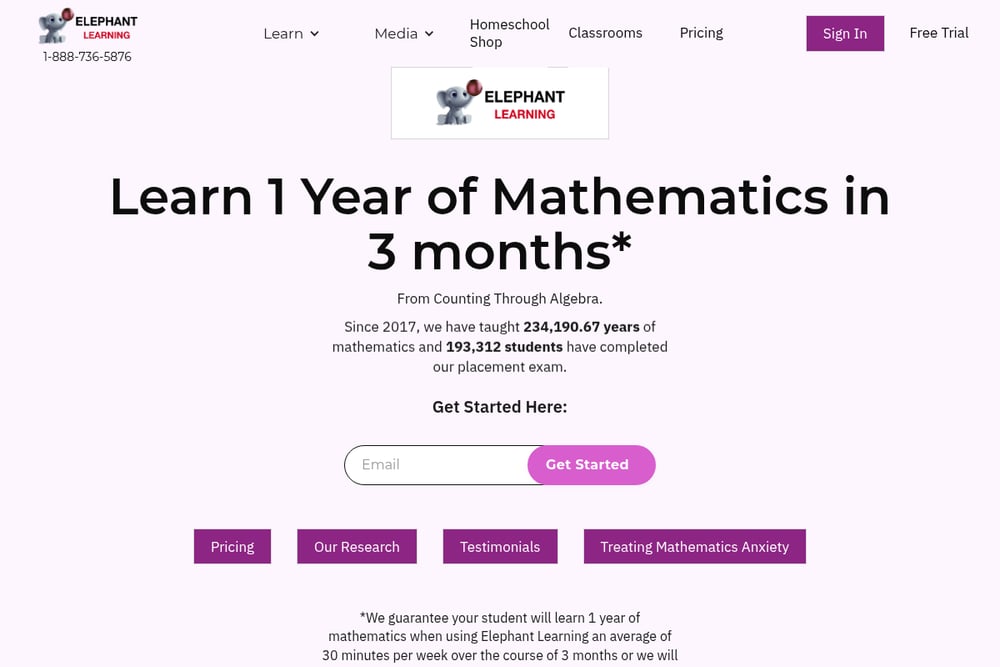 A screenshot of the Elephant Learning website.
Elephant Learning is a gamified math platform for elementary students that feels like playing a puzzle game. It uses an adaptive placement exam to start each child at the right level, then guides them through interactive activities covering counting through algebra. The company describes it as 'like Angry Birds but for math' — kids solve problems to progress through levels. Parents get detailed progress reports showing growth in math age. It's a small, specialized company that focuses on making math fun through game mechanics. The subscription model gives you access to all content, and the platform works on tablets and computers.
At a Glance:
- Pro: Adaptive and self-paced; kids love the game-like interface and earn rewards
- Con: Screen-based only; may not provide enough depth for mastery of complex topics
- Pricing: ~$35/month or ~$249/year subscription
How to Choose the Right Math Curriculum for Your Child
Start by considering your child's learning style. Do they love stories and puzzles? Beast Academy or Chess 4 Math might be a hit. Are they hands-on and need to touch things? Math-U-See or RightStart Math are excellent. If your child thrives on screens and instant feedback, Elephant Learning is a solid choice. Also think about your role: some programs require heavy parent involvement (RightStart, Math-U-See), while others are more independent (Beast Academy online, Elephant Learning). Finally, consider budget and scope — Chess 4 Math is narrow but cheap, while Math-U-See covers K–12 but costs more upfront.
Automating Your Math Routine
To make math practice a seamless part of your day, set up a simple workflow. For screen-based programs like Elephant Learning or Beast Academy online, schedule 15–20 minutes daily on a tablet or computer. For hands-on programs, prep manipulatives the night before and keep them in a dedicated bin. Use a timer to create a consistent 'math time' — kids thrive on routine. If you're using multiple programs (e.g., Chess 4 Math as a supplement), rotate them weekly to keep things fresh. Track progress with a simple spreadsheet or the program's built-in reports.
The Bottom Line
There's no one-size-fits-all math curriculum, but these five programs prove that learning can be fun and effective. Whether your child decodes chess symbols, battles monsters in a comic book, or slides beads on an abacus, each of these options offers a unique path to math confidence. Start with the one that matches your child's interests, and don't be afraid to switch if it doesn't click. The goal is to build a love for math that lasts a lifetime.