
Transit agencies are drowning in vendor-specific data silos, but a new wave of tools is turning that chaos into clean, standardized insights. Here are five platforms and initiatives leading the charge.
The Data Integration Imperative
Transit agencies run on a patchwork of systems—CAD/AVL, scheduling, fare collection, asset management—each spitting out data in its own proprietary format. For years, pulling that data into a unified analytics environment meant costly, custom integration projects that drained IT budgets and delayed insights. The emergence of the Transit ITS Data Exchange (TIDES) standard is changing the game, offering a common language for operational data. Now, a handful of players are building the pipelines and platforms that make TIDES practical, enabling agencies to monitor performance, plan service, and report to the NTD with far less friction. This roundup covers the tools and organizations that are turning raw transit data into a strategic asset.
How We Evaluated the Field
We looked at each solution's ability to connect diverse transit systems, standardize data into TIDES or similar formats, and deliver it to analytics platforms. Service scope mattered—whether they offer pre-built connectors, data governance, or full-scale consulting. We also considered real-world deployment, such as production use at major agencies like WMATA or Caltrans, and how clearly they communicate their value proposition. Finally, we weighed the local fit for US transit agencies, from small operators to statewide programs.
Here's a quick snapshot of the five solutions, ranked by their overall impact on the transit data landscape.
| Provider | Best For |
|---|---|
| Foursquare ITP | Agencies needing custom data infrastructure consulting |
| Transit Lake | Agencies wanting a turnkey TIDES pipeline |
| ETA Transit | Agencies seeking an integrated operations and analytics suite |
| California TIDES Dataset | Researchers and developers needing standardized transit data |
| MobilityData | Staying informed on TIDES standards and governance |
The Five Solutions, Closely Examined
#1 Foursquare ITP
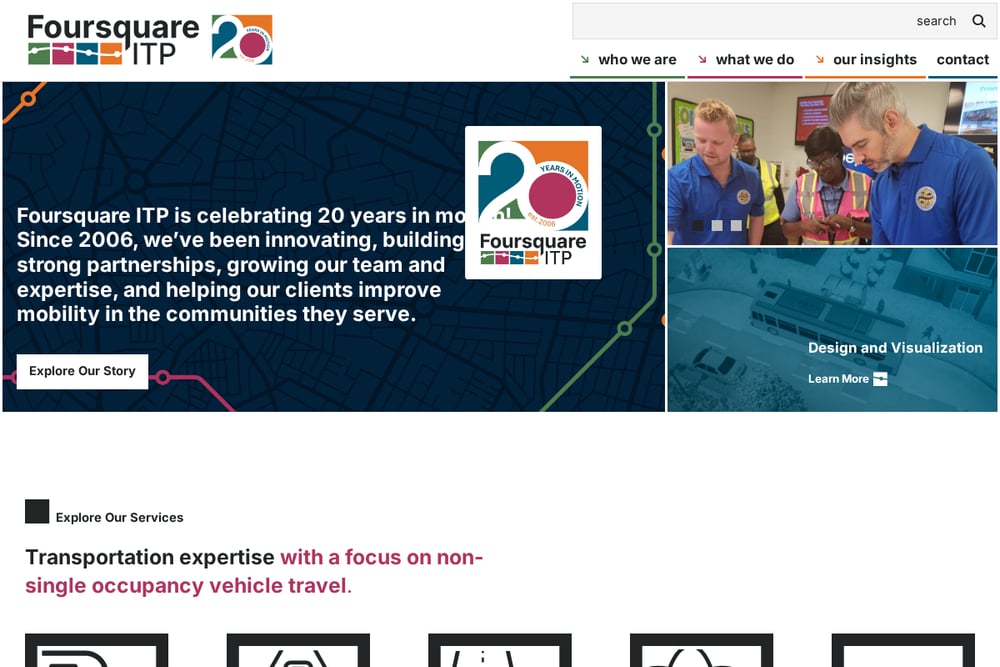 A screenshot of the Foursquare ITP website.
Foursquare ITP is a consulting firm that has been instrumental in prototyping TIDES at WMATA, transforming raw CAD/AVL, APC, and AFC data into standardized tables. Their work on the WMATA SMART Data Hub involved building five data pipelines and 95 data tables, backed by over 300 automated data tests to ensure quality. This hands-on approach makes them a go-to for agencies needing custom data infrastructure planning and prototyping. If you're looking for a partner to design your data hub from scratch, Foursquare ITP brings deep expertise and a proven track record. Their focus on data governance and health metrics helps agencies trust their data. For a tailored, consulting-led path to TIDES, they're a strong choice.
#2 Transit Lake
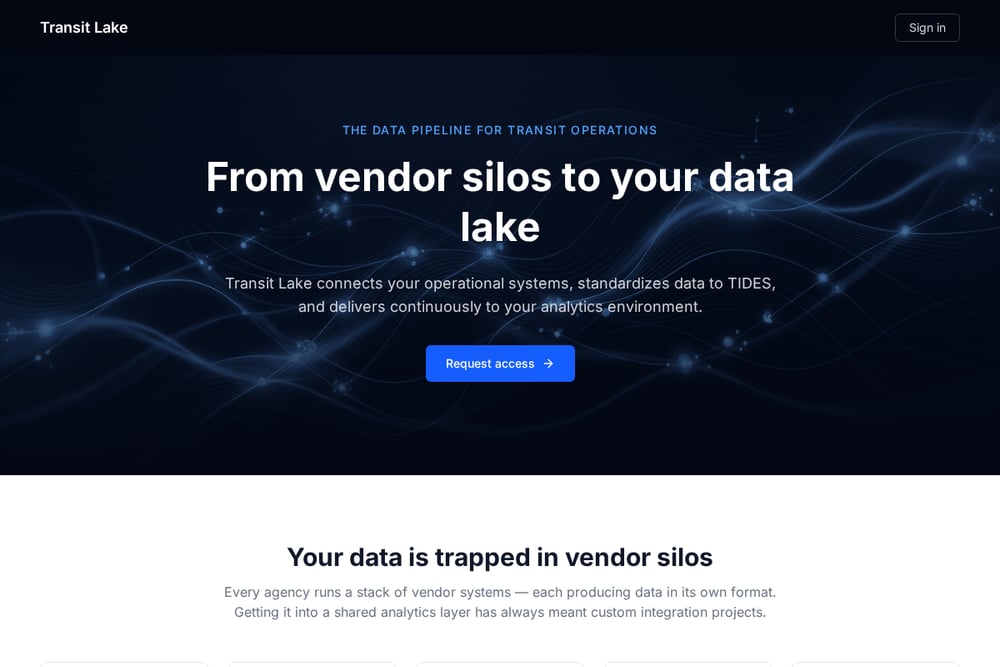 A screenshot of the Transit Lake website.
Transit Lake offers a pre-built data pipeline that connects your existing vendor systems—like Swiftly, Clever Devices, and Trapeze—directly to your data lake, standardizing everything into TIDES along the way. You skip the custom integration projects and get continuous delivery to Azure, Snowflake, or Oracle, with real-time health monitoring and a documented data catalog. The platform has been in production for over five years, powering statewide data platforms like Cal-ITP and serving 200+ agencies, with 25 billion events archived. If you want a plug-and-play solution that gets you to TIDES without the consulting overhead, Transit Lake is your answer. Their dbt packages produce analytics-ready tables daily, so your team can start querying immediately. It's the fastest route from vendor silos to a unified analytics environment.
#3 ETA Transit
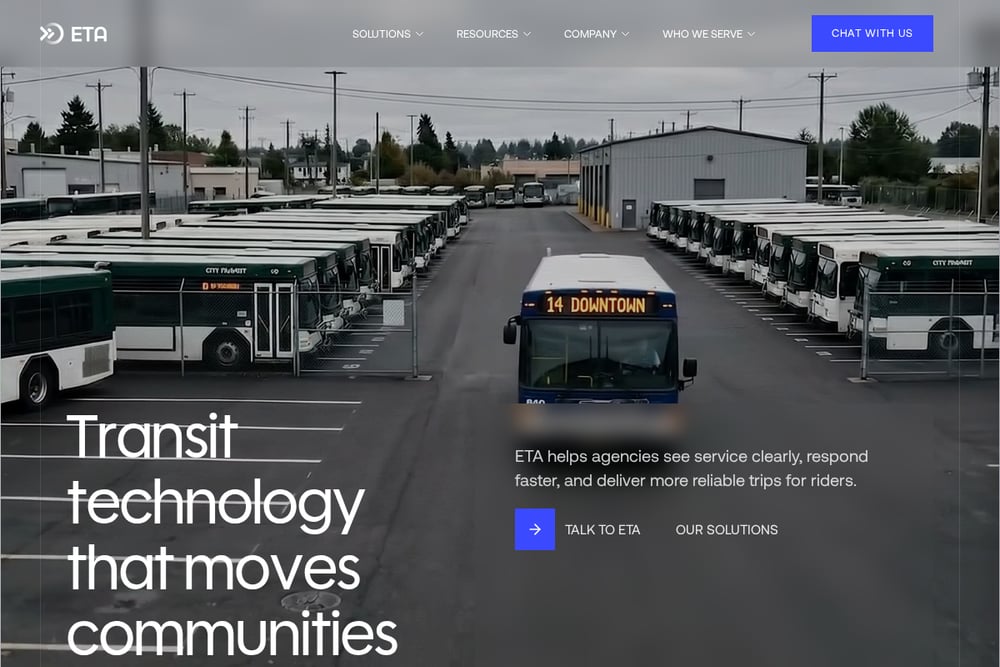 A screenshot of the ETA Transit website.
ETA Transit is a comprehensive transit technology provider that offers a suite of solutions, including CAD/AVL, passenger info, and NTD reporting. Their TransitBase platform benchmarks your agency against peers, while TransitOps handles dispatch and monitoring, and TransitGPT lets you ask questions of your transit data. They've been active in the TIDES conversation, with blog posts exploring the standard and its extensions. ETA is ideal for agencies that want an all-in-one operational platform with built-in analytics, rather than a separate data pipeline. Their strength lies in integrating operations and data, giving you a single source of truth. If you're looking to modernize your entire tech stack, ETA is a solid contender.
#4 California TIDES Dataset
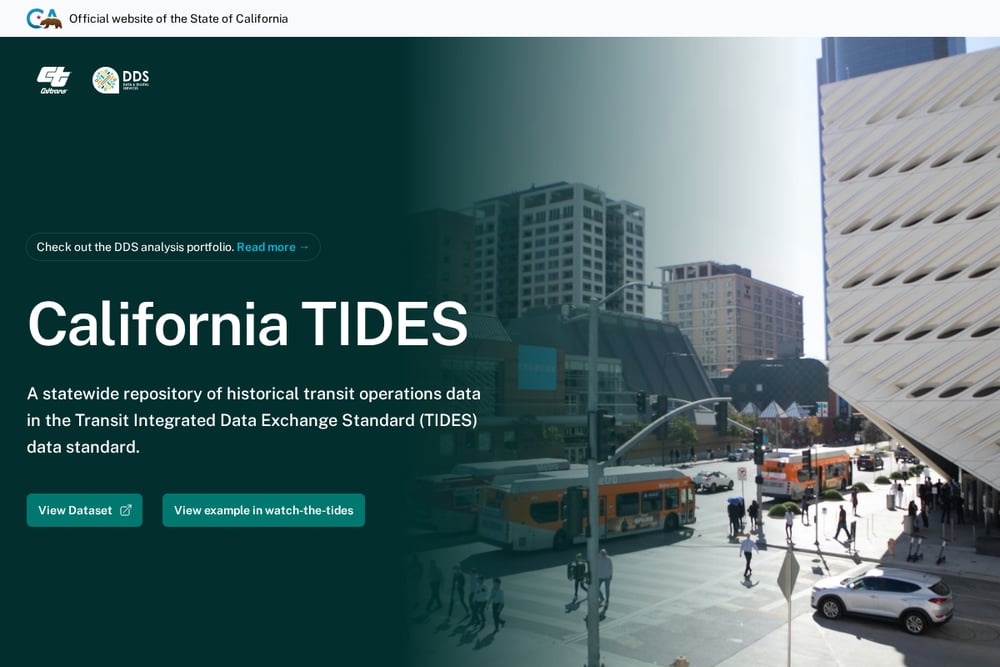 A screenshot of the California TIDES Dataset website.
The California TIDES Dataset is a statewide repository of historical transit operations data, standardized into the TIDES format and hosted by Caltrans. It provides a public, queryable dataset that includes vehicle locations, passenger counts, and fare transactions, making it a goldmine for researchers and consultants. The dataset uses a requester-pays model on Google Cloud, so you need a billing project to access it, but the egress costs are minimal. For agencies looking to benchmark or for developers building cross-agency tools, this is a unique resource. It's not a pipeline tool, but rather a data source that demonstrates TIDES in action. If you need historical data to fuel your analytics, this is the place to start.
#5 MobilityData
 A screenshot of the MobilityData website.
MobilityData is the nonprofit organization that manages the TIDES specification, along with other standards like GTFS and ODS. They recently assumed management of TIDES from Caltrans, ensuring its ongoing development and adoption. For agencies and vendors, MobilityData provides the governance and community support needed to make TIDES a lasting standard. They don't offer a pipeline or dataset, but they're the reason TIDES exists as a viable option. If you're evaluating TIDES, following MobilityData's work is essential to understand the roadmap and best practices. They're the backbone of the ecosystem, connecting stakeholders and driving standardization.
How to Choose the Right Transit Data Solution
Start by assessing your agency's current data infrastructure and technical capacity. If you have a data lake but struggle with vendor silos, a turnkey pipeline like Transit Lake can save you months of development. If you need a custom architecture and have budget for consulting, Foursquare ITP can design a solution tailored to your exact systems. For agencies that want to replace multiple systems with an integrated platform, ETA Transit offers a broader suite. If your goal is to access historical data for analysis or benchmarking, the California TIDES Dataset is a free (almost) resource. And regardless of your choice, keep an eye on MobilityData to stay aligned with the evolving TIDES standard.
Automating the Path to TIDES
The ideal workflow starts with connecting your operational systems—CAD/AVL, scheduling, fare collection—via pre-built connectors, as Transit Lake does. These connectors automatically extract data and standardize it into TIDES tables, eliminating manual ETL. The standardized data is then continuously delivered to your data lake, where dbt packages transform it into analytics-ready models. Real-time monitoring alerts you to data outages, and a data catalog documents everything for easy querying. This automation reduces the need for custom code and lets your team focus on analysis, not plumbing.
The Future of Transit Data
The transit industry is finally moving from data chaos to data clarity, and TIDES is the catalyst. Whether you choose a turnkey pipeline, a consulting partner, or a public dataset, the goal is the same: unlock the insights hidden in your operations data. By adopting these solutions, you can improve service reliability, optimize ridership, and make data-driven decisions with confidence. The tools are here—now it's up to you to put them to work.