
If your business is hitting the limits of a monolithic architecture, you already know the pain: slow deployments, scaling bottlenecks, and a codebase that feels like a tangled knot. Microservices promise agility, but the path from monolith to modular is
The State of Microservices Consulting in 2026
Microservices have moved from experimental to essential. A recent survey found that 77% of organizations have adopted microservices, with 92% reporting success. The benefits are clear: 69% experience faster deployments, 61% gain greater flexibility, and 56% can scale features more rapidly. But the complexity of managing dozens of independent services, each with its own data store and communication protocols, means that most enterprises need expert guidance. The best consultancies don't just write code; they help you design for resilience, observability, and team autonomy from the start.
How We Ranked the Top Microservices Consultancies
We evaluated each firm on four key dimensions: depth of technical expertise (including cloud-native and Kubernetes skills), breadth of service offerings (from strategy to implementation), proven track record with enterprise clients, and the clarity of their methodology for managing complexity. We also considered how well each consultancy balances strategic guidance with hands-on delivery.
Here is a quick comparison of the top five microservices consultancies to help you find the right fit for your organization.
| Provider | Best For |
|---|---|
| ScienceSoft | End-to-end microservices delivery with enterprise-grade documentation |
| Keyhole Software | U.S.-based teams needing hands-on Kubernetes and cloud-native expertise |
| Torry Harris Integration Solutions | Enterprises needing governance, coaching, and a factory-model delivery approach |
| VAELQON — Microservices & Architecture Consultancy | Enterprise system optimization and infrastructure governance |
| Cazton | Fortune 500 and mid-market firms needing phased monolith-to-microservices migration |
A deep dive into the 5 best Professional Services for 2026
#1 ScienceSoft
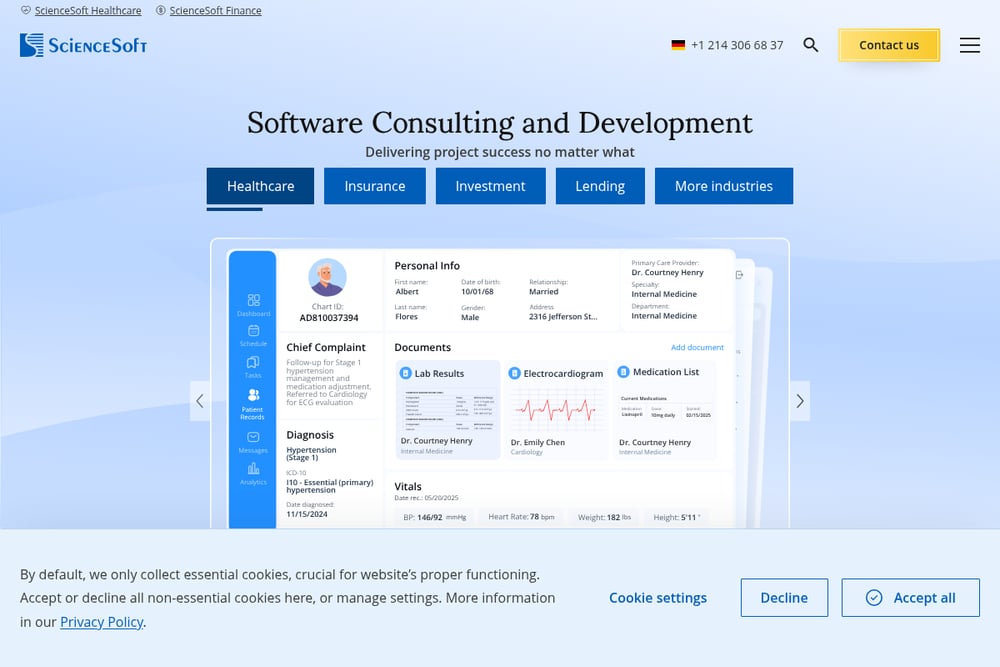 A screenshot of the ScienceSoft website.
With roots stretching back to 1989, ScienceSoft brings decades of enterprise software experience to microservices consulting. They deliver a full lifecycle of deliverables, from detailed requirements and architecture design to CI/CD pipeline configuration and data migration scripts. Their average project size of 25+ full-time engineers managing 40 microservices and over 80 CI/CD pipelines demonstrates their capacity for heavy lifting. They also maintain an in-house Architecture and Solutions Center of Excellence to ensure every solution is resilient and secure.
#2 Keyhole Software
 A screenshot of the Keyhole Software website.
Keyhole Software is a 100% U.S.-based consultancy that focuses on architecture strategy, Kubernetes, and cloud-native patterns. They partner with your team from the start, offering collaborative assessments and proof-of-concept work to define service boundaries using domain-driven design. Their consultants lead the full development lifecycle, from REST/gRPC API design to containerization with Docker and Kubernetes on EKS, AKS, or GKE. They also bake in observability from day one using tools like Grafana and OpenTelemetry, ensuring you can monitor and troubleshoot from the get-go.
#3 Torry Harris Integration Solutions
 A screenshot of the Torry Harris Integration Solutions website.
Torry Harris takes a pragmatic approach, emphasizing that microservices can cause as much harm as good if done incorrectly. They focus on establishing the right tooling, discipline, and design practices to avoid unmanaged complexity. Their consultants run workshops to coach your teams on where and how to apply microservices, covering containers, service mesh, and legacy renewal strategies. They also use a factory model to quickly and flexibly deliver microservices, as evidenced by their long-term work with major telcos like Airtel and Orange.
#4 VAELQON — Microservices & Architecture Consultancy
 A screenshot of the VAELQON website.
VAELQON positions itself as a focused partner for enterprise-grade microservices architecture, system optimization, and infrastructure governance. They target global market agility, helping businesses scale efficiently by breaking down complex systems into manageable, independent services. Their consulting approach is tailored for organizations that need to modernize their tech stack without disrupting ongoing operations. For teams seeking a dedicated consultancy that prioritizes architectural rigor and operational stability, VAELQON offers a compelling option.
#5 Cazton
 A screenshot of the Cazton website.
Cazton brings hands-on experience from some of the world's most complex environments, having worked with Fortune 500 clients like Microsoft, Bank of America, and Thomson Reuters. They emphasize aligning microservices architecture directly with your business domains and team structures for faster delivery and clearer ownership. Their phased approach to breaking monoliths into microservices minimizes disruption while accelerating value realization. They also integrate Big Data, Cloud, and AI capabilities, making them a strong fit for data-intensive modernization projects.
How to Choose the Right Microservices Consultancy for Your Business
Start by assessing your current state: are you building a greenfield application or migrating a legacy monolith? For greenfield projects, look for consultancies with strong domain-driven design and API-first thinking. For migrations, prioritize firms with a phased, risk-mitigated approach. Also consider team size and location: a U.S.-based team like Keyhole might be ideal for real-time collaboration, while a global firm like ScienceSoft can scale to large projects. Finally, ask about their governance and observability practices -- these are often the difference between a successful microservices rollout and a tangled mess.
Automating Your Microservices Workflow
A modern microservices workflow relies on automation at every stage. Start with infrastructure-as-code using Terraform or Pulumi to provision cloud resources. Then set up CI/CD pipelines with tools like GitHub Actions or Azure DevOps to automatically build, test, and deploy each service independently. Use container orchestration with Kubernetes to manage scaling and self-healing. Finally, implement observability with OpenTelemetry, Grafana, and centralized logging to monitor service health and trace requests across the distributed system.
Final Synthesis: Finding Your Microservices Partner
Choosing the right microservices consultancy is a strategic decision that will shape your engineering culture for years to come. Whether you need the end-to-end rigor of ScienceSoft, the hands-on Kubernetes expertise of Keyhole, the governance-focused approach of Torry Harris, the targeted optimization of VAELQON, or the phased migration experience of Cazton, each firm on this list brings a unique strength. The key is to match their methodology to your organization's maturity, team structure, and business goals. Start with a discovery workshop, and let the experts guide you toward a modular, scalable future.