
Reading stories you actually enjoy is one of the fastest ways to absorb a new language. Here are five platforms turning leveled stories into serious progress.
Why Story-Based Language Learning Is Booming
Language learners are tired of endless drills and gamified streaks that never quite turn into real comprehension. Story-based platforms flip the script: you read short, level-matched texts, tap words you do not know, and let context do the heavy lifting. The approach draws on comprehensible input theory, which says you acquire language most efficiently when you understand roughly 95 percent of what you read. That is why so many tools now grade stories from A1 to C2, layer in native audio, and turn the words you struggled with into flashcards. The result is a crowded but exciting category, with options ranging from free libraries to full courses and adapted bestsellers.
How We Evaluated These Platforms
We looked at the same factors for every platform: language coverage, how well the leveling system matches CEFR standards, the quality of in-story word help, audio support, vocabulary review tools, and how clearly free versus paid access is explained. Lingovia stood out for its tap-any-word meaning lookup, word rating system, and structured Learning Path quests that end in short tests. MeloLingua impressed with its broad 13-language lineup and clear A1-to-B2 story levels. StoryLearning earned attention for its deep course catalog and the way it teaches grammar naturally through narrative. Erla drew notice for native read-along audio that highlights each sentence as it is spoken. Eppika caught the eye with adapted bestsellers across 18 languages and a strong flashcard workflow. Each platform approaches the same core idea from a different angle, so the right pick depends on your goals, budget, and how you like to read.
Here is a quick look at the five platforms, ordered by how well they balance breadth, depth, and learner experience.
| Provider | Best For |
|---|---|
| MeloLingua | Learners who want the widest language selection with clear CEFR levels |
| Lingovia — learn a language by reading stories | Readers who want a structured, level-by-level path with smart flashcard review |
| StoryLearning | Learners who want a full course built around the story method |
| Erla | Learners who want native audio synced to leveled reading |
| Eppika | Book lovers who want to read adapted bestsellers while learning |
The Five Platforms in Detail
#1 MeloLingua
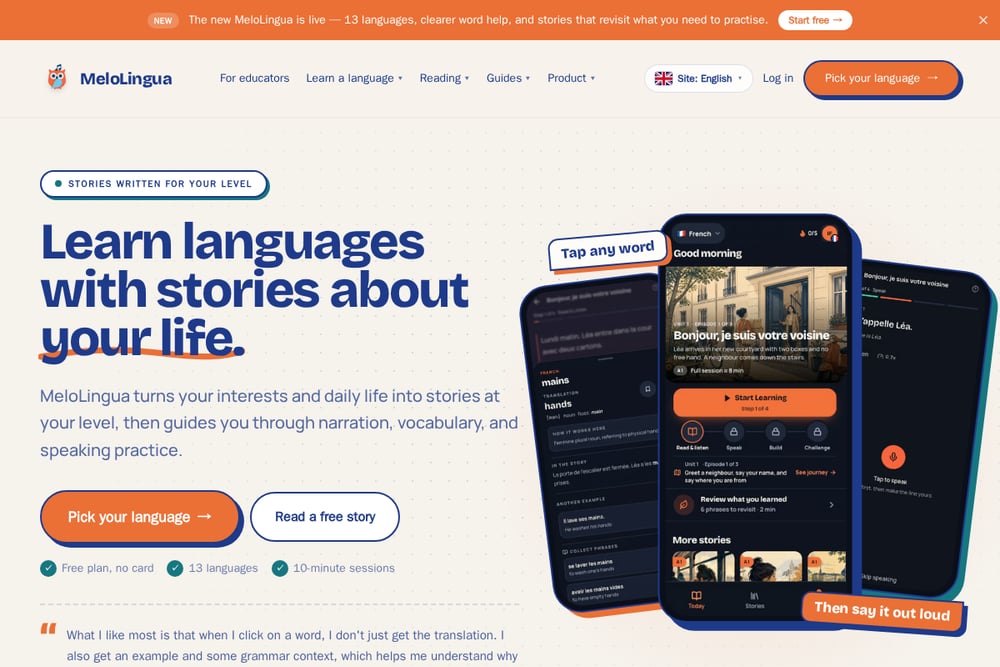 A screenshot of the MeloLingua website.
MeloLingua has grown into a serious contender with 13 languages, including Spanish, French, German, Italian, Korean, and Russian. Its story levels map cleanly to A1 through B2, so you always know where you stand. The platform pairs leveled texts with comprehension exercises and a Foundations A1 path for true beginners. It also publishes comparison guides, like its breakdown of story sessions versus daily drills, which helps you understand the method before committing. If you want a wide language menu and a clear path from beginner to upper intermediate, MeloLingua delivers.
#2 Lingovia — learn a language by reading stories
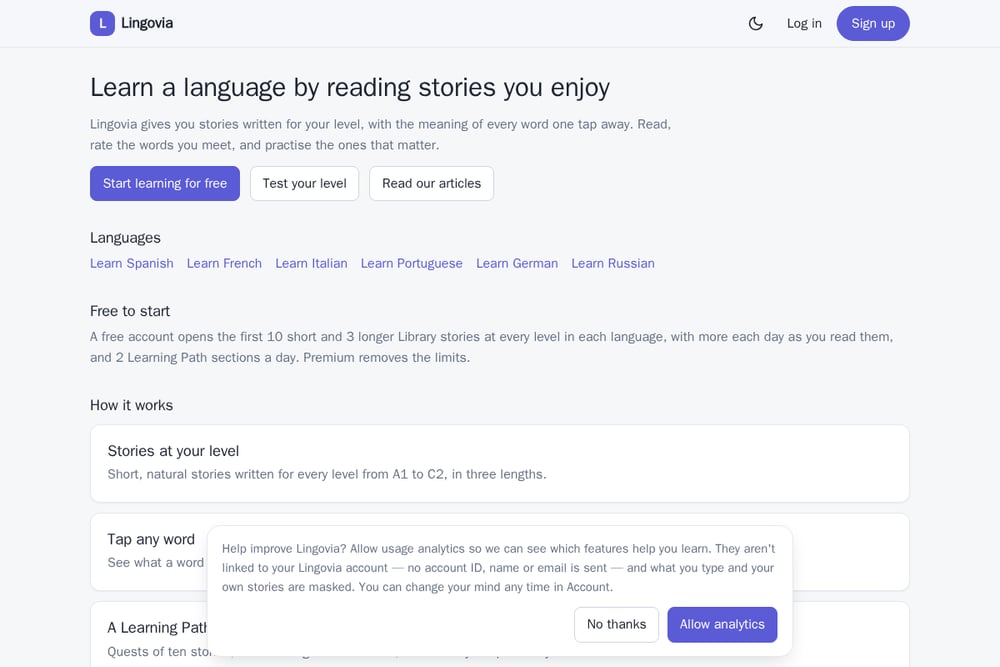 A screenshot of the Lingovia website.
Lingovia teaches Spanish, French, Italian, Portuguese, German, and Russian through short, natural stories written for every level from A1 to C2. Tap any word and you see its meaning in that story, then rate how well you know it so the platform can focus your practice. A Learning Path groups stories into quests of ten, each ending in a short test that moves you up level by level. Flashcards pull from the words you found hardest in the stories you actually read, which keeps review relevant. A free account opens the first 10 short and 3 longer Library stories at every level in each language, with more unlocking daily, plus 2 Learning Path sections a day. Premium removes those limits entirely.
#3 StoryLearning
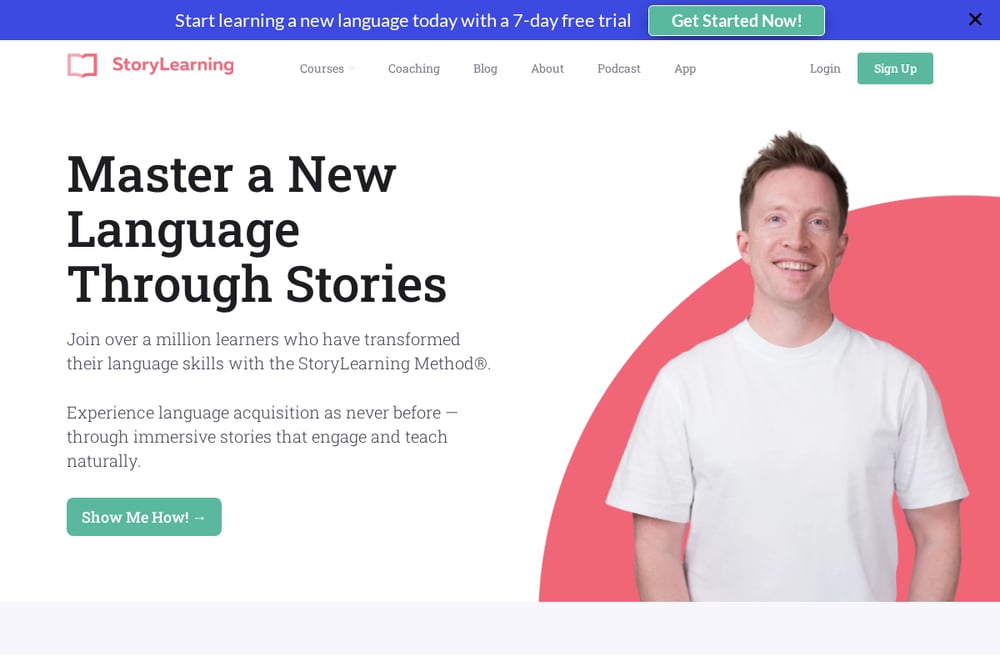 A screenshot of the StoryLearning website.
StoryLearning built its reputation on the idea that you learn languages through stories, not rules. Its course catalog spans Arabic, Cantonese, Chinese, Danish, French, German, Italian, Japanese, Korean, Latin, Portuguese, Norwegian, Russian, Spanish, Swedish, and Turkish. The method emphasizes reading and listening simultaneously, which helps you understand spoken language faster. Grammar is absorbed naturally as you see patterns repeat across narratives. A seven-day free trial lets you test the approach before committing. If you want a proven method with deep course content and a strong theoretical foundation, StoryLearning is worth a close look.
#4 Erla
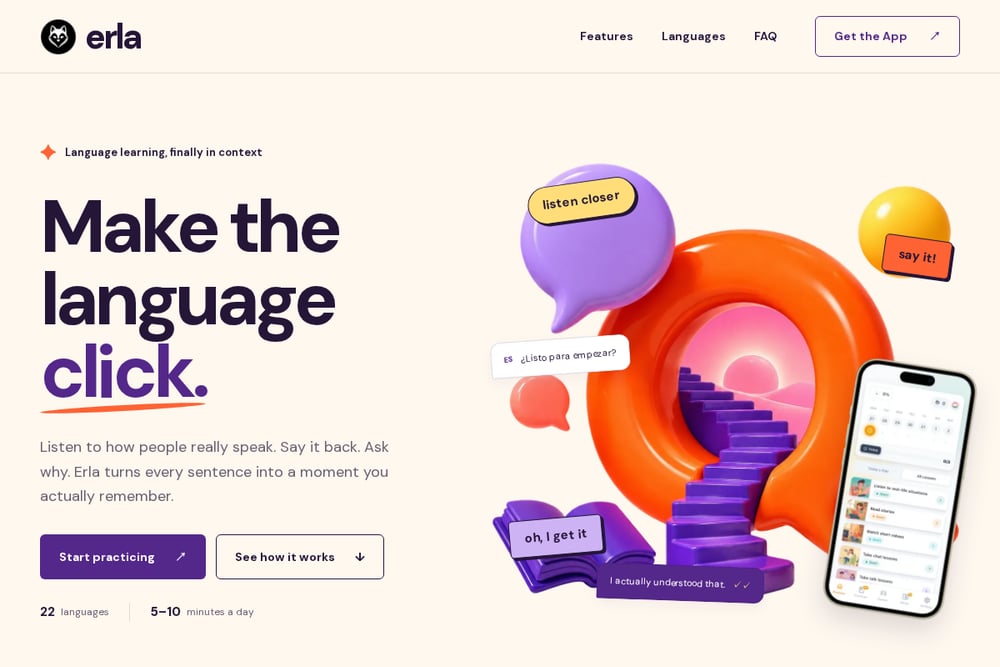 A screenshot of the Erla website.
Erla focuses on reading mode with native read-along audio that highlights each sentence as it is spoken. Stories are matched to your level, whether beginner, intermediate, or advanced, and you can change levels whenever you like. Tap any line for a translation, a grammar breakdown, and a word-by-word explanation. Sessions run five to ten minutes, which makes it easy to fit practice into a lunch break or commute. A small comprehension score climbs as you stop needing the tap, giving you a tangible sense of progress. If you want to bridge the gap between reading vocabulary and spoken comprehension, Erla is built for exactly that.
#5 Eppika
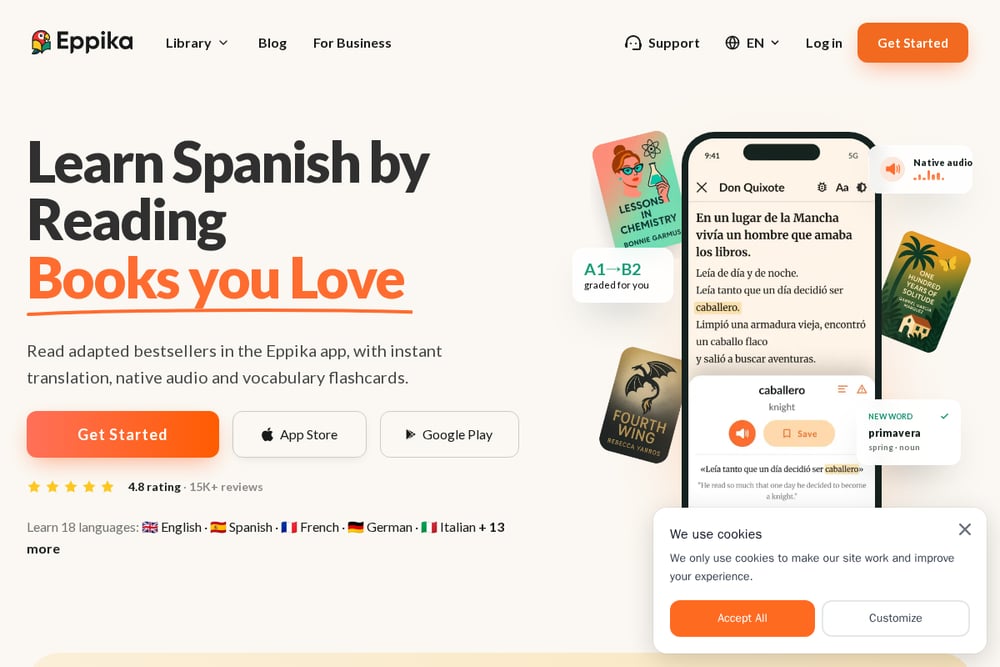 A screenshot of the Eppika website.
Eppika takes a book-first approach, offering adapted bestsellers across 18 languages, including Spanish, English, French, German, Italian, Portuguese, and more. You choose a book at your level, from A1 to C1, and tap any word or phrase for an instant translation. Narration lets you switch between reading and listening, and you can save vocabulary directly from stories for later flashcard review. The library spans multiple genres, so you are not stuck with textbook dialogues. With over 75,000 learners reading across its catalog, Eppika has built a loyal following. If you want to learn through complete books rather than short texts, this is your platform.
How to Choose the Right Platform for You
Start with your target language. If you are learning Spanish, French, German, Italian, Portuguese, or Russian, all five platforms have you covered. If you want Korean, Japanese, or a less common language, check the catalog before you commit. Next, think about your level. True beginners benefit from a structured A1 path, while intermediate learners may want richer texts and native audio. Consider how you like to review vocabulary. Lingovia and Eppika both turn story words into flashcards, which keeps review tied to context. If audio is important, Erla and StoryLearning emphasize listening alongside reading. Finally, look at pricing clarity. Lingovia offers a generous free tier, StoryLearning has a seven-day trial, and the others typically gate most content behind a subscription. Match the platform to your habits, not the other way around.
Building a Daily Reading Habit That Sticks
The best platform is the one you actually open every day. Set a small, repeatable goal: one short story with Lingovia, a five-minute Erla session, or a chapter of an Eppika book. Pair reading with review by letting the platform surface the words you rated hardest, so your flashcards stay relevant. If you use StoryLearning, schedule simultaneous reading and listening sessions to train your ear. Track your streak, but do not let it become the point. The goal is comprehension, not a perfect record. Rotate between platforms if it helps: use one for structured quests and another for free reading. Consistency beats intensity every time.
The Bottom Line
Story-based learning works because it respects how your brain actually acquires language: through meaning, context, and repetition you care about. Lingovia offers a clear level-by-level path with tap-any-word help and flashcards drawn from your own reading. MeloLingua brings the widest language menu and clean CEFR levels. StoryLearning provides a deep, method-driven course catalog. Erla excels at synced native audio for reading and listening together. Eppika lets you learn through adapted bestsellers across 18 languages. Pick the one that fits your language, your level, and your daily routine, then start reading. Your future self will thank you.