
If you're a parent of a child with special needs, life insurance isn't just about final expenses. It's about making sure the circle of support around your child stays intact when you're no longer here.
The Special Needs Life Insurance Landscape
For families raising a child with special needs, traditional life insurance advice often falls short. You're not just replacing income. You're funding decades of therapies, housing, supervision, and transportation. You're also navigating trusts and ABLE accounts so that a death benefit doesn't accidentally disqualify your child from means-tested benefits. Carriers have responded with simplified issue policies, no-medical-exam options, and coverage amounts that reach $1 million or more. The result is a market where the right guidance matters as much as the right policy.
How We Evaluated These Resources
We looked at five factors across every provider. First, service scope: do they address special needs planning specifically, or just generic life insurance? Second, coverage flexibility: term, whole life, IUL, universal life, and no-exam options. Third, pricing clarity: can you get a straight answer on rates and underwriting without a maze of phone calls? Fourth, educational depth: do they explain trusts, ABLE accounts, and beneficiary designations in plain language? Fifth, local fit: for US families, does the provider operate nationwide and understand state-level benefit rules? Each organization below stood out on different factors, and your priorities will determine which one fits your family.
Here's a quick look at five resources that help special needs families secure long-term financial protection. Each one approaches the problem from a slightly different angle.
| Provider | Best For |
|---|---|
| Guardian | Parents who want to understand trusts before buying coverage |
| Special Needs Benefits Partners | Parents who want simplified underwriting and special needs guidance in one place |
| New York Life | Families who want a long-established mutual insurer for permanent coverage |
| Western & Southern | Readers who want to study policy mechanics before choosing |
| Ethos | Busy parents who want a fast, online no-exam application |
The 5 Resources in Detail
#1 Guardian
 A screenshot of the Guardian website.
Guardian brings a deep bench of educational content to the special needs conversation. Their guide walks you through why a special needs trust should often be the beneficiary instead of your child directly, and it explains how a trust can receive and distribute funds without disrupting eligibility for government benefits. You'll also find practical guidance on choosing between term and permanent coverage when your child may never be self-sufficient. The writing is clear enough for parents who are new to estate planning, yet detailed enough to bring to a meeting with an attorney. If you want to understand the 'why' before you shop for a policy, this is a strong starting point.
#2 Special Needs Benefits Partners
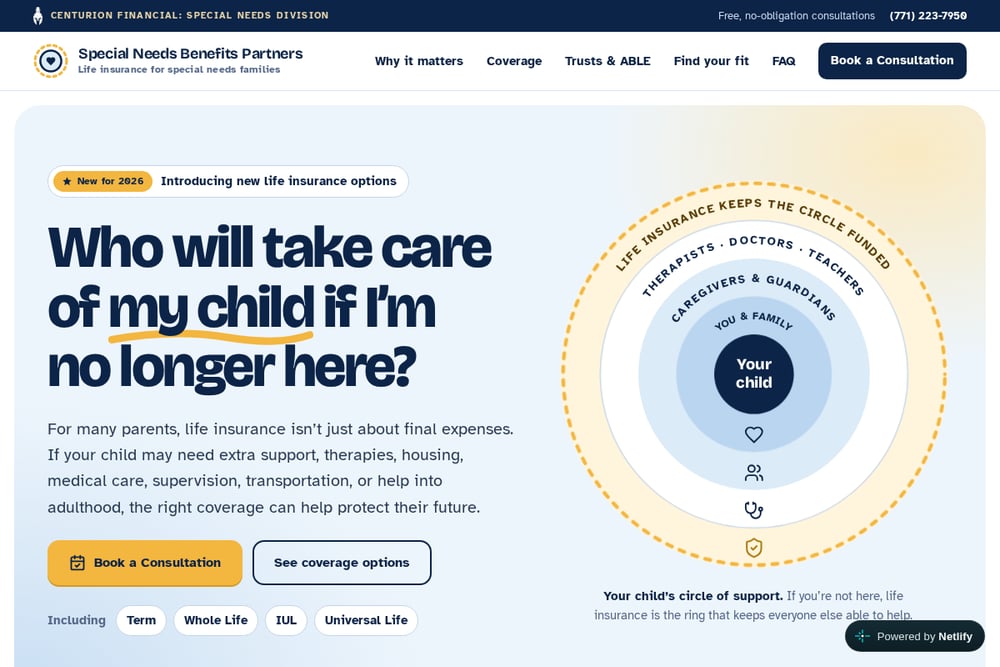 A screenshot of the Special Needs Benefits Partners website.
Special Needs Benefits Partners, the Special Needs Division of Centurion Financial, is built specifically for families like yours. They offer term, whole life, IUL, and universal life policies with coverage up to $1 million and more, and many plans approve you with a short set of health questions instead of needles and lab work. That matters if you've assumed your health history or schedule would make life insurance too hard to get. They also compare carriers to find the ones that look at pre-existing conditions differently, and they provide guidance on trusts and ABLE accounts so your death benefit doesn't undermine your child's eligibility for benefits. Rates can be locked in, benefits don't decrease, and approvals are often fast and simple. You can book a free, no-obligation consultation to see where you fit.
#3 New York Life
New York Life offers a full spectrum of permanent and temporary coverage, including term, whole life, universal life, and variable universal life. For special needs families, the appeal is the stability of a mutual insurer that has paid dividends for generations and the breadth of permanent policies that can fund a trust over a long horizon. Their educational hub explains how different policy types work, which helps you compare cash value accumulation against pure death benefit protection. If you're working with an attorney on a special needs trust, a permanent policy from a carrier like this can be a predictable funding vehicle. The trade-off is that underwriting may be more traditional, so a no-exam path isn't guaranteed.
#4 Western & Southern
 A screenshot of the Western & Southern website.
Western & Southern provides a broad life insurance library that covers whole life, universal life, term, indexed universal life, and more. Their resources explain concepts like paid-up additions, modified endowment contracts, and cash value taxation, which can be useful when you're trying to structure coverage inside a special needs plan. The company also publishes guides on who needs life insurance, including children and seniors, so you can think through coverage for multiple family members. For parents who want to understand the mechanics of permanent policies before committing, this is a solid reference. You'll still want a specialized agent to connect the policy to a trust strategy.
#5 Ethos
 A screenshot of the Ethos website.
Ethos focuses on making life insurance fast and accessible, with a strong emphasis on no-medical-exam options and simplified issue policies. Their guide to life insurance for people with disabilities covers eligibility, what insurers review, and how to improve your chances of approval. They also address buying coverage for a disabled child or parent, which is relevant if you're protecting multiple generations. The application process is largely online, which appeals to busy parents who can't easily schedule a paramedical exam. What Ethos doesn't do is specialize in special needs trust coordination, so you'll likely pair it with an attorney or a specialized advisor.
How to Choose the Right Resource for Your Family
Start with the planning question, not the product. If you haven't set up a special needs trust or ABLE account, prioritize a resource that explains how a death benefit can be structured so it doesn't disqualify your child from benefits. Next, look at underwriting. If you have a health history that might trigger a decline, focus on providers that offer simplified issue or no-medical-exam options and that compare multiple carriers. Then check coverage size. If your child's lifetime care could cost seven figures, you need a path to $1 million or more. Finally, consider who will manage the money after you're gone. The policy is only one piece. The trustee, the trust language, and the beneficiary designation matter just as much.
A Simple Workflow to Get Covered
Step one: write down your child's annual care costs and multiply by the number of years you want to fund. Step two: decide whether you need term, permanent, or a mix. Step three: gather your health history and any prior underwriting decisions. Step four: book consultations with two or three of the resources above and ask specifically about no-exam options, trust coordination, and rate locks. Step five: have your attorney review the beneficiary designation before you sign. Step six: once the policy is issued, store the documents with your estate plan and tell your trustee where to find them.
The Bottom Line
You don't need the perfect policy. You need a policy that's in force, funded correctly, and pointed at the right beneficiary. Guardian and Western & Southern will help you understand the planning concepts. New York Life offers permanence and scale. Ethos gives you speed. Special Needs Benefits Partners sits in the middle of all of it, combining simplified underwriting with special needs-specific guidance and coverage that can reach $1 million or more. Start with a free consultation, bring your questions, and build the ring that keeps your child's circle of support intact.