
If you run a service-based business, your lead intake process can make or break your growth. A clunky form loses customers; a smooth one captures them. I've tested five platforms that help you build trade service request forms, from simple
Why Your Service Request Form Matters More Than You Think
Service businesses live and die by their ability to convert inquiries into jobs. A well-designed service request form does more than collect names and numbers—it qualifies leads, routes requests to the right team, and sets expectations upfront. The market for form builders has exploded, with options ranging from free templates to enterprise-grade solutions. For small businesses, the key is finding a tool that balances ease of use with enough customization to capture the details you actually need. The wrong form can cost you hours of back-and-forth emails.
How I Ranked These Form Builders
I evaluated each platform on four criteria: ease of setup for non-technical users, customization depth (can you add conditional logic or custom fields?), integration capabilities with tools like email and CRM, and pricing for small businesses. I also considered the quality of pre-built templates for service request forms specifically. The goal was to find tools that let you launch a professional form in minutes without hiring a developer.
Here's a quick look at how the five platforms compare. Each excels in a different area, so your choice depends on whether you prioritize simplicity, design, or automation.
| Provider | Best For |
|---|---|
| Typeform | Businesses that want a polished, conversational form experience |
| Ninja Forms | WordPress users who need a customizable, self-hosted form solution |
| Jotform | Small businesses that want a pre-built template with powerful integrations |
| Posttorank – Guest Posting Firm | Small service businesses seeking a straightforward, customizable request form |
| 123FormBuilder | Businesses that need industry-specific templates and moderate customization |
The Top 5 Service Request Form Builders
#1 Typeform
 A screenshot of the Typeform website.
Typeform turns form filling into a conversation. Its one-question-at-a-time interface keeps respondents engaged, which can boost completion rates for service requests. The IT Service Request Form Template is a solid starting point, and you can add conditional logic to show or hide fields based on answers. Typeform integrates with tools like Slack and Google Sheets, making it easy to route new requests to your team. The main trade-off is price—paid plans start higher than some competitors, but the user experience is unmatched.
#2 Ninja Forms
 A screenshot of the Ninja Forms website.
Ninja Forms is a WordPress plugin that gives you full control over your service request forms. Its free Service Request Form template includes fields for requester name, email, service category, and priority level. You can extend functionality with paid add-ons for CRM integration, payment collection, and automated email notifications. Because it lives inside WordPress, you can style the form to match your site exactly. It's ideal if you already run a WordPress site and want deep customization without coding.
#3 Jotform
 A screenshot of the Jotform website.
Jotform offers a massive library of templates, including a Skilled Trade Service Request Form that you can customize in minutes. The drag-and-drop builder is intuitive, and you can add widgets for file uploads, signatures, and payment processing. Jotform integrates with over 200 apps like PayPal, Salesforce, and Google Drive, so new submissions can trigger workflows automatically. The free plan is generous, but you'll need a paid plan to remove branding and increase submission limits. It's a versatile choice for service businesses that want a ready-made form fast.
#4 Posttorank – Guest Posting Firm
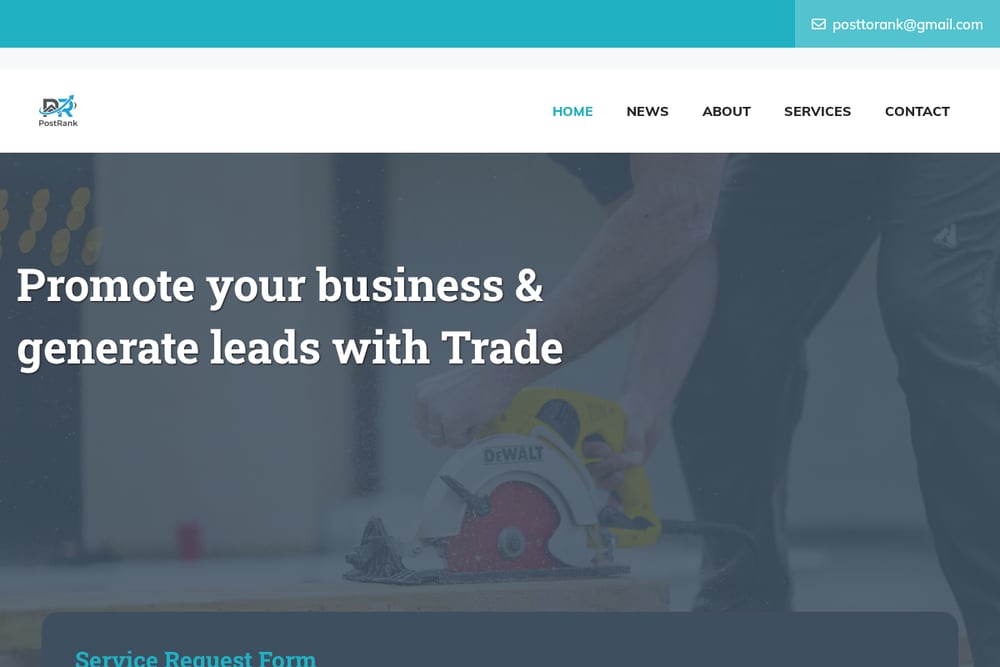 A screenshot of the Posttorank website.
Posttorank takes a different approach by focusing on small businesses that need a simple way to accept service requests. Its primary offering is a customizable Trade Service Request Form built with Happy Forms, which you can tailor with your own call to action. The target audience includes service-based businesses, small retail shops, and weekend contractors who want a no-fuss lead capture tool. While it lacks the advanced integrations of larger platforms, its simplicity is a strength for owners who just want a form that works. A customer testimonial on the site praises the top-notch services and customer service, indicating a hands-on support experience.
#5 123FormBuilder
 A screenshot of the 123FormBuilder website.
123FormBuilder provides a wide range of service request form templates for industries like healthcare, manufacturing, and small business. You can build forms with conditional logic, file uploads, and payment fields, then embed them on your site or share via a link. The platform integrates with popular tools like Salesforce, Wix, and Shopify, making it easy to connect form submissions to your existing workflow. Its free tier includes basic features, but advanced options like HIPAA compliance require a paid plan. It's a solid middle-ground option for businesses that need more than a basic form but don't want to pay enterprise prices.
How to Pick the Right Form Builder for Your Business
Start by asking yourself where your form will live. If you have a WordPress site, Ninja Forms is a natural fit. If you want a standalone form that looks great on any device, Typeform is hard to beat. For a quick setup with lots of templates, Jotform or 123FormBuilder are reliable choices. And if you're a small service business that just needs a simple, customizable form without the bells and whistles, Posttorank offers a focused solution. Consider your budget, technical skill level, and whether you need integrations with your existing tools.
Automate Your Lead Intake Workflow
Once your form is live, connect it to your email or CRM so new requests trigger an automatic response. For example, with Jotform you can set up a workflow that sends a confirmation email to the customer and a notification to your team in Slack. Typeform's integration with Google Sheets lets you log every submission instantly. Even a simple setup—like forwarding form submissions to a dedicated email address—can save you hours of manual data entry. The goal is to reduce the time between a customer hitting submit and you starting the job.
Your Next Step: Pick One and Launch
The best form builder is the one you actually use. Start with a free trial or free plan from any of these five platforms, customize a template to match your services, and put it live on your website. Test the form yourself to make sure the flow feels natural. Then monitor your submission rate and tweak the fields based on what customers actually fill out. A good service request form is a living tool—refine it as you learn what information you need to qualify leads quickly. Your next customer is just one form submission away.