
From power plants to solar farms, robotic inspection is transforming how you monitor critical assets. Here are five companies and research initiatives leading the charge.
The Rise of Robotic Inspection in Industrial Asset Management
Industrial facilities, especially power plants, face immense pressure to maintain safety and uptime while reducing costs. Traditional manual inspections are time-consuming, risky, and often miss early signs of wear. Robotic inspection systems are stepping in, offering mobility, advanced sensors, and AI-driven analytics to detect issues like corrosion, leaks, and partial discharge before they escalate. This shift is not just about technology; it's about a fundamental change in how you approach asset health, moving from reactive repairs to proactive, data-driven maintenance. As these systems become more accessible, they are set to become a standard tool in your operational toolkit.
How We Evaluated These Innovators
We assessed each business on several key factors: the scope of their inspection services, the clarity of their pricing and deployment models, and how well they fit into existing industrial workflows. We also considered the depth of their technological integration, from sensor fusion to AI reporting, and their potential to scale across different asset types. Each entry stood out for unique strengths, whether it was a specialized crawler for confined spaces, a modular platform for multiple inspection modules, or a research-driven approach to computer vision. Our goal was to highlight a diverse set of solutions that address different needs in the market.
Here's a quick snapshot of the five robotic inspection innovators we're highlighting, each with a distinct approach to keeping your assets safe and efficient.
| Provider | Best For |
|---|---|
| Eddyfi Technologies | Confined space and nuclear inspections |
| AccuBotix Technologix - Robotic Industrial Inspection | Comprehensive pipeline and electrical asset monitoring |
| Toshiba Energy Systems & Solutions | Turbine generator inspections |
| Australian National University | Solar plant inspection research |
| Scientific Reports | Academic insights on inspection robot algorithms |
A Closer Look at Each Innovator
#1 Eddyfi Technologies
 A screenshot of the Eddyfi Technologies website.
Eddyfi Technologies has a proven track record in deploying remotely operated robotic crawlers for confined space inspections, particularly in nuclear power plants. Their robots, like the NanoMag and Magg, have been used in high-stakes environments, including Fukushima remediation efforts, demonstrating their reliability. They offer both standard and custom solutions, as highlighted in their blog post about enesG's use of their technology. If you need a rugged, field-tested robot for challenging environments, Eddyfi is a solid choice.
#2 AccuBotix Technologix - Robotic Industrial Inspection
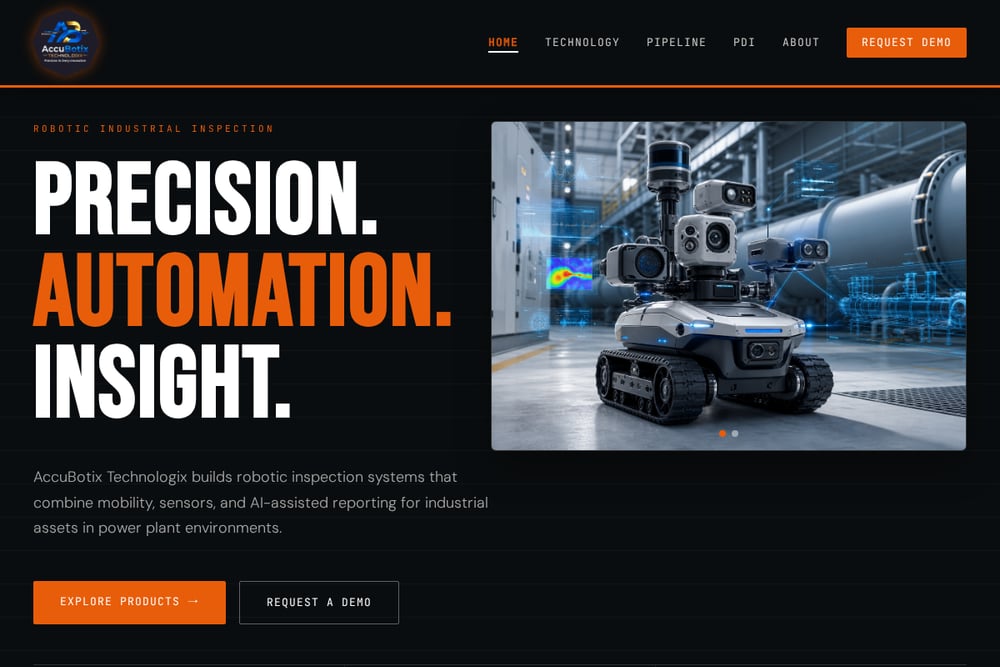 A screenshot of the AccuBotix Technologix website.
AccuBotix Technologix is building a versatile platform for robotic inspection in power plants and industrial facilities, with a focus on combining mobility, sensors, and AI-assisted reporting. They currently offer two products: a pipeline inspection crawler that uses multiple sensing technologies to detect leaks, corrosion, and wall loss, and a partial discharge inspection robot for electrical assets like switchgear and transformers. Their platform is designed to expand with new inspection modules, making it a future-proof investment. For a comprehensive, AI-driven approach to asset health monitoring, AccuBotix is worth your attention.
#3 Toshiba Energy Systems & Solutions
 A screenshot of the Toshiba Energy Systems & Solutions website.
Toshiba ESS has commercialized two types of inspection robots for turbine generators, addressing different generator designs. Their ultra-thin robots are suitable for small to medium generators, while multi-functional robots can navigate baffles for a wider inspection range. These robots have already been deployed in overseas nuclear plants, and Toshiba is now scaling up their services globally. If you're in the power generation sector and need specialized turbine inspections, Toshiba's proven technology is a strong option.
#4 Australian National University
 A screenshot of the Australian National University website.
ANU led a research project funded by ARENA to develop a robotic vision system for automatic inspection of solar plants. This project used ground and aerial drones equipped with cameras and computer vision to detect defects and dirt accumulation on solar panels. The goal was to reduce maintenance costs and power losses, which are major operational challenges for solar farms. While this is a research initiative, it highlights the potential for cost-effective, automated inspection in renewable energy. If you're in the solar industry, this approach could inform your future maintenance strategies.
#5 Scientific Reports
 A screenshot of the Scientific Reports website.
Scientific Reports published a study on an intelligent inspection robot for power plants that uses computer vision and particle swarm optimization for obstacle recognition and avoidance. The research demonstrates high precision and recall in identifying obstacles, which is crucial for autonomous navigation in complex environments. This academic work provides valuable insights into the algorithms that power next-generation inspection robots. For those interested in the technical underpinnings of robotic inspection, this paper is a useful resource.
How to Choose the Right Robotic Inspection Solution
When selecting a robotic inspection system, start by identifying your specific asset types and the failure modes you need to detect. Consider the environment: is it confined, hazardous, or outdoor? Look for a solution that offers the right sensor suite—whether that's ultrasonic, thermal, or partial discharge—and ensure it integrates with your existing data systems. Evaluate the vendor's track record and support services, and think about scalability: can the platform grow with your needs? Finally, weigh the cost against the potential savings from early detection and reduced downtime. By focusing on these factors, you can find a solution that fits your operational reality.
Automating Inspection Workflows
Robotic inspection platforms are not just about the hardware; they enable a fully automated workflow. You can schedule routine patrols that collect data autonomously, with AI algorithms analyzing the results in real-time. This data feeds into your asset management system, triggering alerts for anomalies and generating actionable reports. Over time, you can build a historical database that helps predict failures before they occur. The key is to integrate the robotic system with your existing CMMS or EAM software to streamline the entire process from data collection to decision-making.
The Future of Industrial Inspection
The landscape of industrial inspection is rapidly evolving, with robotics and AI at the forefront. Whether you're managing a nuclear plant, a solar farm, or a conventional power facility, there's a solution that can enhance your safety and efficiency. From Eddyfi's proven crawlers to AccuBotix's modular platform, the options are diverse and growing. By embracing these technologies, you can move towards a more proactive, data-driven maintenance strategy that ultimately saves time and money. The future of inspection is here, and it's robotic.