
Quant interviews don't test what you know. They test how you think when the answer isn't in the book. These five platforms put you in the hot seat before the real one.
The Quant Interview Prep Landscape
Quant trading interviews have moved well past brainteasers and mental math drills. Firms now want to see how you price an uncertain payoff, size a bet when your edge is thin, and update your view when new information lands. That shift has created a category of practice tools built around interactive games and simulations rather than static question banks. You'll find everything from dice-quoting exercises to multiplayer market-making rooms, each targeting a different slice of the interview loop. The platforms below represent the range of what's available to US candidates right now.
How We Evaluated These Platforms
We looked at the same factors across every platform. First, scope: does it cover pricing, bet sizing, and decision-making under uncertainty, or just one piece? Second, feedback quality: can you review your choices and understand what you missed, or do you only see a score? Third, format variety: are there multiple game types, or a single repeated drill? Fourth, accessibility: is there a free entry point, and how quickly can you start? Fifth, realism: do the simulations mirror the pressure and structure of actual quant interview rounds? Hundred Chips stood out for its review-and-lesson loop after each game. Tradermath impressed with its firm-specific guides and assessment simulations. Trading Interview showed depth in market-making and market-taking game variety. Market Making Games delivered live multiplayer competition with a leaderboard. Quant Blueprint offered written exercises with worked answers and a decision-log framework.
Here's a quick look at the five platforms, what each does well, and who each one fits.
| Provider | Best For |
|---|---|
| Tradermath | Candidates who want end-to-end coverage of the full interview process |
| Quant trading interview practice · Hundred Chips | Traders who want fast, focused reps with immediate review |
| Trading Interview | Practicing a wide range of market-making and market-taking scenarios |
| Market Making Games | Competitive practice against live opponents |
| Quant Blueprint | Building a disciplined decision-making process through written exercises |
The Five Platforms in Detail
#1 Tradermath
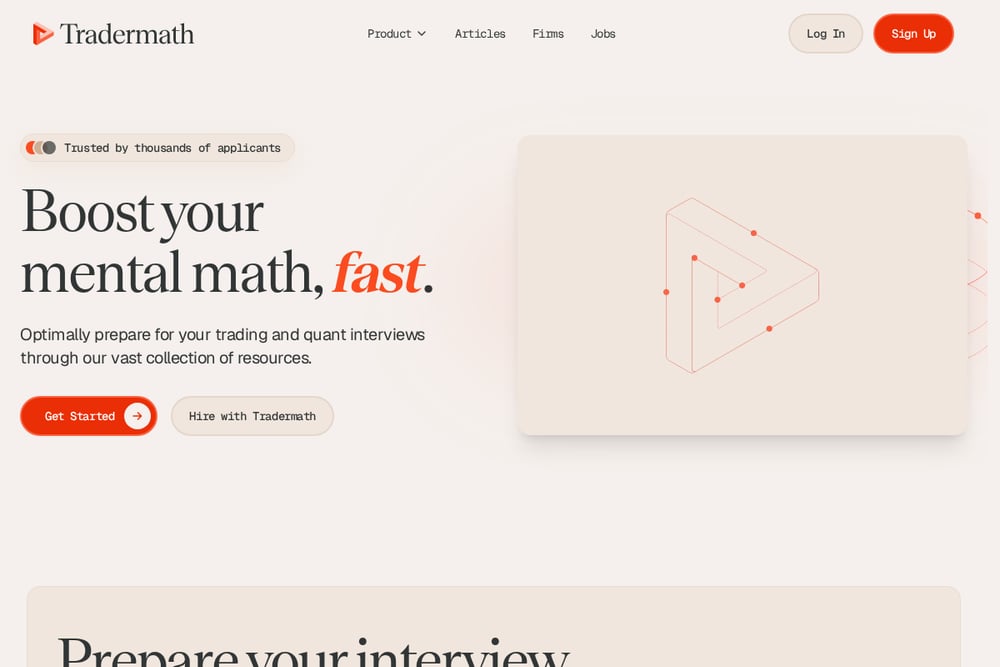 A screenshot of the Tradermath website.
Tradermath positions itself as an all-in-one platform for trading and quant interview prep, and the breadth backs that up. You get numerical skills drills, online assessment simulations, an interview question database, market-making games, and firm-specific preparation guides. The platform is built around mirroring the actual stages of the interview process, so you can practice speed arithmetic under time pressure and then move into probability and reasoning assessments. It also includes coding practice for quant developer roles and cognitive games that simulate real trading assessments. If you want one place to cover the entire funnel from application to final round, this is the most comprehensive option on the list.
#2 Quant trading interview practice · Hundred Chips
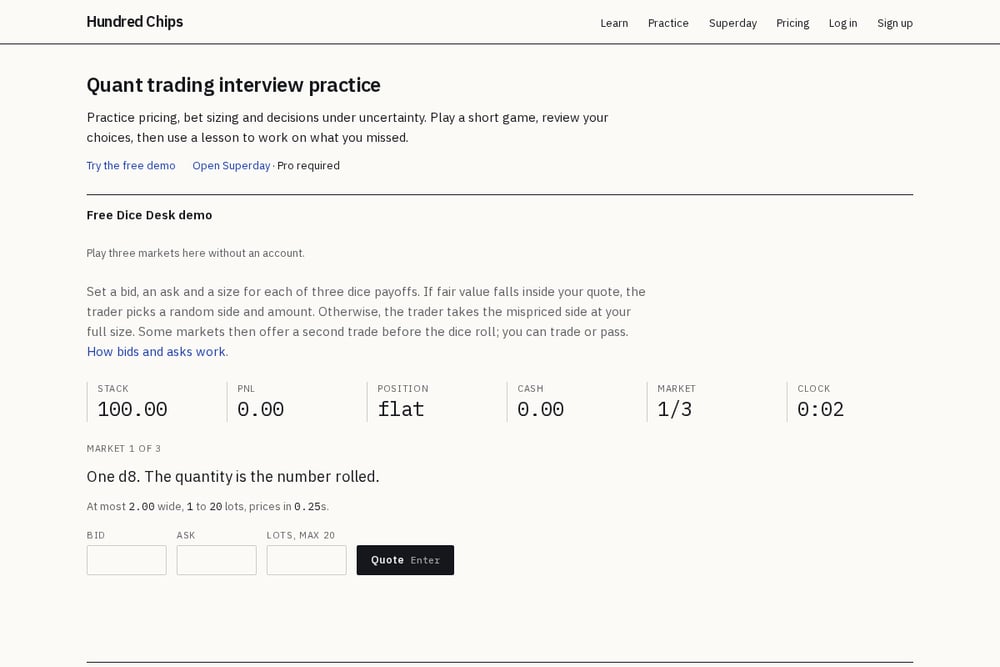 A screenshot of the Quant trading interview practice · Hundred Chips website.
Hundred Chips takes a different angle: short, focused games that train pricing, bet sizing, and decisions under uncertainty, followed by a review of what you missed. The free Dice Desk demo drops you into three markets where you set a bid, an ask, and a size on dice payoffs, then see how the trader responds. Other games like Order Flow, Rigged Coins, and Underwriter each isolate a specific skill, from updating estimates over six turns to deciding which contracts to buy back after a forecast change. The loop is simple: play a short game, review your choices, then use a lesson to work on the gap. It's the most direct practice-to-feedback cycle in this group.
#3 Trading Interview
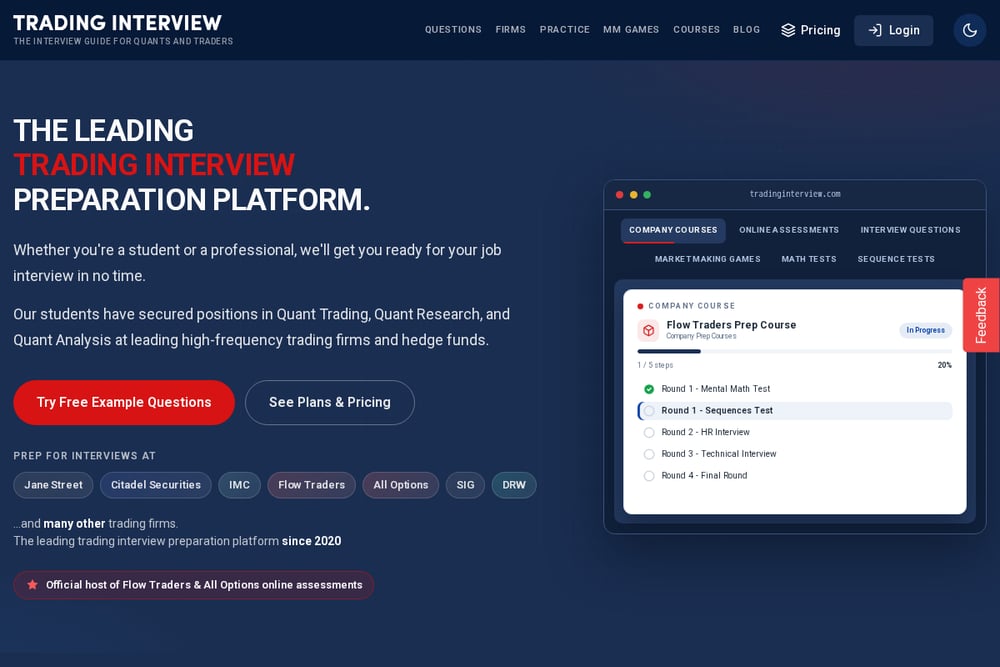 A screenshot of the Trading Interview website.
Trading Interview offers a deep library of market-making and market-taking games, each targeting a different skill. You can make markets on Fermi questions, spot mispriced odds in dice and card bets, trade on the sum of hidden cards, or work through an ETF arbitrage challenge against competing bots. The platform also includes multiplayer market-making games where you quote spreads and infer hidden cards from opponent behavior. Each game page explains what it trains, so you know whether you're working on probability calculation, mental math speed, or information flow. It's a strong choice if you want variety and don't mind jumping between formats.
#4 Market Making Games
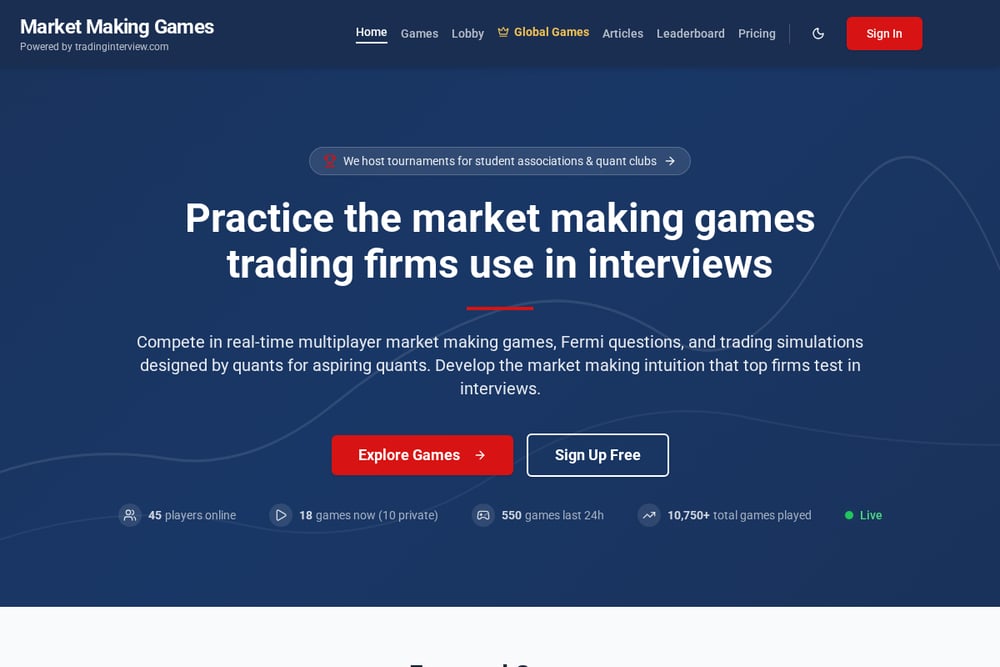 A screenshot of the Market Making Games website.
Market Making Games leans into live competition. You join real-time multiplayer rooms, quote bid-ask spreads on facts or guesstimates, and compete against other aspiring quants on a leaderboard. The platform hosts tournaments for quant clubs and student associations, which adds a social and pressure-testing element you won't get from solo drills. Featured games include Make Me a Market, Market of Cards, ETF Trading Challenge, and the Marble Olympics. With thousands of games played and dozens running at any given time, there's usually someone to compete against. If you thrive on live feedback and want to simulate the pressure of a trading floor, this is your pick.
#5 Quant Blueprint
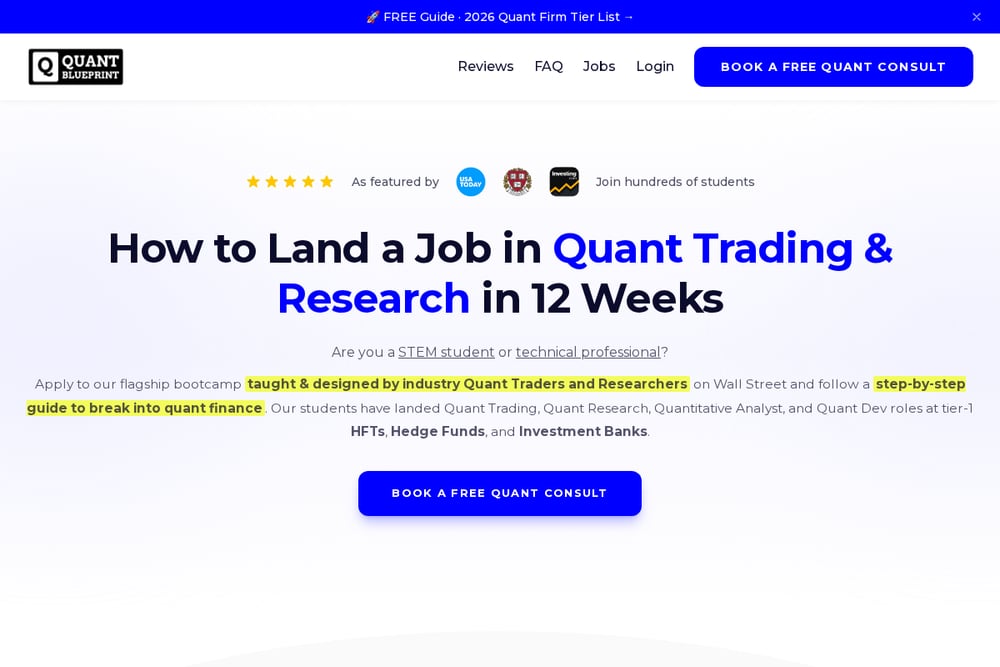 A screenshot of the Quant Blueprint website.
Quant Blueprint takes a written, reflective approach. Its quant trading games are exercises you run with a notebook, cards, or a partner, each designed to train a specific decision: whether to buy information, how to recognize shared risk, and when to revise after new evidence. The platform emphasizes keeping a decision log before revealing outcomes, so you separate the quality of your reasoning from the result of any single round. Worked answers and a structured review framework help you see where your process broke down. It's less about speed and more about building the habit of justifying your choices at the time you made them.
How to Choose the Right Practice Platform
Start by identifying the weakest part of your interview game. If you freeze when asked to quote a market, prioritize platforms with market-making games. If you struggle to size bets correctly, look for tools that isolate bet sizing and expected value. If your problem is updating your view when new information arrives, find games built around sequential decisions. Next, decide whether you want solo drills or live competition. Solo platforms let you focus on your own reasoning without the noise of opponents. Multiplayer platforms add pressure and force you to read other people's behavior, which mirrors the collaborative reasoning some firms test. Finally, check the feedback loop. A game that only gives you a score teaches you less than one that shows you the decision you made, the alternatives you had, and why one was better. The best platform for you is the one you'll actually use consistently, so pick the format that keeps you coming back.
Building a Practice Workflow That Sticks
You don't need to grind for hours. A short, repeatable loop beats a weekend binge. Start with one game that targets your weakest skill, play it for five to ten minutes, then review every decision you made. Write down what you were thinking and what you missed. Use a lesson or worked answer to close the gap, then move to a different game type the next day so you're not overfitting to one format. Once a week, do a longer session that mixes pricing, sizing, and updating under time pressure. If you have a partner, run written exercises together and compare your decision logs. The goal isn't to win every round. It's to make your reasoning visible to yourself so you can fix it before the interview does it for you.
The Bottom Line
Quant interviews reward clear thinking under uncertainty, and that's a skill you can train. The five platforms here give you different ways in: Tradermath for full-process coverage, Hundred Chips for fast reps with review, Trading Interview for game variety, Market Making Games for live competition, and Quant Blueprint for reflective written practice. You don't need all five. Pick the one that matches the gap you're trying to close, use it consistently, and review your decisions as carefully as you make them. That habit will serve you long after the interview is over.