Product information management (PIM) software helps online retailers keep product data consistent across channels. The right platform can centralize product content, enrich it, and syndicate it to marketplaces and storefronts. This list covers five PIM tools that online retailers may find worth knowing in 2026. Each entry describes what the company offers and who it suits, based on the provided source pages.
How We Picked These Tools
We selected these companies because their source pages explicitly mention capabilities relevant to online retail, such as syndication to retailers and marketplaces, supplier onboarding, and multichannel commerce. We looked for tools that support product data centralization, enrichment, and distribution. The list is not a ranking of quality; the order is arbitrary. No company is claimed to be the best.
| Provider | Best For |
|---|---|
| Akeneo | Enterprise retailers needing omnichannel product data activation |
| Salsify | Retailers sourcing and validating supplier product content |
| Plytix | Ecommerce teams seeking a user-friendly PIM with Shopify integration |
| Pimcore | Retailers wanting an open-core platform with commerce framework |
| Sales Layer | Retailers seeking AI-driven product data automation |
The 5 Tools in Focus
#1 Akeneo
 A screenshot of the Akeneo website.
Akeneo offers a product cloud platform with PIM, DAM, supplier data management, and activation features. It helps centralize product information, manage assets, and syndicate product catalogs to retailers and marketplaces. The platform includes AI and automation for data enrichment and channel mapping. Akeneo is designed for enterprise businesses and supports omnichannel activation. Online retailers that need to manage complex product data across many channels may find it suitable.
#2 Salsify
 A screenshot of the Salsify website.
Salsify provides a product experience management platform that includes PIM, syndication, and digital shelf analytics. It helps brands and retailers centralize product content, connect to the digital shelf, and automate manual processes. The platform also offers supplier onboarding and content enrichment for retailers. Salsify is built to support commerce growth by turning product data into revenue. Online retailers that need to source and validate supplier product content at scale may find it relevant.
#3 Plytix
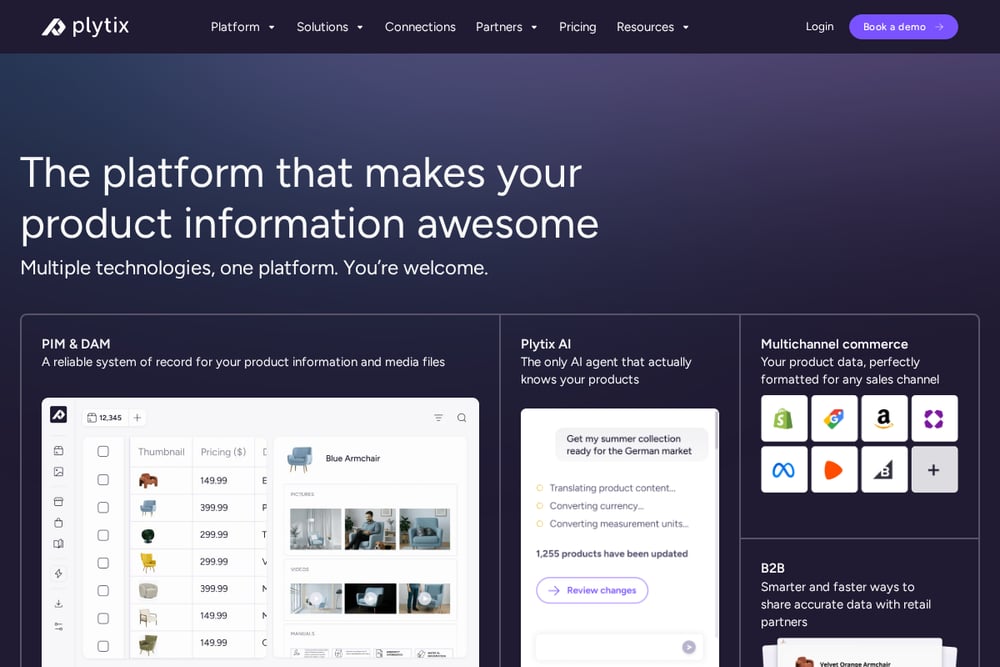 A screenshot of the Plytix website.
Plytix combines PIM and DAM with multichannel commerce and B2B sharing capabilities. It helps centralize product data, optimize content for each channel, and distribute product information automatically. The platform includes Plytix AI for product and image enrichment, and it offers a Shopify content manager. Plytix is designed for teams such as marketing managers, ecommerce managers, and B2B teams. Online retailers looking for a user-friendly PIM with ecommerce integrations may find it worth considering.
#4 Pimcore
 A screenshot of the Pimcore website.
Pimcore is an open-core platform that includes PIM, DAM, MDM, and a digital commerce framework. It enables omnichannel selling and consistent product stories across channels. The platform offers data syndication and delivery via APIs, and product experience portals for real-time product info. Pimcore is available in multiple editions, including a free community edition. Online retailers that want a flexible, open platform with commerce capabilities may find it suitable.
#5 Sales Layer
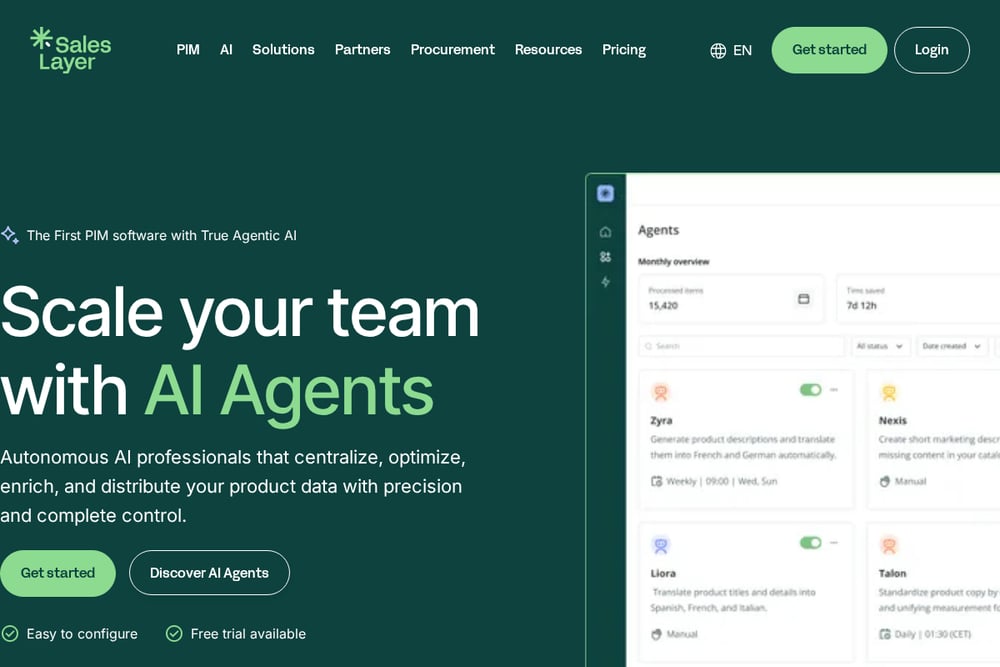 A screenshot of the Sales Layer website.
Sales Layer is a PIM platform with AI agents that automate product data tasks such as translation, content creation, and data quality checks. It helps centralize product data, enrich it at scale, and distribute it to websites, marketplaces, and distributors. The platform includes connectors, instant catalogs, and PDF export. Sales Layer is designed for retailers, manufacturers, and distributors. Online retailers that want AI-driven automation for product data workflows may find it worth exploring.
Which One Should You Choose?
When choosing a PIM for online retail, consider how well it centralizes product data from suppliers and internal sources. Look for enrichment features that help create channel-ready content. Check the syndication options to marketplaces and retailers you sell on. Evaluate whether the platform offers supplier onboarding if you work with many vendors. Also consider the user experience for your team and the availability of integrations with your ecommerce stack. Finally, review pricing and edition options to match your budget and technical requirements.
Final Thoughts
Each of these PIM platforms addresses different needs for online retailers. Akeneo focuses on enterprise omnichannel activation. Salsify emphasizes supplier content sourcing and digital shelf management. Plytix offers a user-friendly approach with Shopify integration. Pimcore provides an open-core platform with commerce capabilities. Sales Layer brings AI-driven automation to product data workflows. The right choice depends on your catalog size, channel mix, and team resources. This list is meant to inform, not to rank companies as better or worse.
Know a company that belongs on this list? Email us at editorial@peekwire.com.