
Physical AI is hungry for real-world training data, and these five providers are feeding it with egocentric video, annotation, and collection services. Here's a look at who's who in this fast-moving niche.
The Physical AI Data Landscape
Physical AI—robots that manipulate objects in the real world—needs demonstrations to learn from. But unlike language models that scraped the web, robots have few public datasets of skilled work. Most egocentric video collections are research-only or staged in labs. A few companies are now recording real operators on actual factory floors and farms, with proper rights and labels. This is the frontier where data quality meets real-world relevance.
How We Evaluated These Providers
We looked at each provider's service scope—whether they offer collection, annotation, or both. We considered data authenticity, like whether footage comes from real work sites or staged setups. We also weighed licensing clarity, since commercial use rights are critical for product development. Finally, we assessed how well each provider fits the needs of robotics labs and AI teams building manipulation policies.
Here's a quick snapshot of the five providers, with their key strengths and best-fit use cases.
| Provider | Best For |
|---|---|
| Boden AI | Industrial-grade egocentric datasets for manipulation |
| Hermai | Physical AI training data from real factory work | Authentic factory-floor demonstrations with clear licensing |
| Appen | Large-scale annotation and evaluation for physical AI |
| AgileX Robotics | Research labs combining robot hardware with data collection |
| Macgence | Custom data sourcing and annotation across multiple AI domains |
The Five Providers, Up Close
#1 Boden AI
 A screenshot of the Boden AI website.
Boden AI positions itself as an industrial-grade data provider for physical AI, with a strong focus on egocentric data for robot training. Their blog explains why first-person perspective is critical for closing the sim-to-real gap, and they offer datasets and solutions for manipulation tasks. If you're building a robot that needs to work in warehouses or dark kitchens, Boden's data is designed to match your end-effector's view. They also cover autonomous driving and LLM data, making them a versatile partner. For teams that want a one-stop shop with deep technical expertise, Boden is a solid choice.
#2 Hermai | Physical AI training data from real factory work
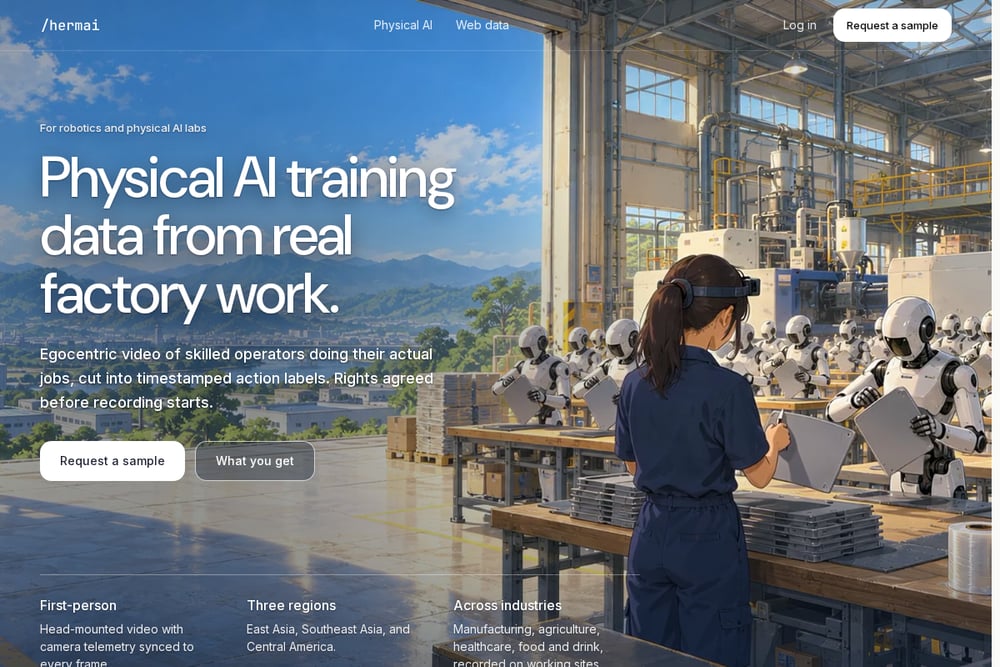 A screenshot of the Hermai website.
Hermai stands out by recording egocentric video of skilled operators doing their actual jobs on working factory and farm sites across East Asia, Southeast Asia, and Central America. Every clip is cut into timestamped action labels—verb, object, hands involved—and synced with head-mounted camera telemetry. Rights are agreed before recording, so you get commercial-use data without legal headaches. This is real work, not staged, which is rare in the industry. If you need demonstrations that reflect true production-line conditions, Hermai delivers.
#3 Appen
 A screenshot of the Appen website.
Appen is a 30-year veteran in AI data, offering annotation and evaluation services for physical AI. They recently partnered with a frontier robotics lab to annotate egocentric video and evaluate robot performance in household environments, delivering over 50,000 data units. Their platform combines automation with human oversight, and they're SOC 2 and ISO 27001 certified. If you need to scale annotation for large video datasets, Appen's global workforce and enterprise-grade security are hard to beat. They're more about labeling than collection, but they cover the full pipeline.
#4 AgileX Robotics
 A screenshot of the AgileX Robotics website.
AgileX Robotics is primarily a robot hardware company, but they've expanded into egocentric data collection with a focus on cross-embodiment learning. Their blog covers how first-person human data can be used to train robots, and they offer data collection services alongside their robot platforms. If you're already using AgileX robots, their data services integrate seamlessly with your hardware. They're a good fit for research labs that want to collect data using low-cost, portable setups. Their approach is more DIY-friendly than full-service data providers.
#5 Macgence
 A screenshot of the Macgence website.
Macgence offers a broad range of AI training data services, including custom data sourcing, annotation, and validation. They have a dedicated AI data marketplace and cover use cases like computer vision, sensor fusion, and generative AI. For physical AI, they can source egocentric video data and annotate it with action labels, though their focus is more general. They're a flexible partner for teams that need custom datasets beyond just egocentric video. If you're looking for a one-stop shop for all your AI data needs, Macgence is worth considering.
How to Choose the Right Provider
Start by asking whether you need raw collection, annotation, or both. If you need authentic factory-floor footage with clear commercial rights, Hermai is your best bet. If you have raw video and need to label it at scale, Appen's enterprise platform shines. For teams that want to collect data themselves using robot hardware, AgileX offers a hands-on approach. Boden AI is ideal if you want a partner with deep robotics expertise and ready-made datasets. Macgence is a good fallback for custom projects that span multiple data types. Match the provider to your specific bottleneck—whether it's data scarcity, labeling speed, or legal clarity.
Automating Physical AI Data Workflows
A typical workflow starts with Hermai's egocentric video collection, where operators wear head-mounted cameras with IMU telemetry. The footage is automatically segmented into timestamped action labels using their taxonomy. Then, you can use Appen's annotation platform to refine labels and add bounding boxes or semantic masks. For evaluation, you might deploy a robot in a test environment and compare its actions against the human demonstrations. Tools like AgileX's data collection rigs can also generate synthetic or real data to augment your training set. The key is to automate as much of the labeling pipeline as possible, using human-in-the-loop only for edge cases.
The Bottom Line
Physical AI is at a turning point, and the data you train on will determine whether your robot succeeds in the real world. Hermai's real-work footage is a game-changer for authenticity, while Boden and Appen bring scale and expertise. AgileX and Macgence offer flexibility for research and custom needs. Choose based on your biggest gap—whether it's data collection, annotation, or integration. The providers here are all worth knowing as you build your next manipulation policy.