
If you're serious about peptide protocols, you know the struggle of juggling spreadsheets, notes, and separate calculators. These five platforms bring order to the chaos—each with its own angle on tracking, dosing, and data.
The Peptide Tracking Landscape
The peptide tracking space has exploded as more people take research compounds into their own hands. You're no longer limited to a notebook and a prayer—apps now offer dose logging, inventory management, and even AI-driven insights. But with that growth comes a big split: some tools are bare-bones loggers, while others aim to be full command centers for your stack. The best ones balance depth with usability, giving you the data you need without drowning you in features. As the market matures, expect more integration with wearables and lab data, but for now, the core battle is between simplicity and power.
How We Evaluated These Tools
We looked at each platform through the lens of a dedicated user: how deep does the tracking go, how clear is the pricing, and how well does it fit into your daily routine? We also weighed the quality of the reference data—because a dose calculator is only as good as the science behind it. Each tool was assessed on its own merits, not against each other, to highlight what makes it stand out for different types of users.
Here's a quick snapshot of the five platforms, so you can see which one might match your style.
| Provider | Best For |
|---|---|
| Peptide Tracker | Free, straightforward dose logging and adherence tracking |
| PepCadence — Peptide Reference & Tracker | In-depth reference, AI bloodwork analysis, and TRT tracking |
| Smart Peptide Tracker | Advanced stack analysis and inventory management |
| PepTracker | Simple dose logging for iPhone users |
| PeptIQ | AI-powered guidance and iMessage integration |
The Deep Dive: Five Peptide Trackers Compared
#1 Peptide Tracker
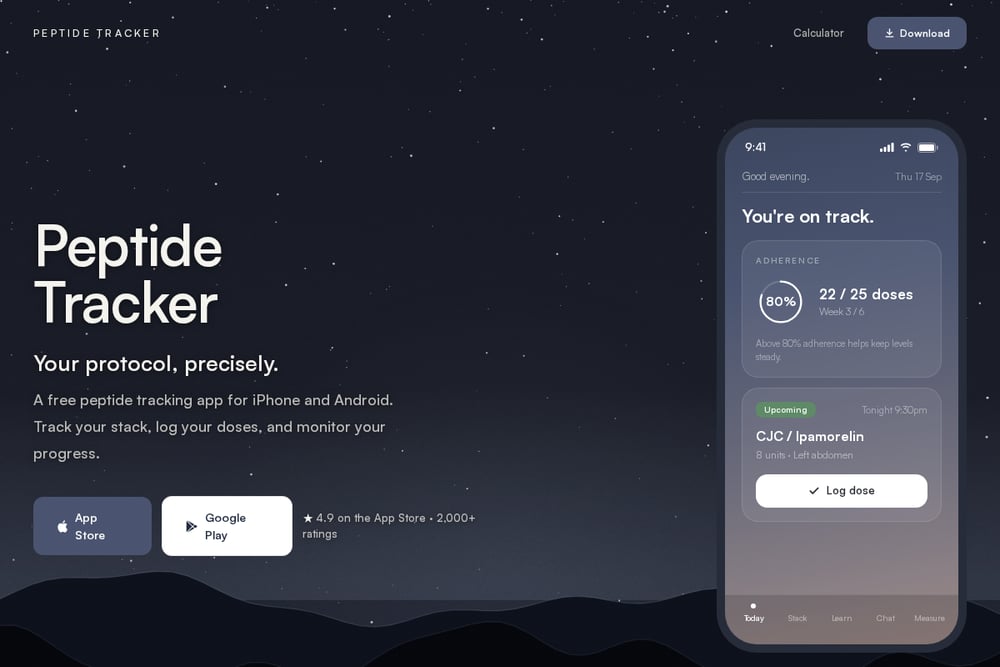 A screenshot of the Peptide Tracker website.
Peptide Tracker is a free app for iOS and Android that focuses on clean, intuitive dose logging and adherence tracking. You can build your stack, set reminders, and get a daily view of what's due—plus a calendar to review your history. It also offers a health timeline that syncs with Apple Health or Health Connect, letting you see weight, sleep, and activity alongside your protocol. The app's 4.9-star rating and 2,000+ reviews suggest it's winning over users with its simplicity and reliability. If you want a no-cost, no-fuss way to stay on schedule, this is a solid starting point.
#2 PepCadence — Peptide Reference & Tracker
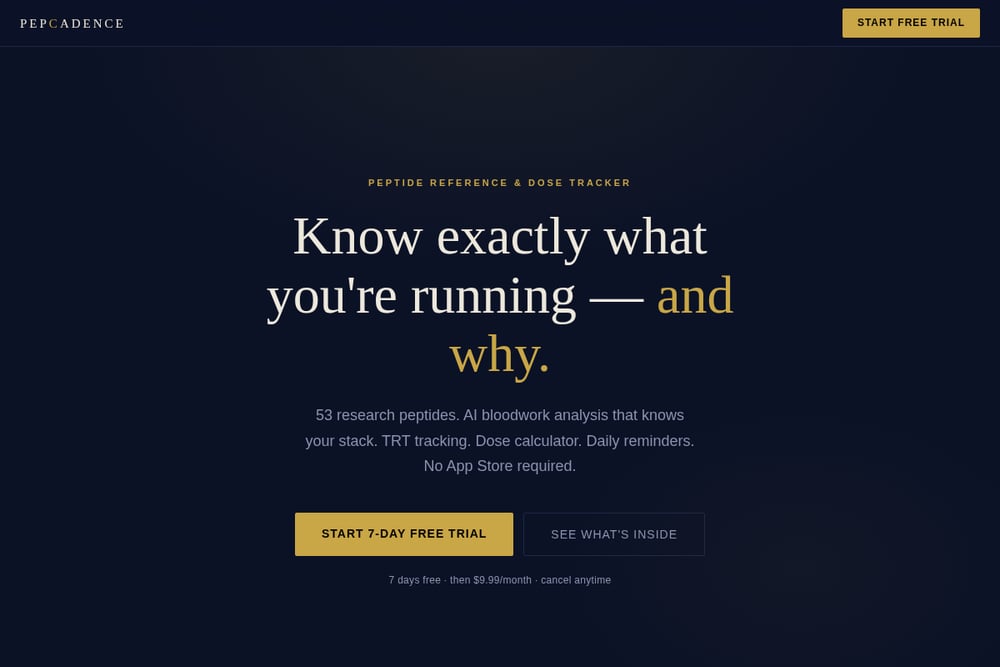 A screenshot of the PepCadence website.
PepCadence is a subscription-based web app that goes beyond simple tracking—it's a full reference library with 53 peptides, each tagged with evidence tiers (HUMAN, MIXED, or ANIMAL) so you know the strength of the science. Its standout feature is AI bloodwork analysis: you upload a photo of your lab panel, and the AI explains out-of-range markers and flags anything relevant to your current stack. You also get a dose calculator that works both ways—from body weight to starting dose, and from desired dose to syringe units. The protocol scheduler handles peptides, TRT, and supplements in one daily view, with reminders and missed-dose prompts. It's built for people who want to understand the 'why' behind their protocol, not just log it. The 7-day free trial lets you test the depth before committing to $9.99/month.
#3 Smart Peptide Tracker
 A screenshot of the Smart Peptide Tracker website.
Smart Peptide Tracker is an Android app that positions itself as a complete research workspace, with features like a Stack Analyzer that visualizes synergy, redundancy, and evidence quality on a radar chart. It also includes an Interaction Network to see how compounds relate, and a Dosing Guide with reference ranges and half-lives. Inventory management goes beyond vials—you can track blends, capsules, nasal sprays, and topicals, with cost and supply estimates. The daily dashboard keeps everything connected, and you can build complex titration schedules that auto-advance. This is a powerful tool for researchers who want to analyze their stack from every angle, though it may feel overwhelming if you just want to log a dose.
#4 PepTracker
 A screenshot of the PepTracker website.
PepTracker is an iOS app that focuses on dose logging and protocol management, with a clean interface designed for quick entry. It lets you set up multiple compounds, track your injection sites, and review your history in a calendar view. The app also includes a reconstitution calculator to help you mix your vials accurately. While it doesn't have the AI features of some competitors, it covers the essentials without clutter. If you're an iPhone user who wants a simple, reliable tracker, PepTracker is worth a look.
#5 PeptIQ
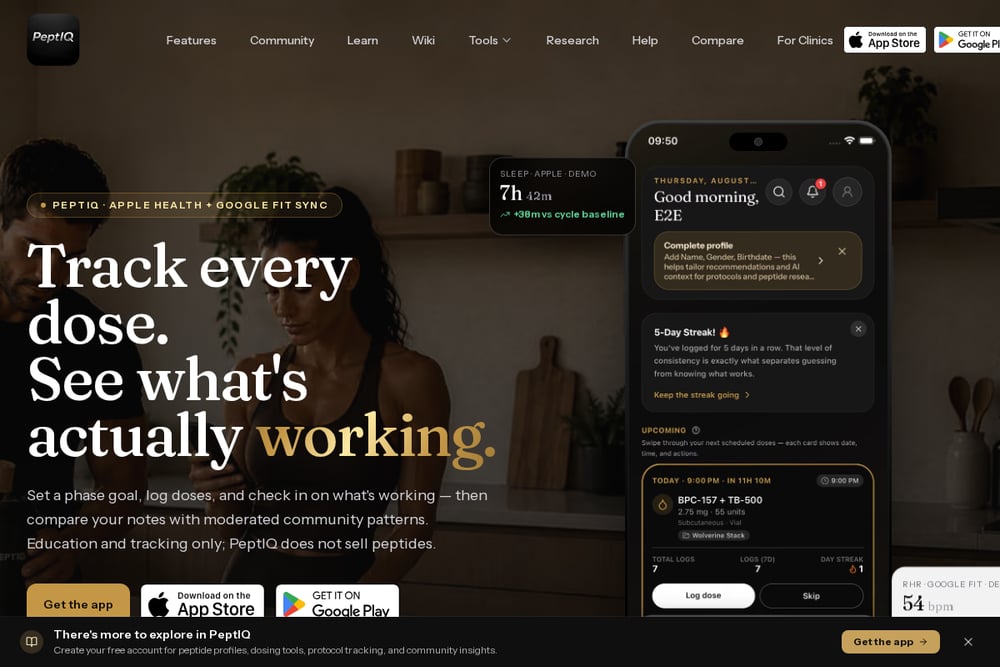 A screenshot of the PeptIQ website.
PeptIQ is a subscription-based app for iOS and Android that combines tracking with AI-powered protocol guidance, including an iMessage assistant for quick questions. You can log doses, manage inventory, and scan vial labels to pull up product info. The app also offers a half-life guide, clearance estimator, and interaction checker, making it a research hub. It's designed for serious protocol managers who want AI support at their fingertips, but the subscription fee and feature density might be overkill for casual users. The web app option is a nice bonus for desktop users.
How to Choose Your Peptide Tracker
Start by asking yourself: what's your primary pain point? If you're constantly forgetting doses, a free app like Peptide Tracker might be all you need. If you're juggling multiple compounds and want to understand interactions, Smart Peptide Tracker's analysis tools could be worth the learning curve. For those who want to dive deep into the science and get AI help with bloodwork, PepCadence offers a unique edge. Consider your platform—iOS, Android, or web—and whether you're willing to pay for premium features. Finally, think about how much data you want to track: just doses, or also labs, symptoms, and inventory? The right tool is the one you'll actually use consistently.
Automating Your Protocol Management
The real power of these tools comes from automation. You can set up daily reminders so you never miss a dose, and some apps will auto-advance titration schedules as you progress. With PepCadence, you can upload a bloodwork photo and get instant AI analysis, saving you hours of manual interpretation. For inventory, Smart Peptide Tracker can estimate how long your supply will last based on your protocol, so you know when to reorder. The goal is to reduce the mental load of managing a complex stack, letting the app handle the math and the reminders while you focus on your research.
The Bottom Line
No single tracker fits everyone, but the landscape is richer than ever. If you want a free, reliable logging app, Peptide Tracker is a great entry point. For a deep reference library and AI bloodwork analysis, PepCadence stands out as a powerful companion. Smart Peptide Tracker appeals to the data-obsessed researcher, while PepTracker offers simplicity for iPhone users. PeptIQ brings AI chat support to the table, but at a cost. Whichever you choose, the key is to pick one that aligns with your workflow and stick with it—your future self will thank you when your protocols are on track and your data is organized.