
If you've ever tried to parse a patent claim, you know it's like decoding a legal maze. These five tools use AI to turn that dense legalese into clear, actionable insights.
The Patent Analysis Landscape in 2026
Patent claims are the backbone of intellectual property protection, but they're notoriously difficult to read. A single claim can be a run-on sentence packed with nested clauses and cross-references. That's why a new wave of AI-powered tools has emerged to help inventors, attorneys, and businesses make sense of it all. From claim charting to invalidity analysis, these platforms are changing how we approach patent work. In 2026, the focus is on speed, accuracy, and transparency—giving you the clarity you need without the headache.
How We Evaluated These Tools
We looked at each tool's core functionality, ease of use, and how well it fits into a typical patent workflow. We considered whether it offers visual breakdowns, export options, and collaborative features. We also weighed the learning curve and whether the tool is accessible to solo inventors versus large firms. Each tool was assessed on its ability to save you time and reduce errors in claim analysis. What stood out for each is how they tackle the same problem from different angles.
Here's a quick snapshot of the five tools we're covering, so you can see at a glance what each one brings to the table.
| Provider | Best For |
|---|---|
| Patlytics | Comprehensive patent litigation and analysis |
| Demystify Patents | Quick, visual claim breakdowns for inventors and attorneys |
| Solve Intelligence | End-to-end patent management with advanced AI agents |
| Attain IP | Verifiable claim charts with source citations |
| Questel | Enterprise-level patent search and portfolio analysis |
The Deep Dive: Five Tools That Make Patent Claims Less Painful
#1 Patlytics
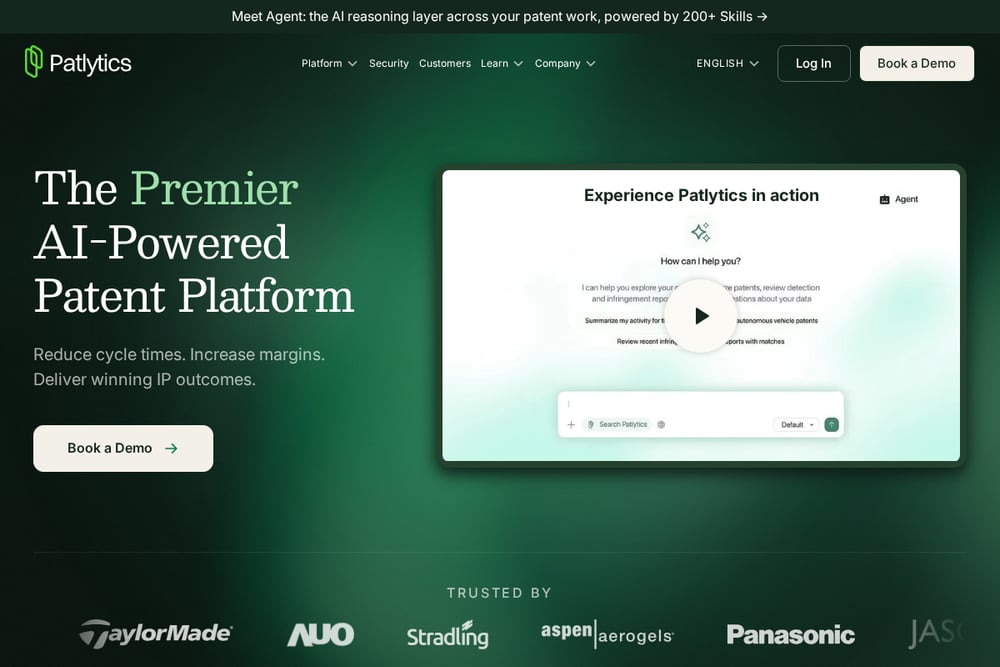 A screenshot of the Patlytics website.
Patlytics is a heavyweight in the AI patent analysis space, offering a full suite of tools for infringement detection, invalidity analysis, and claim chart generation. Its platform is designed to handle complex workflows, from drafting to litigation, all in one place. You can generate detailed claim charts with citations, making it a go-to for attorneys who need evidence-backed arguments. The AI reasoning layer, Agent, automates repetitive tasks, so you can focus on strategy. If you're dealing with high-stakes patent disputes, Patlytics gives you the firepower you need. It's a comprehensive solution that scales from individual practitioners to large enterprises.
#2 Demystify Patents
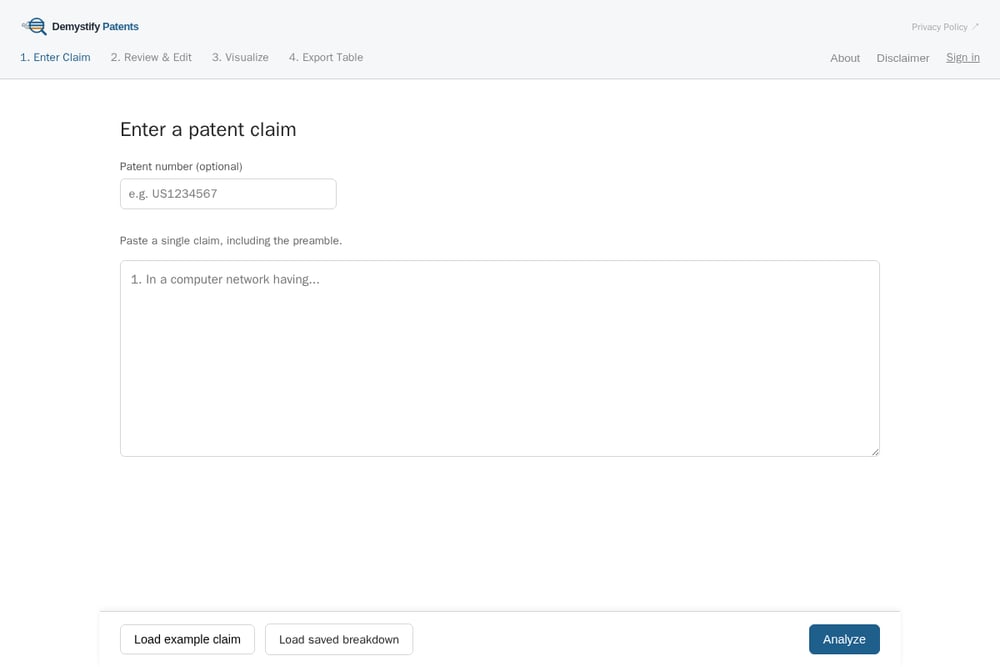 A screenshot of the Demystify Patents website.
Demystify Patents is a focused, web-based tool that uses AI to break down patent claims into parts, steps, and constraints. You paste a claim, and it instantly gives you a visual diagram showing how the elements connect, plus exportable worksheets for your own analysis. It's incredibly user-friendly—you don't need a law degree to understand the output. The tool is perfect for inventors who want to quickly grasp what a claim covers, or for attorneys who need a starting point for invalidity or infringement work. The ability to download PNG diagrams and DOCX/PDF worksheets makes it easy to share findings with clients or colleagues. It's a lean, purpose-built solution that cuts through the noise.
#3 Solve Intelligence
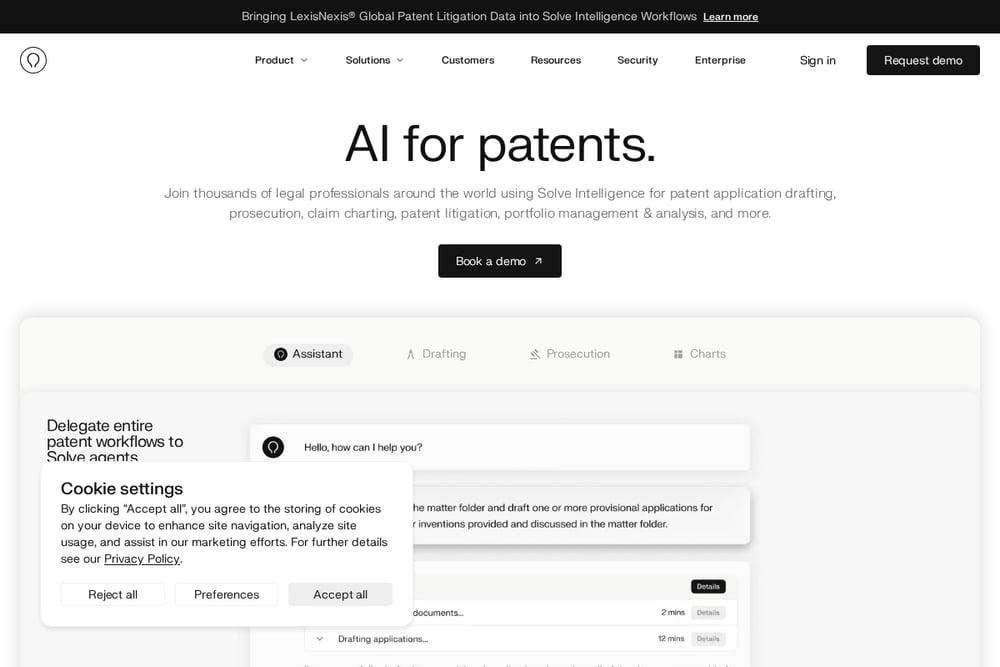 A screenshot of the Solve Intelligence website.
Solve Intelligence is a robust platform that covers the entire patent lifecycle, from drafting to prosecution to litigation. Its claim charting feature is particularly strong, allowing you to generate charts with evidence-backed citations. You can also delegate entire workflows to AI agents, which is a game-changer for busy teams. The platform integrates with LexisNexis litigation data, giving you a competitive edge in court. Whether you're a law firm or a corporate IP department, Solve Intelligence offers a scalable solution. It's a bit more complex to learn, but the payoff in efficiency is worth it.
#4 Attain IP
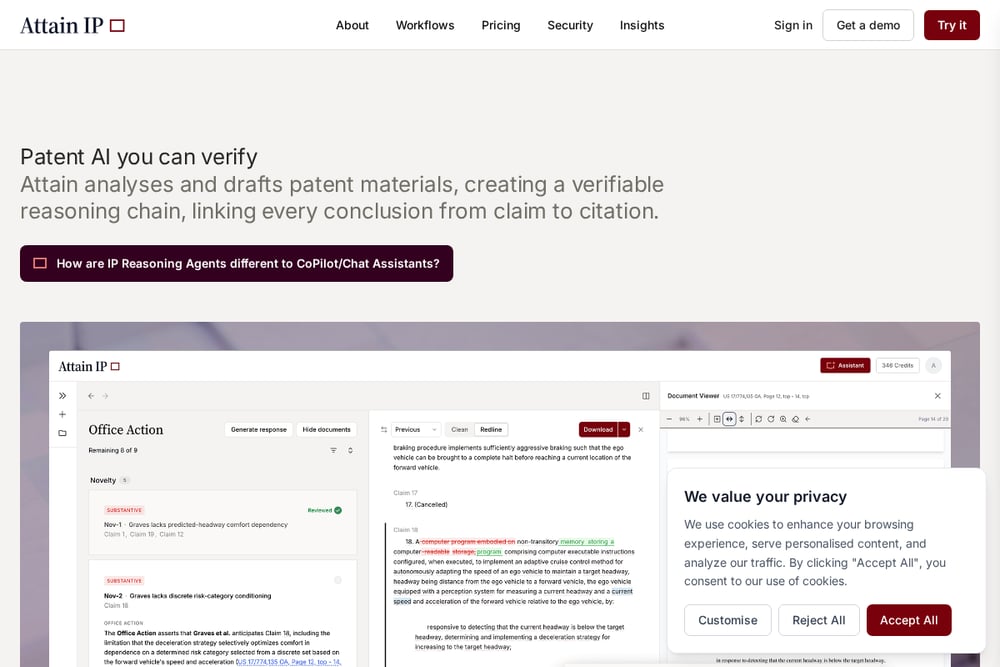 A screenshot of the Attain IP website.
Attain IP specializes in AI claim charting with a focus on verifiability. Its agent decomposes each claim element and maps it to prior art, with source sentences cited to column and line. You can click through to the underlying document to verify every mapping, which is a huge trust factor. The tool is designed for attorneys who need to double-check AI output without redoing the work. It exports to Word, PDF, or spreadsheet, and it's ABA 512 reportable, meaning you can bill the time. If you're doing invalidity or infringement analysis, Attain IP gives you a transparent, auditable trail. It's a niche tool, but it does one thing exceptionally well.
#5 Questel
Questel is a veteran in the IP software space, offering Orbit Intelligence for patent search and analysis. Its AI-powered tools help you map claims and analyze patent landscapes, making it a solid choice for competitive intelligence. You can classify patents automatically and drill down into legal status, which is great for portfolio management. Questel integrates with its broader IP management suite, so you can keep everything in one ecosystem. It's a bit more enterprise-focused, but it's a reliable workhorse for large organizations. If you need deep analytics and global coverage, Questel has you covered.
How to Choose the Right Tool for You
Start by thinking about your primary use case. If you're an inventor who just wants to understand a claim quickly, Demystify Patents is your best bet. If you're a patent attorney handling litigation, you'll want something like Patlytics or Attain IP for its claim charting and evidence features. For a full-service platform that handles drafting and prosecution, Solve Intelligence is a strong contender. And if you're managing a large portfolio, Questel's analytics might be the right fit. Consider your budget, team size, and whether you need exportable files for court. Try a few free trials to see which interface feels most intuitive to you.
Automating the Grunt Work
These tools automate the tedious parts of patent analysis. For example, Demystify Patents uses AI to parse a claim into parts, steps, and constraints, saving you hours of manual reading. Patlytics and Solve Intelligence go further by automating claim chart generation and even drafting responses to office actions. Attain IP automates the mapping of claims to prior art, with a reasoning chain you can verify. Questel automates patent classification and landscape analysis. The workflow is simple: you input your claim or document, the AI does the heavy lifting, and you review the output. This frees you up to focus on strategy and decision-making.
The Bottom Line
No matter which tool you choose, you're going to save time and reduce errors compared to manual analysis. Demystify Patents is the most accessible for quick breakdowns, while Patlytics and Solve Intelligence offer comprehensive suites for professionals. Attain IP is your go-to for verifiable claim charts, and Questel is a reliable enterprise option. The key is to match the tool to your specific needs. Try a couple, see what fits your workflow, and you'll wonder how you ever managed without them.