
If you're developing cancer therapeutics, you know the bottleneck isn't ideas—it's translating them into clinically relevant data. These five platforms are reshaping how we model tumors, decode the microenvironment, and predict patient responses.
The New Era of Translational Oncology
Translational oncology has moved beyond simple cell lines and animal models. Today, the focus is on capturing the complexity of human tumors—the intricate interplay of cancer cells, immune cells, and stromal components that determines therapeutic success. High-throughput platforms, patient-derived models, and multiomic data integration are now essential tools for de-risking drug development. As precision medicine advances, the ability to generate biologically relevant, human-centric data early in the pipeline is becoming a competitive advantage. This roundup highlights five platforms that are leading this charge, each with a unique approach to accelerating oncology research.
How We Evaluated These Platforms
We assessed each platform on its service scope, the depth of its tumor modeling capabilities, the sophistication of its data analytics, and its practical utility for drug developers. We also considered how well each integrates with existing workflows and its track record in supporting translational research. Each platform stood out for distinct reasons—some for their sheer scale of tissue analysis, others for their innovative use of AI, and still others for their accessibility and ease of use. The goal was to provide a balanced view of the current landscape, not to crown a single winner.
Here's a quick snapshot of the five platforms, their core strengths, and what they're best for.
| Provider | Best For |
|---|---|
| Charles River Laboratories - Predictive Translational Immuno-Oncology Platform | End-to-end translational services with a global footprint |
| Farcast biodynamics | High Scale Oncology Translational Research | High-scale TME analysis with AI/ML integration |
| Standard BioTools - Understanding the TME | High-parameter spatial and single-cell TME profiling |
| QIAGEN - Tumor Microenvironment Analysis | RNA-seq-based TME analysis with streamlined workflows |
| ATCC - Patient-derived 2-D & 3-D Cancer Models | Standardized patient-derived models for reproducible research |
Deep Dive: The Five Platforms
#1 Charles River Laboratories - Predictive Translational Immuno-Oncology Platform
Charles River offers a comprehensive predictive translational immuno-oncology platform that integrates patient-derived xenografts, syngeneic models, and advanced immune profiling. Their approach is designed to generate clinically relevant data early in the drug development process, helping you identify the most promising candidates. With decades of experience and a global infrastructure, they provide end-to-end support from target validation to IND-enabling studies. Their platform is particularly strong in assessing combination therapies and understanding resistance mechanisms. If you need a reliable, large-scale partner with a proven track record, Charles River is a solid choice.
#2 Farcast biodynamics | High Scale Oncology Translational Research
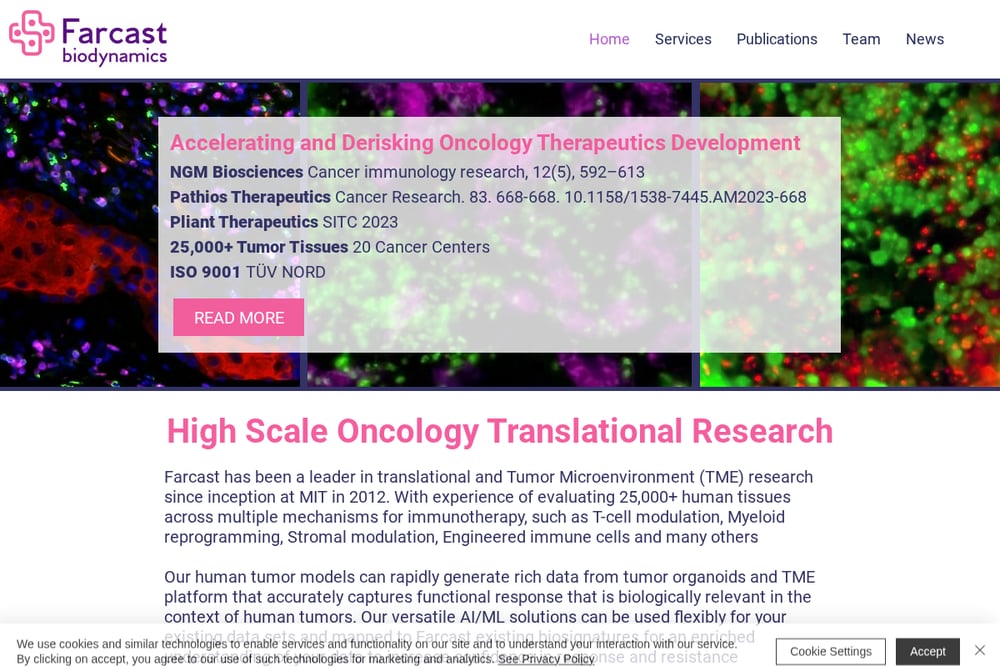 A screenshot of the Farcast biodynamics website.
Farcast has been a leader in translational and tumor microenvironment research since its inception at MIT in 2012. They've evaluated over 25,000 human tissues across multiple immunotherapy mechanisms, including T-cell modulation, myeloid reprogramming, and stromal modulation. Their human tumor models and TME platform rapidly generate rich, biologically relevant data from tumor organoids, capturing functional responses that matter. What sets them apart is their versatile AI/ML solutions, which can be mapped to their existing biosignatures to enrich your understanding of response and resistance. They're ISO 9001 certified and expanding their network beyond 20 cancer centers, making them a high-scale, data-driven partner. If you want to integrate multiomic datasets and create predictive algorithms, Farcast is built for you.
#3 Standard BioTools - Understanding the TME
 A screenshot of the Standard BioTools website.
Standard BioTools provides advanced tools for understanding the tumor microenvironment through high-parameter imaging and mass cytometry. Their Hyperion and CyTOF systems allow you to visualize and quantify cellular interactions within the TME at single-cell resolution. This spatial and functional data is crucial for deciphering the complex immune landscape and identifying biomarkers. They offer a range of consumables and lab services to support your research, from panel design to data analysis. If you're focused on deep immune profiling and spatial biology, Standard BioTools gives you the precision you need.
#4 QIAGEN - Tumor Microenvironment Analysis
 A screenshot of the QIAGEN website.
QIAGEN offers a comprehensive suite of RNA-seq workflows specifically designed for tumor microenvironment analysis. Their solutions enable you to profile immune cell infiltration, tumor heterogeneity, and molecular interactions with high sensitivity. From sample preparation to data analysis and pathway mapping, they provide a streamlined workflow that integrates seamlessly into your research. Their focus on NGS-based approaches gives you the depth and resolution needed to uncover clinically actionable insights. If you're looking for a robust, accessible platform to study the TME, QIAGEN's tools are a practical choice.
#5 ATCC - Patient-derived 2-D & 3-D Cancer Models
 A screenshot of the ATCC website.
ATCC provides a vast collection of patient-derived 2-D and 3-D cancer models that make translational oncology a reality for the scientific community. Their models are well-characterized and authenticated, ensuring reproducibility and reliability in your experiments. Whether you're studying drug response, resistance, or tumor biology, these models offer a physiologically relevant platform. ATCC's extensive catalog and quality standards make it easy to find the right model for your specific research needs. If you value standardization and accessibility, ATCC is a go-to resource.
How to Choose the Right Platform for Your Research
Start by defining your primary research question. Are you focused on deep mechanistic insights into the TME, or do you need high-throughput screening across many models? Consider the scale of your projects—some platforms excel at processing thousands of tissues, while others offer more specialized, in-depth analysis. Evaluate your data analytics needs: if you're generating multiomic datasets, look for platforms with robust AI/ML integration. Also, think about your workflow—do you prefer a full-service partner or a self-serve toolset? Finally, consider your budget and timeline; some platforms offer more flexible, on-demand services. By aligning these factors with your goals, you can select a platform that truly accelerates your path to the clinic.
Automating Translational Research: A Practical Workflow
To maximize efficiency, consider integrating these platforms into a semi-automated workflow. Start with high-throughput tumor model generation using ATCC's standardized models. Then, use Farcast's AI/ML solutions to analyze multiomic data and identify predictive biosignatures. For deeper TME characterization, employ Standard BioTools' imaging systems to validate findings spatially. Finally, use QIAGEN's RNA-seq workflows to confirm gene expression changes and pathway activation. This layered approach allows you to move from hypothesis to validated data with speed and precision, reducing the risk of late-stage failures.
The Future of Translational Oncology
The landscape of translational oncology is rapidly evolving, and these five platforms represent the cutting edge of what's possible. Whether you're a biotech startup or a large pharma, leveraging these tools can significantly de-risk your therapeutic development. The key is to choose a platform that aligns with your specific needs and integrates seamlessly into your existing workflows. As the field advances, we can expect even more sophisticated models and AI-driven insights, making precision cancer medicine a reality for more patients. The future is bright, and these platforms are lighting the way.