
If you're a nursing leader, educator, or healthcare executive, you know the pain: new graduates who aren't ready for the floor, experienced staff with uneven skills, and a constant pressure to prove competence to regulators. The solution isn't more checklists—it's
Why Nursing Competency Frameworks Matter More Than Ever
The nursing competency gap is a well-documented crisis. New graduates often feel unprepared for the realities of bedside care, leading to high turnover, burnout, and compromised patient safety. At the same time, healthcare organizations face increasing pressure from accrediting bodies like The Joint Commission and Magnet to provide audit-ready evidence of staff competence. Manual tracking with spreadsheets and paper forms is no longer viable. Structured, evidence-based competency frameworks are now essential tools for standardizing onboarding, validating skills, and ensuring workforce readiness across all care settings.
How We Evaluated the Top Nursing Competency Frameworks
We evaluated each framework based on five key criteria: evidence base (peer-reviewed or scientifically validated), scope of practice (specialty-specific vs. universal), implementation support (toolkits, digital availability, preceptor materials), adaptability (can it be used across different care settings or roles?), and focus on leadership development. We prioritized frameworks that offer actionable tools, not just theoretical models.
Here's a quick comparison of the five frameworks to help you see which one aligns with your needs.
| Provider | Best For |
|---|---|
| AACN | Critical care and progressive care nurse onboarding |
| AMSN | Medical-surgical nursing competency assessment |
| Sigma Nursing | Nursing leadership development and self-assessment |
| A2C Group — Ability to Capability | Closing competency gaps with a peer-reviewed model |
| Nurses International | Standardized competence development with preceptor support |
Deep Dive: The Top 5 Nursing Competency Frameworks
#1 AACN
 A screenshot of the AACN website.
The American Association of Critical-Care Nurses (AACN) offers a comprehensive Competence Framework for Progressive and Critical Care, now available digitally. This framework provides a structured approach to validating competence for nurses new to critical care, addressing the well-known Experience-Complexity Gap. AACN also provides an implementation toolkit with materials for educators and preceptors, making it easier to standardize onboarding. Their resources are evidence-based and designed to strengthen new nurses' readiness to practice, directly tackling the readiness gap that plagues many hospitals.
#2 AMSN
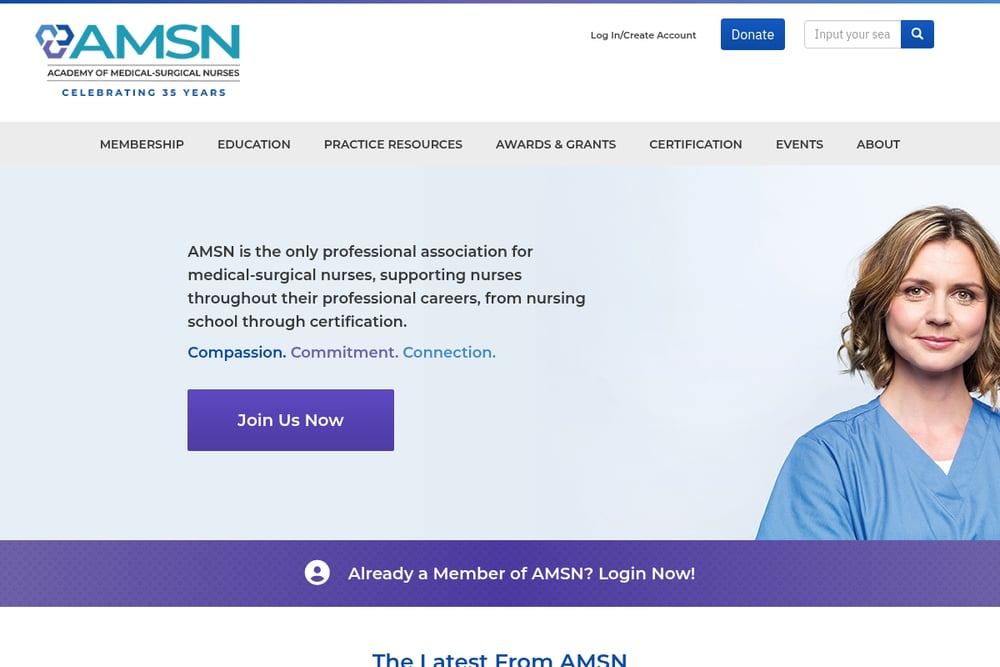 A screenshot of the AMSN website.
The Academy of Medical-Surgical Nurses (AMSN) developed a Medical-Surgical Nursing Competency Framework because no consolidated set of competencies existed for med-surg nurses. This framework covers a wide range of knowledge, skills, abilities, and other qualities (KSAOs) specific to adult health. It allows you and your organization to benchmark nursing skills against scientifically validated competency statements developed by peers. You can uncover strengths and weaknesses, understand how personality traits contribute to competency, and identify areas for growth, taking the guesswork out of personal and organizational assessment.
#3 Sigma Nursing
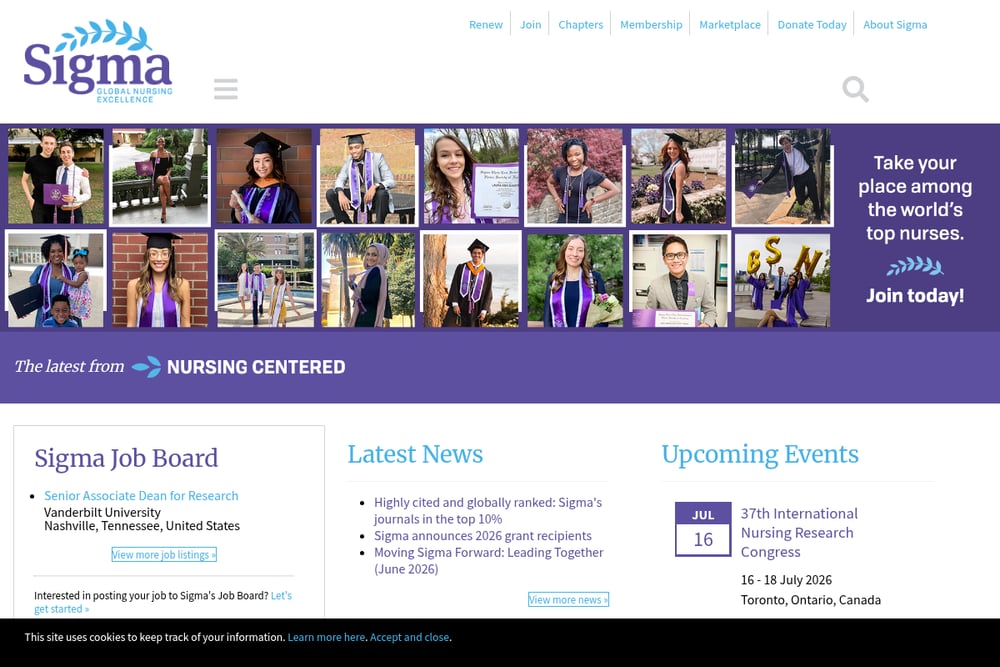 A screenshot of the Sigma Nursing website.
Sigma Nursing, with support from the Johnson & Johnson Foundation, created the Global Nursing Leadership Competency Framework. This guide helps nurses evaluate their leadership through 10 key competencies, each leveled from novice to luminary. You can use it as a self-assessment to set goals, or employers can use it to establish professional development opportunities. The framework also serves as a valuable tool for educators developing new leadership training programs, incorporating lenses like Diversity and Inclusion, Systems Thinking, and Political Savvy.
#4 A2C Group — Ability to Capability
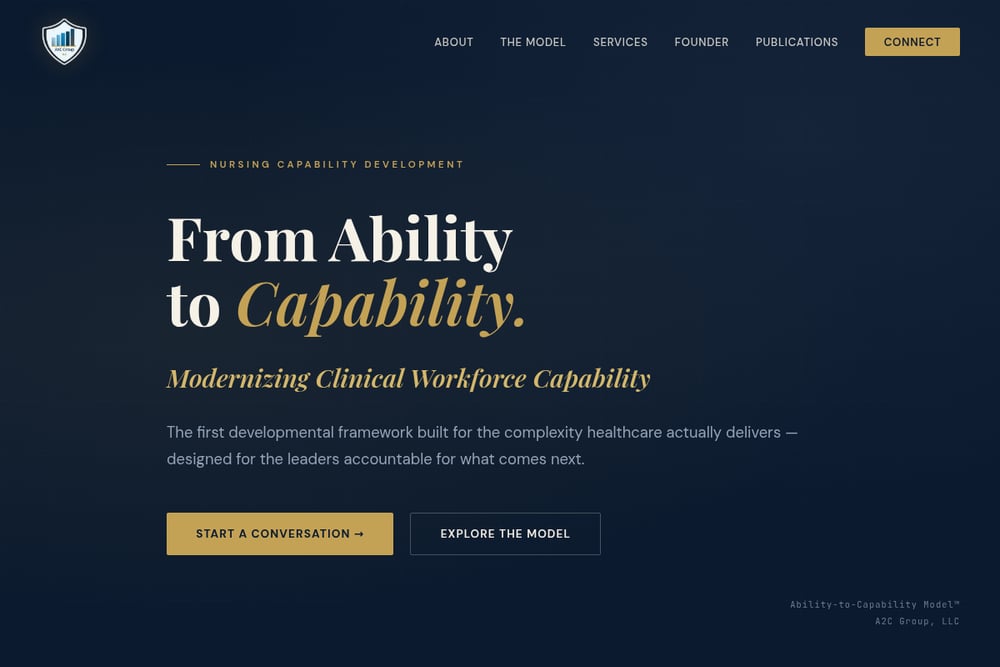 A screenshot of the A2C Group website.
A2C Group provides a peer-reviewed framework specifically designed to close competency gaps in nursing. Their Ability-to-Capability Model targets healthcare leaders, academic institutions, and nursing professionals to improve workforce readiness, safety, and financial performance. Unlike broader frameworks, A2C Group's model is laser-focused on the transition from possessing an ability to demonstrating true capability in modern care settings. This makes it a strong choice for organizations looking to move beyond simple skills checklists and into deep, validated competency.
#5 Nurses International
 A screenshot of the Nurses International website.
Nurses International offers a Clinical Competency Framework (CCF) that provides a comprehensive, structured approach to nurse competence development. The framework integrates evidence-based preceptor support systems and standardizes tools, addressing all levels of nurse hires with a universal set of competencies. Built on prominent nursing theories, it emphasizes preceptor development to cultivate critical thinking and reasoning skills. The CCF is adaptable across various care settings and embodies a 'share and share back' spirit among allied healthcare partners and educators.
How to Choose the Right Competency Framework for Your Organization
Start by identifying your biggest pain point. Are you struggling with new graduate readiness in the ICU? AACN's framework is your best bet. Need a broad med-surg assessment tool? AMSN has you covered. If leadership development is a priority, Sigma Nursing's framework is ideal. For a peer-reviewed model focused on closing specific competency gaps, consider A2C Group. And if you need a universal framework with strong preceptor support, Nurses International is a solid choice. Also consider whether you need digital integration—AACN and Centranum (mentioned in research) offer software solutions, while others may be more manual.
Streamlining Competency Management with Automation
Once you've selected a framework, the next step is automation. Tools like Centranum and Xapify can centralize your competency tracking, replacing spreadsheets and paper forms. A typical workflow: 1) Define role-specific competencies using your chosen framework. 2) Assign assessments and checklists to staff via a digital platform. 3) Track completion and validation in real-time. 4) Generate audit-ready reports for accreditation. This approach saves educators hours of manual work and provides clear visibility of workforce readiness.
Your Next Step Toward a Competent Nursing Workforce
Closing the nursing competency gap isn't a one-time project—it's an ongoing commitment. The five frameworks we've covered each offer a unique path to validating skills, improving readiness, and ultimately delivering safer patient care. Whether you choose AACN's critical care focus, AMSN's med-surg depth, Sigma's leadership lens, A2C Group's peer-reviewed model, or Nurses International's universal approach, the key is to start. Pick the framework that fits your setting, invest in the right tools, and watch your team's confidence and competence grow.