Your patients deserve your attention. Your claims deserve someone who actually chases them. Here are five medical billing and revenue cycle partners worth a serious look.
Why outsourced billing keeps growing
Medical billing is the unglamorous engine of every practice. Claims go out, payers push back, and cash either arrives or it does not. Outsourcing the revenue cycle has become normal for U.S. practices of every size, from solo providers to hospital systems. The reason is simple. Payer rules change, denial rates stay stubborn, and hiring experienced billers is expensive. A good partner brings coders, follow-up teams, and software you would struggle to build alone. The market reflects that. You will find firms built for hospitals, firms built for independent practices, and firms that sell software alongside services. The differences matter more than the marketing suggests. Scope, pricing model, specialty depth, and how much visibility you get into your own numbers all vary widely. That is what this list is for.
How these five were evaluated
Every firm here was weighed on the same factors. Service scope, meaning how much of the revenue cycle is genuinely covered. Pricing and trial clarity, meaning whether you can test or estimate cost before committing. Specialty and payer fit, meaning whether the firm speaks your practice type. Technology, meaning whether software supports the people or replaces them. And transparency, meaning how clearly each firm explains what it does. Global Healthcare Resource stood out for breadth, with front-end, mid-cycle, and back-end coverage plus patient contact center work. CliniHarbor stood out for a connected, practice-centric framing and a clearly stated 15-day free trial. BillingParadise stood out for pairing services with a named software stack, including denial and AR tools. OutsourceRCM stood out for adjacent back-office services and fluency across many billing platforms. CureMD stood out for bundling RCM with a full clinical and AI platform.
Here is the short version. Five medical billing and revenue cycle partners that U.S. practices keep coming back to, each with a different strength. Scan the list, then dig into the details that match your situation.
| Provider | Best For |
|---|---|
| Global Healthcare Resource | Hospitals and large groups needing full front-to-back coverage |
| Medical Billing & Revenue Cycle Management | CliniHarbor | Practices that want a connected revenue cycle with a low-risk trial |
| BillingParadise | Teams that want billing services plus denial and AR software |
| OutsourceRCM | Practices wanting broad back-office support beyond billing alone |
| CureMD | Practices that want billing and a clinical platform in one place |
The five, one by one
#1 Global Healthcare Resource
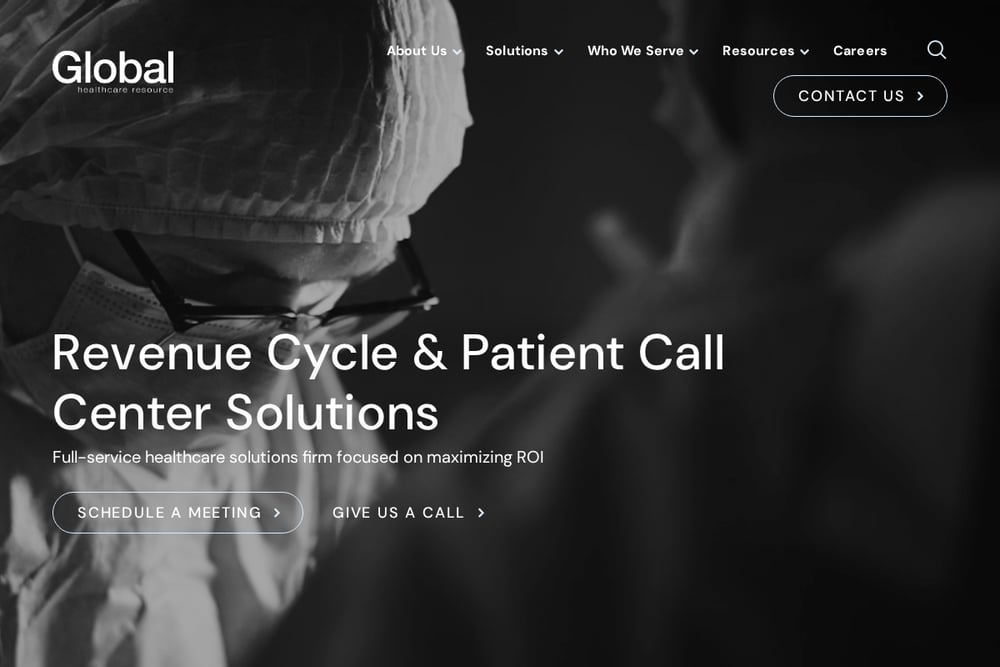 A screenshot of the Global Healthcare Resource website.
Global Healthcare Resource has been in the revenue cycle game for over 25 years, and it shows in the breadth of the service map. The firm covers front-end work like scheduling, registration, eligibility verification, and prior authorization, then carries through coding, clinical documentation improvement, charge entry, claim submission, payment posting, and A/R follow-up with denial management. It also runs patient call center and patient A/R functions, which matters if your front desk is drowning. The company positions itself as an extension of your team for hospitals, physician groups, ambulatory surgery centers, and even other RCM companies. If you need one partner to absorb a wide slice of the cycle, this is a serious contender. See the full service breakdown at Global Healthcare Resource.
#2 Medical Billing & Revenue Cycle Management | CliniHarbor
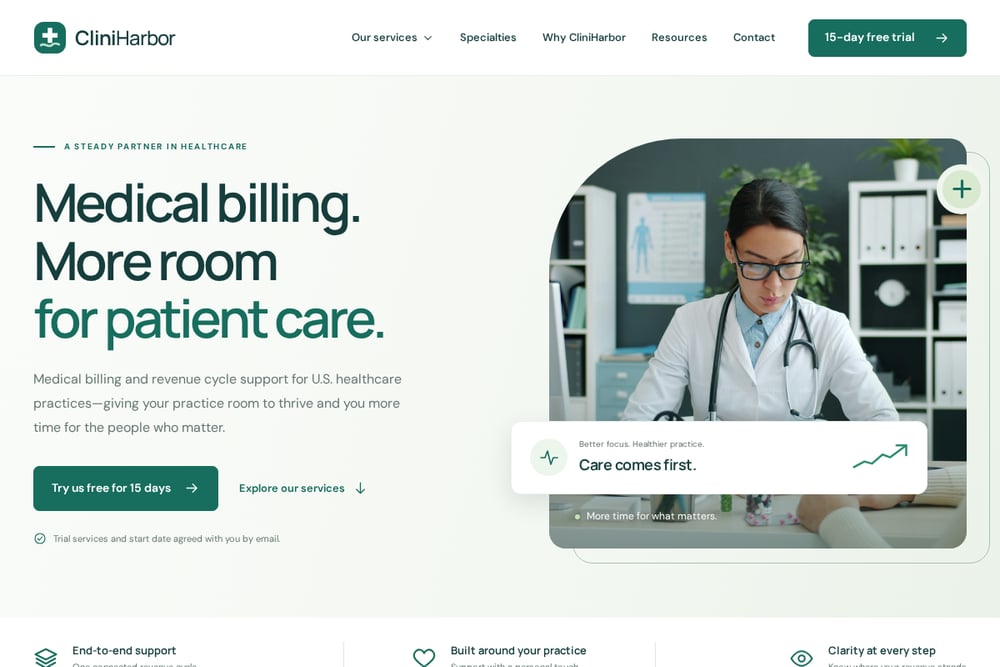 A screenshot of the Medical Billing & Revenue Cycle Management | CliniHarbor website.
CliniHarbor is built around a simple idea. Your practice has its own people, pressures, and priorities, and your billing support should understand all three. The firm offers end-to-end revenue cycle support covering medical billing from charge entry to payment posting, medical coding, accounts receivable follow-up, denial management, provider credentialing, and billing audit and insights. What stands out is the framing. CliniHarbor talks about being a steady partner rather than a vendor, with clarity at every step so you know where your revenue stands. It also offers a 15-day free trial, with the start date agreed by email, which is a genuinely low-risk way to test the relationship before you commit. If you want one connected cycle instead of five disconnected handoffs, start at CliniHarbor.
#3 BillingParadise
BillingParadise pairs outsourced RCM with a stack of purpose-built tools, and that combination is the pitch. On the service side you get eligibility verification, denial management, AR services, coding support, medical billing, credentialing, and end-to-end revenue cycle management. On the software side there is denial management software, AR management software, a claim scrubbing tool, a patient cost estimator, patient eligibility automation, an EOB-to-ERA converter, and revenue analytics. The firm organizes its offerings by practice type too, with tracks for hospitals, community hospitals, medical group practices, independent practices, and in-house billing teams. That last one is interesting. If you already have a billing department, BillingParadise can work alongside it rather than replace it. Explore the service and product mix at BillingParadise.
#4 OutsourceRCM
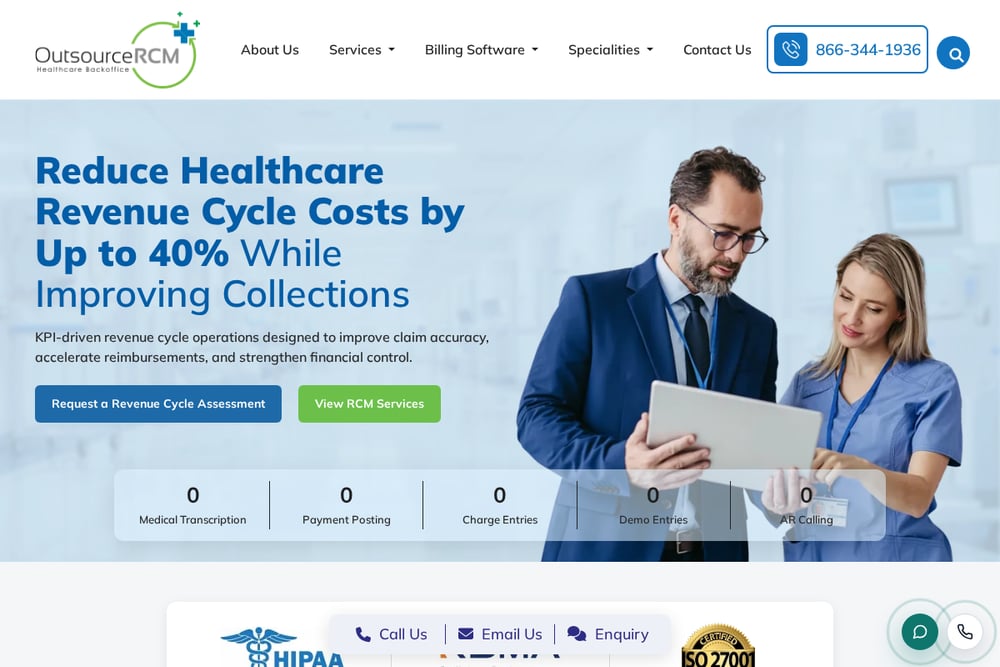 A screenshot of the OutsourceRCM website.
OutsourceRCM casts a wide net. The core services cover medical billing, medical coding, claims management, denial management, patient billing and collections, insurance verification, financial reporting and reconciliation, AR management, and payment posting. Then it goes further, adding patient care coordinators, electronic visit verification, pre-charting, medical transcription, healthcare call center support, healthcare data entry, healthcare IT, pharmacy management, and teleradiology. It also supports a long list of billing software platforms, including Athena, ChiroTouch, eClinicalWorks, IMS, Kareo, Office Ally, and Lytec. That platform fluency is useful if you are not switching your EHR anytime soon. The trade-off is breadth. You will want to confirm which services are truly in-house versus coordinated, and get that in writing. Start with the service list at OutsourceRCM.
#5 CureMD
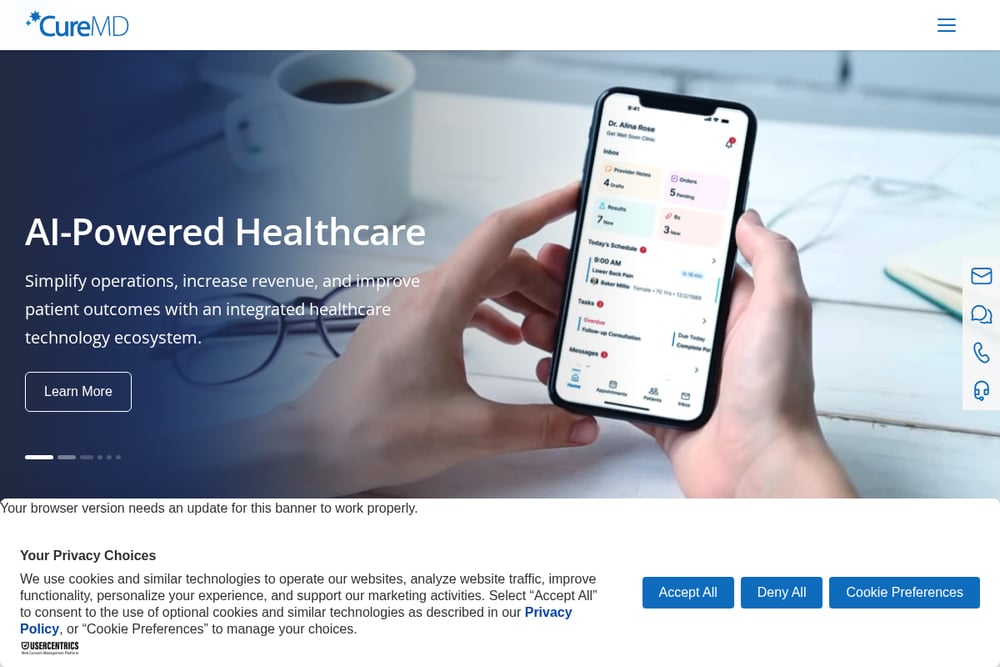 A screenshot of the CureMD website.
CureMD comes at revenue cycle from the platform side. The company has spent 29-plus years building a unified healthcare platform that combines electronic health records, practice management, specialty EHR, mobile EHR, a patient portal, and chronic care management with billing and revenue cycle management. Its AI layer includes an AI medical scribe, an AI coder that suggests ICD-10 and CPT codes in real time, and an AI contact center for appointment booking and patient queries. On the revenue side it offers RCM and credentialing services aimed at capturing every dollar and cutting leakage. The appeal is consolidation. If you are shopping for both a clinical system and a billing partner, one vendor means one integration and one throat to choke. The catch is that you are buying into the platform, so evaluate fit carefully. Details at CureMD.
What to ask before you sign
Start with your pain. Is it denials, aging AR, coding accuracy, or credentialing delays? Match the partner to the specific leak, not to a generic service list. Next, ask who actually touches your claims. You want named people and a clear escalation path, not a call center queue. Ask how they report. A monthly PDF is not enough. You want visibility into clean claim rate, days in AR, and denial trends. Check payer and EHR experience in your specialty, because cardiology billing is not pediatrics billing. Ask about pricing structure up front. Percentage of collections, per-claim, and flat fee models all exist, and each shifts risk differently. Finally, insist on a trial or pilot. CliniHarbor offers a 15-day free trial, which is a low-risk way to see how the team works before you commit. Test the handoff, the communication, and the first batch of claims.
Where automation fits into your revenue cycle
Automation is not a replacement for a billing partner. It is the layer that makes the partner faster. Start with claim scrubbing so errors get caught before submission. Add eligibility checks that run before the visit, not after. Route denials into a rules engine that flags the reason code and the next action. Push payment posting toward EOB-to-ERA conversion so cash lands in your ledger without manual keying. Then use the reporting layer to spot the gaps. CliniHarbor folds billing audit and insights into its service mix, which gives you a feedback loop. BillingParadise and OutsourceRCM both lean on software tools for denial and AR management. CureMD bundles the platform itself. The practical move: let your partner handle judgment calls and payer follow-up, and let automation handle the repetitive steps. That combination is what keeps days in AR from creeping up.
How to make the call
There is no single right answer here. There is only the right fit for your practice size, your specialty, and how much control you want to keep in-house. If you want a partner that treats your revenue cycle as a connected whole and gives you a low-risk way to test the relationship, start with CliniHarbor and its 15-day trial. If you need scale across hospitals or a large group, Global Healthcare Resource has the depth. If software tools matter as much as people, BillingParadise and OutsourceRCM give you both. If you are also shopping for a clinical platform, CureMD bundles the pieces. Pick two, run a short trial or pilot, and compare clean claim rates and days in AR after 60 days. That beats a long sales cycle every time.