Your Maryland board has a deadline, a budget line, and a stack of confusing statute citations. These five resources help you sort it out before the clock runs out.
The Maryland Reserve Study Landscape Right Now
Maryland changed the game in 2022. Condominiums, housing co-ops, and most HOAs now must update a reserve study at least every five years, and the rules trace back to Real Property 11-109.4, 11B-112.3, 11B-112.2, and Corporations and Associations 5-6B-26.1. The threshold matters: an HOA responsible only for common-area components totaling under $10,000 is exempt. Everyone else is in. County timelines stagger the pain. Prince George's County communities had to be set up before October 1, 2020, with studies from October 1, 2016 counting, a first study due October 1, 2021, an update by October 2026, and funding to the study by fiscal year 2027. Montgomery County runs a similar lane with a 2021 setup cutoff and 2017 study lookback. That means boards across the state are shopping for qualified preparers at the same time. A preparer can qualify in several ways, including having prepared 30 studies in the past three years. First studies also get a runway: five fiscal years to reach the yearly contribution the study recommends. The market response has been a mix of national firms with Mid-Atlantic offices, regional specialists, and one Maryland-focused information hub that routes boards to a firm in their county.
How We Looked at These Five
We weighed the same factors for every entry. First, service scope: does the provider handle full reserve studies, updates with and without site visits, and the ancillary reports boards actually need? Second, Maryland fit: does the provider speak to the state's 2022 law, county deadlines, and the $10,000 exemption in plain terms? Third, pricing and quote clarity: can you get a proposal without a maze? Fourth, educational depth: sample reports, law guides, calculators, and FAQs that help a volunteer treasurer understand what they are buying. Fifth, accessibility: how easy it is for a board in a smaller county to reach a human. Maryland HOA Reserve Study stood out for turning statute into a county-by-county timeline and a single quote path. Reserve Advisors stood out for a broad service menu and a dedicated Maryland requirements page. Association Reserves stood out for a deep resource library and a Mid-Atlantic regional structure. Reserve Study Group stood out for a straightforward Maryland law summary and a clear proposal request. Prime Reserve Planning stood out for engineer-and-accountant teams and explicit state data points.
Here is the short version before the deep dive. Each entry below serves a slightly different board: the one that needs a deadline explained, the one that needs a full engineering report, the one that needs a fast update, and the one that needs a proposal this week.
| Provider | Best For |
|---|---|
| Reserve Advisors | Boards wanting a full-service engineering-grade report |
| Maryland HOA Reserve Study: Deadlines, Funding, Quotes | Boards that need county deadlines decoded first |
| Association Reserves | Boards that want options from DIY to full site visit |
| Reserve Study Group | Managers who want a fast, no-frills proposal |
| Prime Reserve Planning | Mixed property types needing financial consulting too |
The Five, One by One
#1 Reserve Advisors
 A screenshot of the Reserve Advisors website.
Reserve Advisors runs a full-service reserve study practice with a dedicated Maryland requirements page under its recent legislation resources. You get reserve studies plus structural integrity reserve studies, insurance appraisals, preventative maintenance reports, and energy services. The firm serves homeowner associations, condominium associations, high-rise associations, and private clubs, which matters if your community has elevators, roofs, and pools all competing for the same dollars. Its Mid-Atlantic regional structure means a Maryland board is not talking to a call center in another time zone. The site also publishes sample reports and continuing education material, so your treasurer can see the deliverable before signing. See the Maryland page at Reserve Advisors for the legislation summary.
#2 Maryland HOA Reserve Study: Deadlines, Funding, Quotes
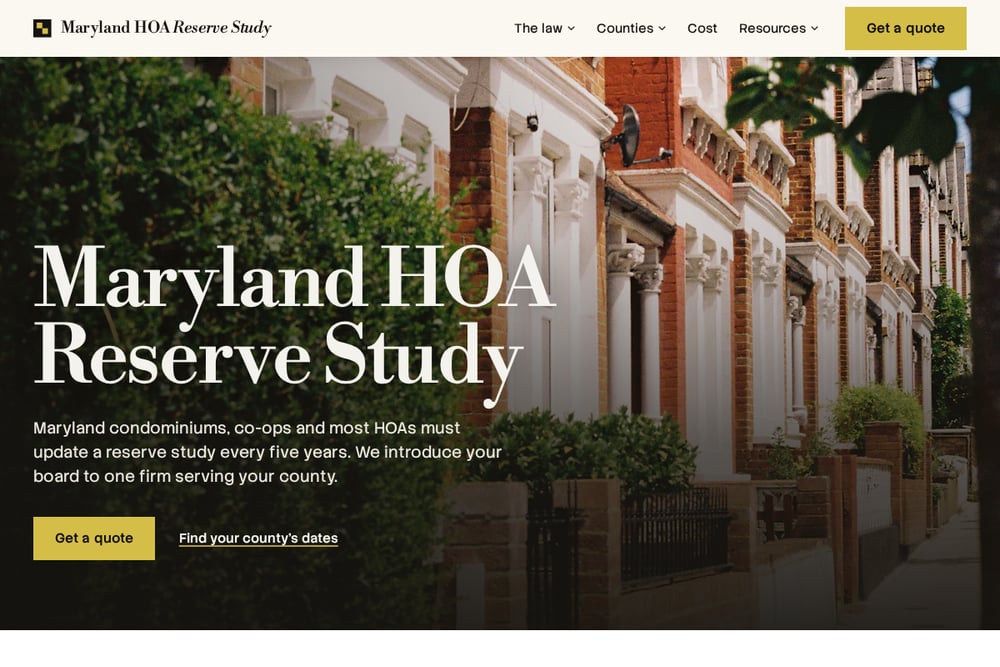 A screenshot of the Maryland HOA Reserve Study website.
This is the resource to read before you call anyone. Maryland HOA Reserve Study translates the 2022 law into four figures: five years between studies, $10,000 as the common-area cost threshold that brings an HOA under the law, five fiscal years to reach the recommended yearly contribution, and 30 studies in three years as one way a preparer qualifies. It then does something most provider sites skip: a county picker. You choose condominium, HOA, or housing cooperative, pick your county from Allegany to Worcester, and the timeline lights up. Prince George's County shows setup before October 1, 2020, studies from October 1, 2016 counting, a first study by October 1, 2021, an update by October 2026, and funding by fiscal year 2027. Montgomery County shows its own lane with a 2021 setup cutoff and 2017 lookback. The site also covers funding to the study, who may prepare one, typical costs, and a quote request that introduces your board to one firm serving your county. If your board is confused about dates, start here.
#3 Association Reserves
 A screenshot of the Association Reserves website.
Association Reserves brings a large regional footprint to Maryland through its Mid-Atlantic office, and the depth shows in the service menu. You can buy a full reserve study, an update with a site visit, an update without a site visit, or a loyalty update plan, which gives a board a predictable multi-year path instead of a one-off purchase. There is also a do-it-yourself reserve study kit and a uPlanIt consulting option for communities that want to keep costs down. The resource library is unusually thick: webinars, ebooks, an industry insights report, a Fannie Mae and Freddie Mac update, and a guide called Understanding Reserves. For a volunteer board that has never seen a reserve study, that education is worth real money. The firm also publishes sample reports so you know the format before you commit.
#4 Reserve Study Group
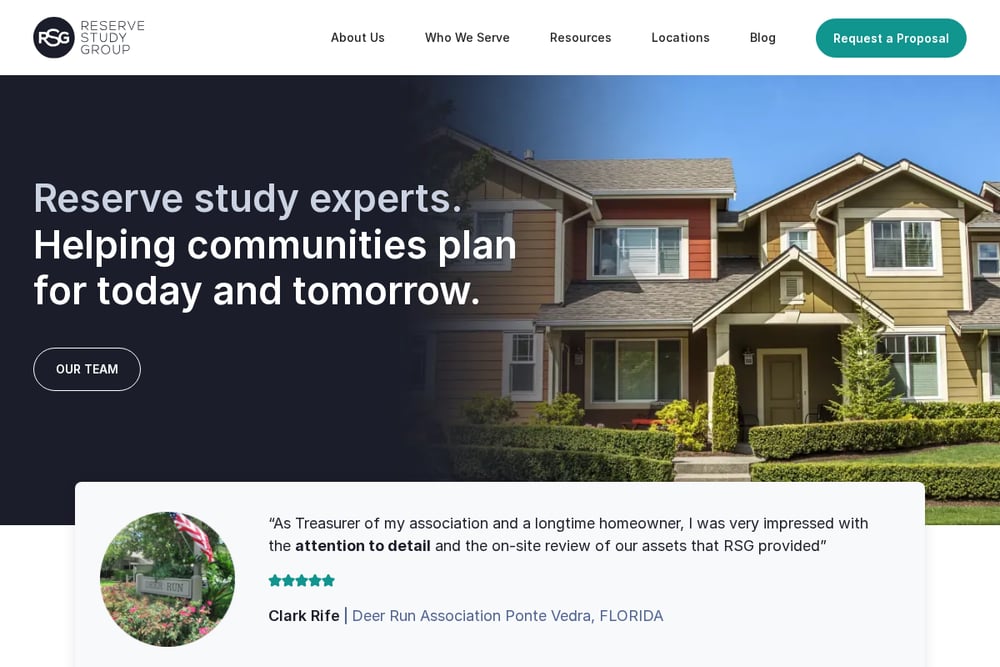 A screenshot of the Reserve Study Group website.
Reserve Study Group keeps its Maryland page short and to the point, which some boards will appreciate. It states plainly that Maryland law mandates reserve studies for condominium and homeowner associations, and it flags the $10,000 exemption for associations responsible only for common areas below that total initial purchase and installation cost. The firm serves homeowner associations, condominium associations, association management companies, and commercial property owners. Its footprint spans the Northeast, Southeast, Great Lakes, Mountain, and Pacific West regions, with a Virginia office handling the Mid-Atlantic corridor. You get a reserve study report, a reserve fund calculator, a law guide, and an FAQ in the resources section. Requesting a proposal is a single click from the Maryland page, which is refreshing when you are comparing three firms in one week.
#5 Prime Reserve Planning
 A screenshot of the Prime Reserve Planning website.
Prime Reserve Planning markets itself as engineers and accountants producing reports that board members can actually read. For Maryland, the firm puts the key numbers right on the page: roughly 7,300 community associations in the state, reserve studies required every five years, and reserve funding required. That framing helps a board understand it is not alone in this. The firm serves condominium associations, HOAs, townhome communities, senior and assisted living facilities, country clubs, schools, and worship facilities, so it is comfortable with property types beyond the standard subdivision. Service areas listed include Baltimore, Columbia, Easton, Ellicott City, Frederick, Gaithersburg, Germantown, Rockville, Silver Spring, and Waldorf. Sample reports are available, and the firm offers in-house reserve studies and consulting alongside the standard study.
How to Pick the Right One for Your Board
Start with your calendar, not your vendor list. Find your county's deadline first, because a Prince George's County board facing an October 2026 update and fiscal year 2027 funding target has less room to shop than a community in a later lane. Use the Maryland HOA Reserve Study county picker to confirm your dates, then decide what you are buying. If your last study is recent and the components have not changed, an update without a site visit may be enough. If you have never had a study, or your buildings are aging, pay for the site visit. Ask every firm three questions: who signs the report, how many studies has that preparer completed in the past three years, and what does the quote include. Remember the five-fiscal-year runway for reaching the recommended contribution on a first study. That runway is your friend, but only if the study is accurate. Finally, check whether the firm serves your county specifically. A national brand with a Mid-Atlantic office is fine, but confirm a human will walk your property.
Where Automation Fits In
You do not need software to comply, but a little automation saves board meetings. Set a recurring calendar reminder five years out from your last study date, plus a 12-month warning. Store your county deadline, your fiscal year end, and your funding target in one shared document the whole board can see. Use a reserve fund calculator, like the one Reserve Study Group offers, to sanity-check the contribution number before the report lands. Keep a simple spreadsheet of component ages and replacement costs so your next update is faster and cheaper. When you request quotes, send the same scope sheet to every firm so you compare apples to apples. And archive the final report, the funding plan, and the board vote in one folder, because the next treasurer will thank you.
The Bottom Line
Maryland's 2022 reserve study law turned a good idea into a deadline, and deadlines reward preparation. Read the plain-language county timelines at Maryland HOA Reserve Study first so you know exactly what you owe and when. Then match the provider to your situation: Reserve Advisors for engineering depth, Association Reserves for flexible service tiers and education, Reserve Study Group for a quick proposal, and Prime Reserve Planning for mixed property types and financial consulting. Whichever you choose, get the quote in writing, confirm the preparer's qualifications, and put the five-year clock on your calendar today. Your reserve fund will be healthier for it, and your board will sleep better.