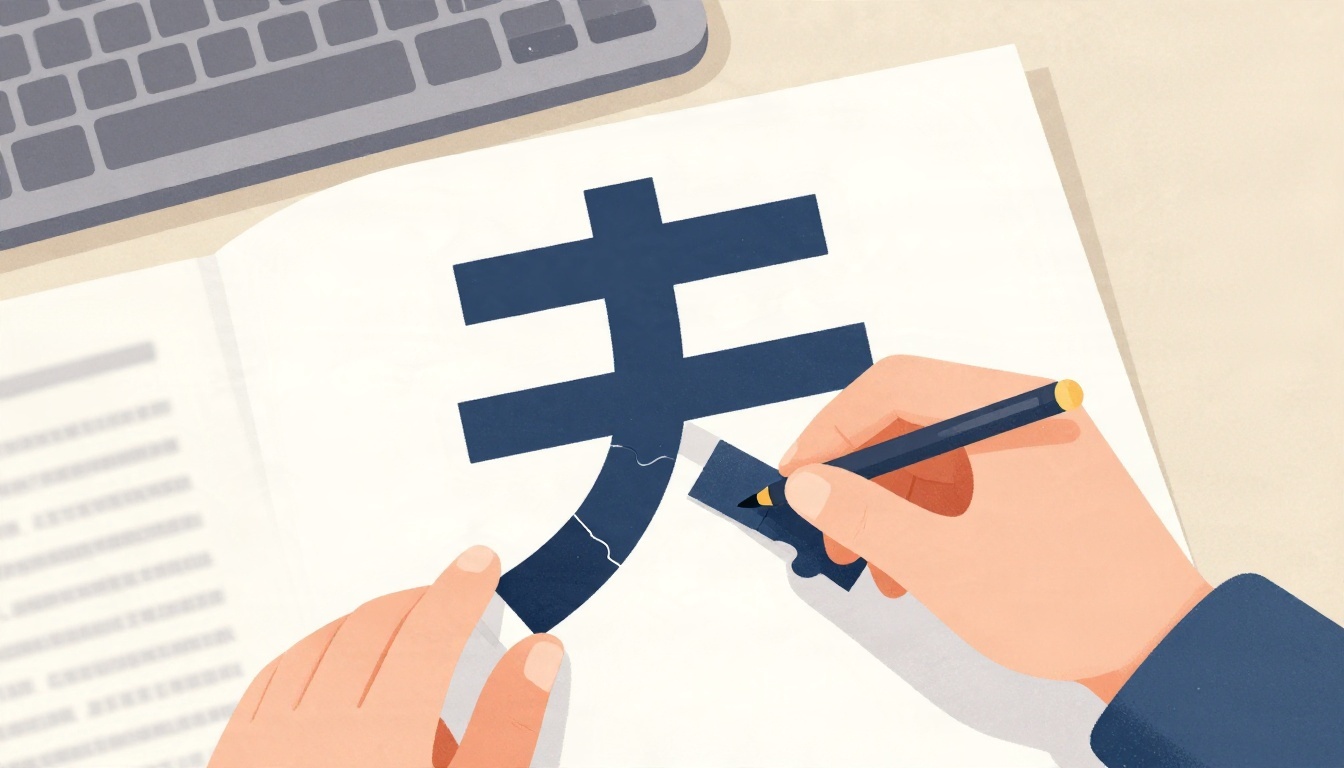
Why Copying Characters Isn't Enough
Many students are told to copy each character until it sticks. But for some, that advice doesn't work. LexiPress, a new publisher of Chinese language workbooks, suggests a different approach. When copying a whole character until it sticks is not enough, the advice is to take a step back. Beginners often try to hold shape, sound and meaning at once, and the character can still look like a little drawing.
What helps instead is the building blocks. LexiPress emphasizes starting with strokes: where each one begins, which parts touch and which stay apart, and in what order. "Stroke order is structure, not decoration — it makes the form predictable and transferable from one character to the next," LexiPress said. Strokes combine into components, and components into characters. Once writing is treated as a system, recognition can get clearer and mistakes become less likely, because the learner is no longer guessing at a picture. The official HSK syllabus itself keeps separate lists for characters to recognise and characters to write: related skills, not the same job.
Repetition still has a place, but each attempt should have a purpose: study the model, practice carefully, then cover it and check from memory. That self-check without the model is the real test of whether it sticks. Shape, sound and meaning hold more readily when the form itself already makes sense.
The Missing Middle Step in Free Resources
Free worksheets and how-to pages often leave thin the middle step: not only what to copy, but what to notice, how the parts fit, and how to check without the model beside you. LexiPress points out that clear criteria for "correct" are often missing—start and end points, which parts touch or stay apart, and proportions—so "looks fine" is not the standard.
Beginners aiming at AP® Chinese or HSK usually need that bridge. Strokes build components; components build characters, and the same parts return across many words. Free sheets are often one-off lists rather than that reusable system. Sound and meaning belong with the form from early on. A short practice loop helps: recognise the strokes first, write carefully, cover it, and check. That is foundational work, not exam prep. The HSK 3.0 Level 1 paper tests listening and reading, though the syllabus already includes characters to write for Levels 1–2. AP® Chinese and HSK still differ by exam and version, so the test prep has to match the paper the student will sit.
Early Habits That Show Up on Exam Day
One early trap is settling for a character that looks roughly right beside the model. Imprecise strokes—wrong start or end, parts that should touch or stay apart, proportions that blur two similar characters—turn "close enough" into an identity error. LexiPress notes that this is a teaching concern, not a claim about what every student does. Another early comfort is recognition only: knowing a character when they see it, without clean production when writing is required.
On exam day it shows up differently by test. In the new HSK 3.0, writing begins at Level 2; in the older HSK 2.0, it begins at Level 3. An approximate shape that is still the wrong character does not count. On the AP® Chinese exam, students type their written answers using Pinyin or Bopomofo input, and the whole response is scored, not just the characters chosen. The AP course still requires both regular handwriting practice and keyboarding with accurate character selection. Early stroke precision still matters for lifelong writing and for HSK production; clear character identity matters for AP typing. The two exams are not the same system.
Practical Takeaways
- Start with strokes: learn where each begins, which parts touch, and the order.
- Treat writing as a system: strokes build components, components build characters.
- Use a purposeful practice loop: study, write, cover, check from memory.
- Set clear criteria for correctness: start/end points, touching parts, proportions.
- Know your exam: in HSK 3.0, writing begins at Level 2 (Level 3 in HSK 2.0); AP® Chinese uses typed input with character selection.
For more on LexiPress and their upcoming HSK and AP® Chinese materials, visit LexiPress.
AP® is a trademark of the College Board, which is not affiliated with and does not endorse LexiPress.