
If your plant's data is scattered across silos, you're leaving answers on the table. These five platforms turn that chaos into a connected, queryable knowledge graph—so you can finally get the insights you need.
The State of Industrial Knowledge Graphs
Industrial operations generate a firehose of data—from sensor readings and maintenance logs to CAD drawings and shift reports. Yet most of it sits in disconnected systems, locked in spreadsheets or trapped in someone's head. Knowledge graph platforms have emerged to solve this by linking disparate data sources into a unified, semantic web of information. This lets engineers, operators, and managers ask natural-language questions and get answers with source citations, not just raw data dumps. In 2026, these platforms are becoming the backbone of AI-driven industrial operations, enabling predictive maintenance, root-cause analysis, and faster decision-making. The challenge is choosing the right one for your specific operational context.
How We Evaluated These Platforms
We assessed each platform on its ability to ingest diverse data types, build a connected knowledge graph, and deliver actionable insights to end-users. We looked at deployment flexibility—cloud, on-prem, or edge—and how quickly you can pilot the solution. Pricing transparency and the ease of getting started were also key factors. We considered the strength of the AI capabilities, especially how well the platform can answer questions with cited sources. Finally, we weighed the platform's fit for heavy industry, including support for SCADA, ERP, and document-heavy workflows.
Here's a quick look at the five platforms we're covering, from the fast-pilot specialist to the enterprise-scale data foundation.
| Provider | Best For |
|---|---|
| Cognite | Enterprise-scale industrial data unification |
| Concorde Systems — Operational Intelligence for Heavy Industry | Rapid deployment and field technician support |
| SymphonyAI | AI-driven industrial analytics with vertical depth |
| Stardog | Ontology-driven semantic AI for complex enterprises |
| DataMesh | Semantic digital twins for facility and asset management |
The Platforms, Deep Dive
#1 Cognite
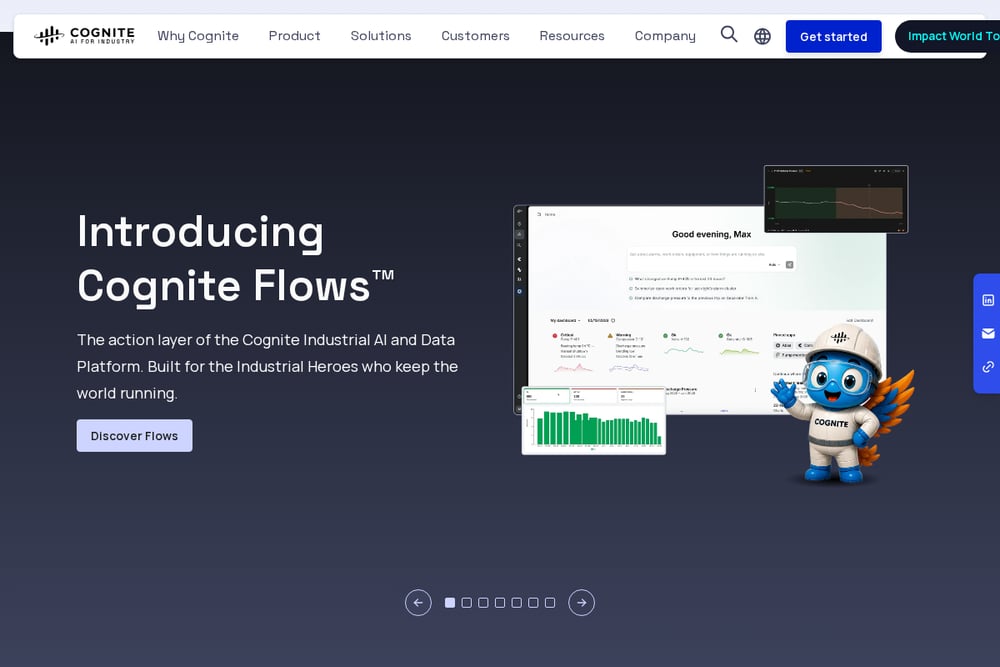 A screenshot of the Cognite website.
Cognite Data Fusion is a heavyweight in the industrial knowledge graph space, designed to handle massive volumes of time-series sensor data, documents, and 3D models. It excels at liberating data from legacy systems and building a flexible, labeled property graph that adheres to industry standards. With built-in SQL transformation services, it automates the creation of your knowledge graph, making it easier to scale. Cognite's platform is built for enterprise-scale operations, and it's trusted by major energy and manufacturing companies. If you need a robust, data-fabric-style solution that can handle complex industrial data landscapes, Cognite is a strong contender. Its focus on high-frequency data and engineering context makes it a favorite for digital twin initiatives.
#2 Concorde Systems — Operational Intelligence for Heavy Industry
 A screenshot of the Concorde Systems website.
Concorde Systems stands out for its promise of 'pilot in days, not months,' making it the fastest path to a working knowledge graph. Its DECODER product ingests everything from PDF manuals and Excel logs to SCADA exports and site photos, linking them into a living graph. ASSIST then lets you ask questions and get answers with citations, guiding technicians step-by-step through procedures. The platform is deployable on cloud, on-prem, or edge, giving you flexibility. Concorde's focus on 'answers with receipts' ensures trust in AI outputs, which is critical on the plant floor. For heavy industry operators who want to see value quickly without a massive IT project, Concorde is a compelling choice.
#3 SymphonyAI
 A screenshot of the SymphonyAI website.
SymphonyAI's Industrial Cortex (Knowledge Graph) is part of a broader AI platform that includes digital twins and predictive asset intelligence. It addresses siloed data by creating a comprehensive, interconnected view of assets and processes. The platform uses a unified namespace to harmonize information from disparate sources, which is crucial for large-scale operations. SymphonyAI's strength lies in its vertical-specific solutions for industries like oil and gas, chemicals, and pharmaceuticals. If you're looking for a knowledge graph that integrates with a wider suite of AI tools, SymphonyAI offers a robust ecosystem. Its focus on outcome-based layers helps evolve the graph into a structured knowledge repository.
#4 Stardog
 A screenshot of the Stardog website.
Stardog takes a semantic approach to knowledge graphs, using ontologies to give AI a shared understanding of your business. This is particularly valuable if you need to reason across complex data relationships and ensure consistency across applications. Stardog's platform is open and scalable, and it doesn't lock you into a proprietary environment. It's designed to unify enterprise data where it lives, adding the semantic context AI agents need. For organizations that already have a strong data governance framework, Stardog can be a powerful semantic layer. It's a good fit for those who want to build custom AI agents on a trusted, ontology-driven foundation.
#5 DataMesh
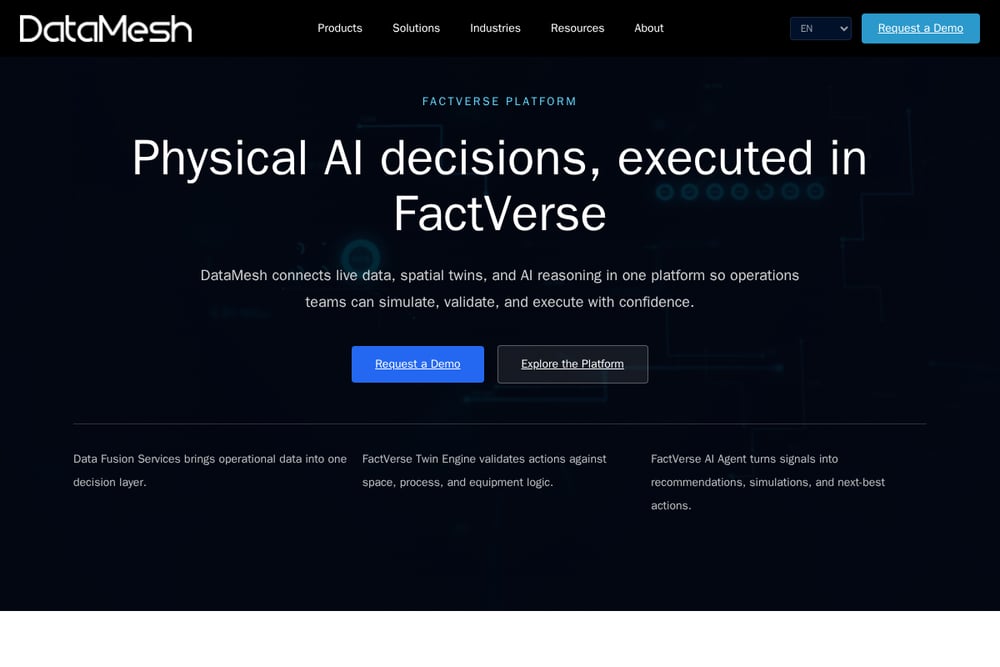 A screenshot of the DataMesh website.
DataMesh focuses on connecting physical assets, spaces, and systems to create a semantic digital twin. Its FactVerse platform models the operating site in a way that engineers, operators, and AI agents can all use. The graph includes spatial structures, physical assets, systems, data points, and knowledge objects like SOPs and manuals. This makes it ideal for facility management and operational context. DataMesh's approach is particularly strong for visualizing and simulating operations in a 3D environment. If you're looking to build a digital twin that grounds AI answers in real-world context, DataMesh is worth exploring.
How to Choose the Right Platform
Start by defining your primary use case: do you need to unify data for analytics, support field technicians, or build a digital twin? Consider your data landscape—if you have massive time-series data, Cognite's scale might be necessary. If you need to get up and running quickly, Concorde's rapid pilot approach could be a game-changer. Evaluate the level of semantic rigor you need; Stardog's ontology-driven approach is powerful but may require more upfront modeling. Think about deployment: cloud, on-prem, or edge—and whether the platform can handle your security requirements. Finally, involve your engineers and operators in the demo process to see which platform feels intuitive for them.
Automating Workflows with Knowledge Graphs
Once your knowledge graph is live, you can automate report generation, root-cause analysis, and even guided troubleshooting. For example, with Concorde, you can set up ASSIST to automatically pull the latest sensor data and generate a daily shift report with citations. With Cognite, you can build automated alerts that trigger when a pump's vibration pattern matches a known failure mode. The key is to start with a single workflow—like incident reporting—and then expand as your team gains confidence.
The Bottom Line
The era of disconnected industrial data is ending. Whether you choose Concorde for speed, Cognite for scale, SymphonyAI for vertical AI, Stardog for semantic rigor, or DataMesh for digital twins, the goal is the same: turn your data into a trusted, queryable asset. The right platform will not only answer questions but also empower your team to make faster, safer, and more informed decisions. Start with a pilot, measure the impact, and scale from there.