
You've validated your imaging AI, but can you trust it on today's scanner with today's protocol? These five companies are tackling that question from different angles.
The Imaging AI Reliability Landscape
Imaging AI has moved from research to clinical deployment, but the gap between validation conditions and real-world acquisition states remains a stubborn problem. Models trained on curated datasets often stumble when faced with different scanners, protocols, or dose levels. Regulatory bodies like the FDA and the EU AI Act are pushing for continuous monitoring, not just pre-market validation. Meanwhile, hospitals and vendors are realizing that DICOM metadata alone can't capture the pixel-level shifts that affect AI performance. This has spawned a niche but critical market for reliability infrastructure, validation platforms, and governance tools.
How We Evaluated These Solutions
We looked at each company's approach to closing the validation-to-deployment gap. Key factors included the depth of physics or data science behind their methods, the scope of their platform (from data sourcing to governance), and how directly they address the real-world acquisition variability that breaks AI models. We also considered whether they offer actionable insights for clinicians and vendors, and how well they integrate into existing workflows.
Here's a quick snapshot of the five companies and what they bring to the table.
| Provider | Best For |
|---|---|
| Segmed | Sourcing diverse real-world imaging data for validation |
| GammaMetric — Acquisition-State Reliability for Imaging AI | Real-time monitoring of acquisition-state reliability for deployed AI |
| QMENTA | End-to-end validation workflows for clinical trials and regulatory submission |
| Censinet | Enterprise AI governance and third-party risk management |
| Eunoia Consulting Co. | Strategic consulting for AI validation programs and regulatory compliance |
The Five Solutions, Closer Look
#1 Segmed
 A screenshot of the Segmed website.
Segmed tackles the AI validation gap by providing access to vast, de-identified real-world imaging data. Their platform, Openda, lets you source diverse datasets that reflect true clinical heterogeneity, so you can test your model against the messiness of actual practice. This is crucial because, as they note, high performance on internal validation doesn't guarantee real-world reliability. If you're a developer or researcher needing to stress-test your algorithm across institutions and scanners, Segmed gives you the raw material to do it. They focus on data access and curation, making it easier to build robust training and validation sets. For teams that need to close the gap before deployment, Segmed is a solid starting point.
#2 GammaMetric — Acquisition-State Reliability for Imaging AI
 A screenshot of the GammaMetric website.
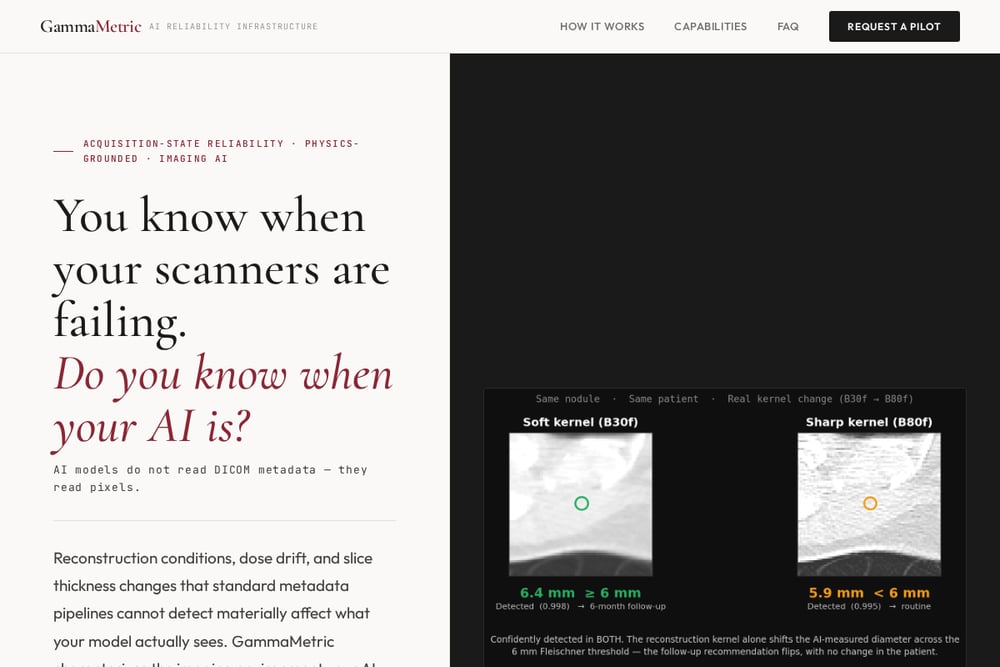
GammaMetric zeroes in on the exact problem you face after deployment: is today's study inside your model's validated envelope? Instead of relying on DICOM metadata, they fingerprint the actual pixels to detect reconstruction conditions, dose drift, and slice thickness changes that can silently degrade AI performance. Their physics-grounded sensitivity scoring tells you how much a protocol shift might impact your model's accuracy, as shown in their example where a 3.75mm slice thickness drove a -8.1 percentage point change. This is a proactive, monitoring-first approach that gives you a per-study confidence score. If you're a vendor or a hospital running AI on diverse scanners, GammaMetric helps you know when to trust the result and when to review manually. It's a niche but essential layer for safe AI deployment.
#3 QMENTA
 A screenshot of the QMENTA website.
QMENTA offers a cloud-based platform that streamlines the entire medical imaging AI validation workflow, from data management to algorithm testing and central review. Their tools are designed to support clinical trials and regulatory approval, making them a strong fit for organizations that need to generate robust evidence for AI-based biomarkers. They emphasize reproducibility and efficiency, which are critical when you're dealing with multi-site studies. If you're in CNS, oncology, or other therapeutic areas, QMENTA provides the infrastructure to validate your imaging AI in a controlled, auditable way. Their platform is more about the validation process itself, rather than post-deployment monitoring, but it's a key piece of the puzzle.
#4 Censinet
 A screenshot of the Censinet website.
Censinet approaches AI reliability from the governance and risk management side. Their platform helps healthcare organizations assess and manage third-party AI vendor risk, including model validation and robustness testing. They distinguish between validation (does it work?) and robustness (does it keep working when conditions change?), which is a crucial distinction for safety. Censinet's strength lies in its enterprise-wide risk framework, covering cybersecurity, operational risk, and AI governance. If you're a health system trying to oversee multiple AI tools across departments, Censinet gives you the oversight layer to ensure each model is monitored and safe. It's less about the technical validation itself and more about the governance around it.
#5 Eunoia Consulting Co.
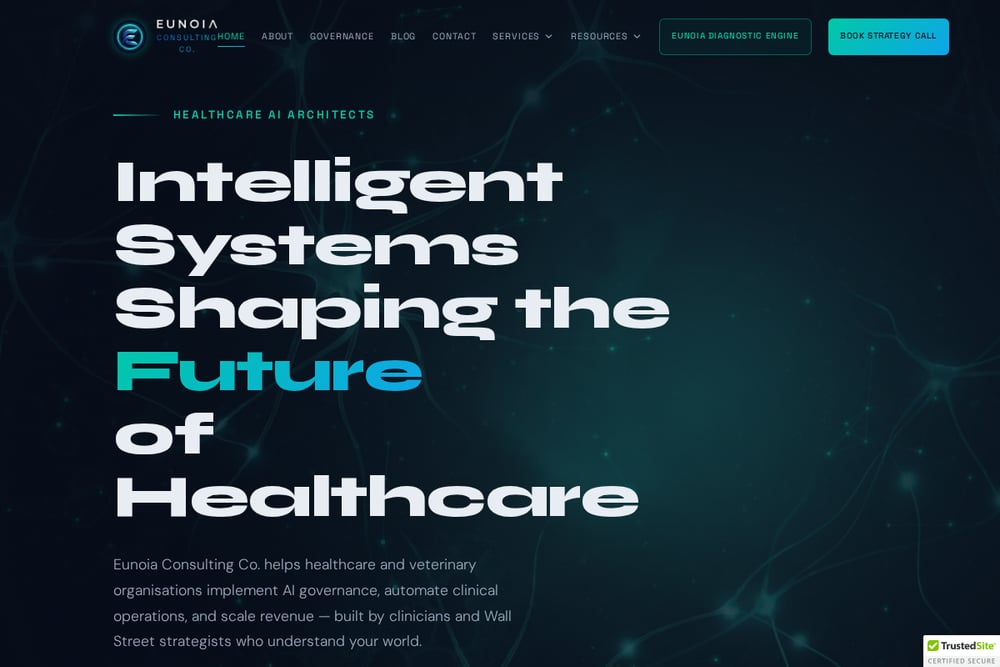 A screenshot of the Eunoia Consulting Co. website.
Eunoia Consulting Co. provides advisory services to help healthcare organizations build and execute AI validation programs. They emphasize that validation is not a one-time test but a continuous program that spans pre-deployment, go-live, and ongoing monitoring. Their guidance covers regulatory compliance, bias auditing, and clinical workflow integration, which are often overlooked but critical for safe deployment. If you're a hospital or a startup that lacks in-house expertise, Eunoia can help you navigate the complex landscape of FDA SaMD requirements and the EU AI Act. They're a consulting partner rather than a software platform, so they're best for organizations that need strategic direction and hands-on support. Their focus on real-world performance in your specific patient population is a valuable perspective.
How to Choose the Right Partner for Your AI Reliability Needs
Start by asking what stage you're in: pre-deployment, go-live, or ongoing monitoring. If you need diverse data to validate your model, Segmed is your go-to. If you're already deployed and worried about protocol drift, GammaMetric gives you the real-time, physics-based checks you need. For organizations in clinical trials, QMENTA's platform can manage the entire validation workflow. If you're a health system juggling multiple AI vendors, Censinet's governance layer will keep you compliant and safe. And if you're just starting out and need expert guidance, Eunoia Consulting can build your validation program from scratch. Consider your internal resources, regulatory pressures, and the specific failure modes you're most worried about.
Automating Reliability: From Validation to Continuous Monitoring
The future of imaging AI reliability lies in automation. Imagine a workflow where your AI model is automatically tested against a continuous stream of real-world data, flagging any study that falls outside its validated envelope. GammaMetric's pixel-based fingerprinting can be integrated into your PACS to score every incoming study in real time. Segmed's data platform can feed diverse cases into your validation pipeline on a schedule. QMENTA's cloud infrastructure can automate the execution of validation tests and generate reports for regulators. Censinet can automate the monitoring of vendor performance and alert you to changes. And Eunoia can help you design these automated workflows from the start. The goal is to move from periodic validation to always-on assurance.
Closing the Loop on Imaging AI Trust
No single solution covers every aspect of imaging AI reliability, but together these five companies represent a comprehensive ecosystem. Segmed gives you the data, GammaMetric gives you the real-time monitoring, QMENTA gives you the validation workflow, Censinet gives you the governance, and Eunoia gives you the expertise. As AI becomes more embedded in clinical care, the question isn't just 'does it work?' but 'does it work for this patient, on this scanner, today?' The answer lies in combining these approaches to create a safety net that catches every deviation. Start with the one that addresses your most pressing need, and build from there.