
If you're navigating the new wave of autonomous operations, these five platforms are redefining how humans and AI work together—without sacrificing control.
The Shift from Scripted to Autonomous
The gap between traditional automation and modern operational demands is widening. Scripted workflows break under unexpected conditions, while fully autonomous AI often operates as a black box, leaving you without accountability. The emerging sweet spot is human-guided autonomy: systems that execute at machine speed but keep you in the loop for every critical decision. This approach is gaining traction across defense, cybersecurity, and physical operations, where speed and control are non-negotiable. The platforms below are leading this charge, each with a distinct angle on how to blend human judgment with AI-driven execution.
How We Evaluated These Platforms
We assessed each platform on its ability to balance autonomy with human oversight, the depth of its orchestration capabilities, and how clearly it communicates its value to operators. We also looked at the breadth of use cases—from cyber defense to physical AI—and how each platform handles the inevitable edge cases that arise in real-world missions. Finally, we considered the transparency of decision-making, because trust is the foundation of any human-AI partnership.
Here's a quick snapshot of the five platforms, ordered by our overall assessment of their current market fit and innovation.
| Provider | Best For |
|---|---|
| XTEND | Physical AI and robotic fleet coordination |
| Automedon | Human-Guided AI Orchestration for Defense | Human-guided autonomous cyber operations |
| Stellar Cyber | AI-driven SOC automation and threat detection |
| SentinelOne | Enterprise endpoint and cloud security automation |
| BlueVoyant | Managed detection and response with AI |
The Five Platforms in Detail
#1 XTEND
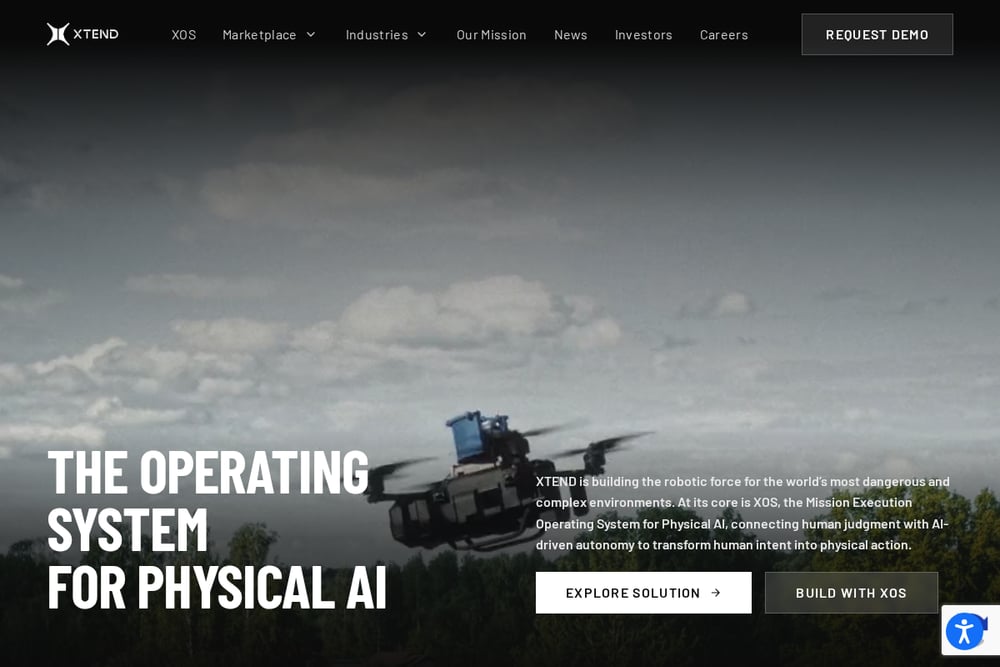 A screenshot of the XTEND website.
XTEND is building the operating system for physical AI, connecting human judgment with AI-driven autonomy to turn intent into action. Its XOS platform is hardware-agnostic, meaning you can deploy it across aerial, ground, and maritime systems without being locked into a specific vendor. The company emphasizes that humans think while machines act, keeping you at the center of every mission. With a focus on defense and high-risk operations, XTEND offers a robust ecosystem for autonomous patrols, counter-UAS, and rapid response. If you're looking to orchestrate physical robots at scale, this platform stands out for its open architecture and mission execution focus.
#2 Automedon | Human-Guided AI Orchestration for Defense
 A screenshot of the Automedon website.
Automedon is a defense-grade AI orchestration platform that keeps you in full control while coordinating autonomous agents for cyber operations. Its seven-layer technology stack includes a mission planner that translates high-level objectives into executable steps, and an orchestrator that manages multi-agent coordination with real-time heartbeat monitoring. What sets Automedon apart is its dynamic replanning on failure—if an agent hits an obstacle, the system adapts without requiring your intervention. The platform promises 10x faster operations than manual processes while maintaining 100% human oversight and zero black-box decisions. For mission-critical cyber defense, this is a compelling option that balances speed with accountability.
#3 Stellar Cyber
 A screenshot of the Stellar Cyber website.
Stellar Cyber offers an AI-native security operations platform that augments your SOC team with multi-layer AI and human oversight. Its agentic SOC platform automates investigation workflows, triage, and threat hunting, so you can cut through alert noise and focus on real threats. The platform integrates with hundreds of security products, making it a flexible choice for modern security teams. With features like AI-powered case orchestration and continuous threat hunting, Stellar Cyber helps you accelerate response times without losing control. If you're looking to modernize your SOC with AI-driven decisioning, this platform is worth a close look.
#4 SentinelOne
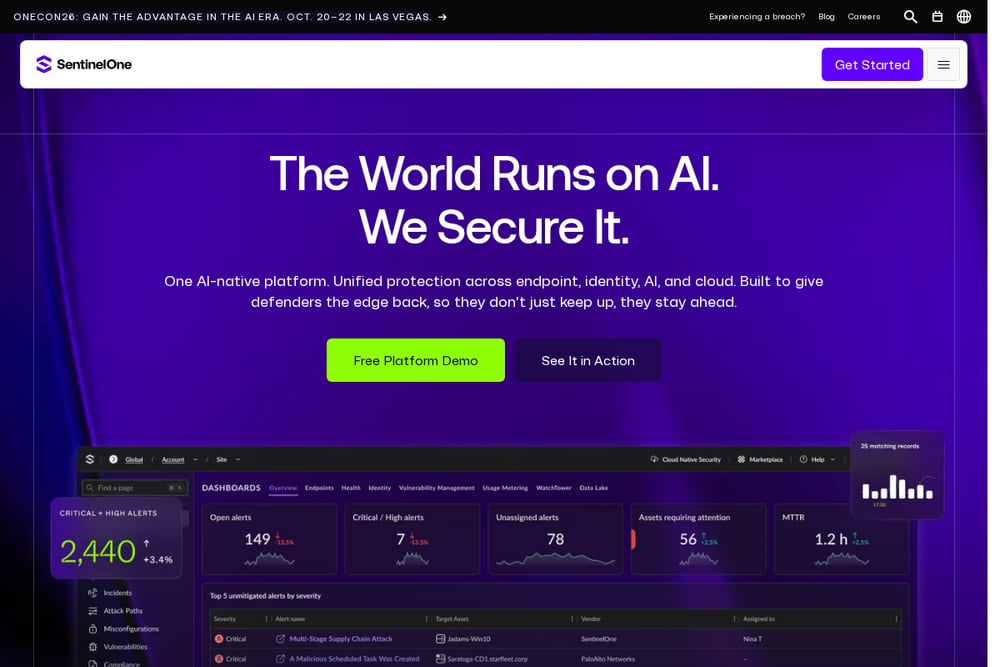 A screenshot of the SentinelOne website.
SentinelOne's Singularity platform delivers autonomous security operations with machine-speed protection and response. It covers endpoint, cloud, and AI security, giving you a unified view of your entire environment. The platform's AI SOC capabilities are designed to detect and respond to threats in real time, reducing the burden on your security team. With one-click integrations and a focus on enterprise readiness, SentinelOne is a solid choice for organizations that need scalable, automated defense. If you're after a comprehensive security platform that can act on its own, this is a strong contender.
#5 BlueVoyant
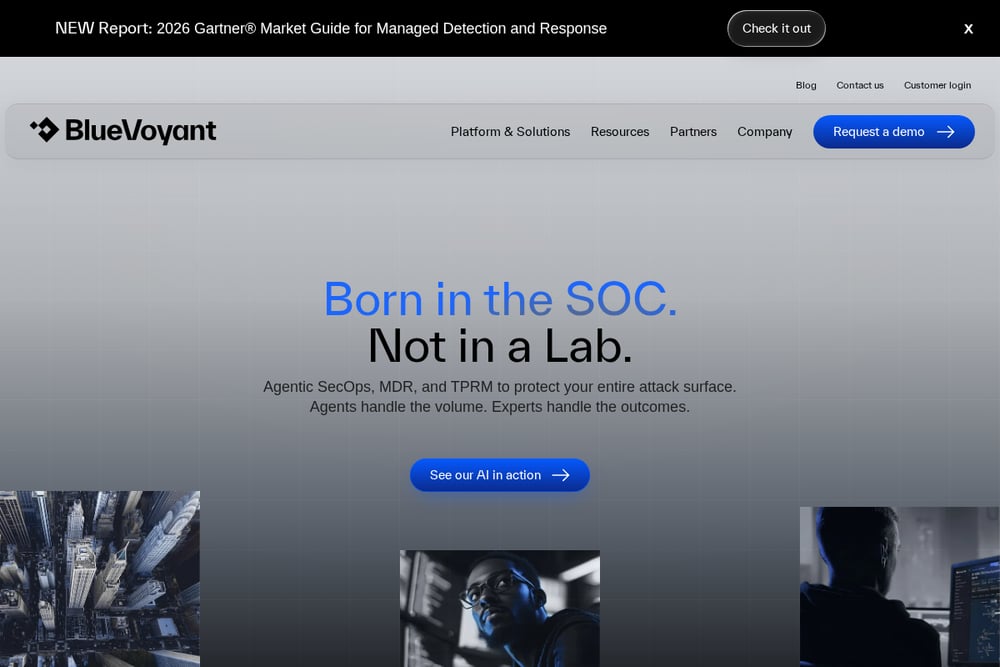 A screenshot of the BlueVoyant website.
BlueVoyant provides AI-driven cyber defense that combines external threat intelligence with internal telemetry to protect your organization. Their platform uses machine learning to detect and respond to threats across your supply chain and digital footprint. BlueVoyant's approach is heavily focused on proactive threat hunting and managed detection and response, making it a good fit for teams that want expert-led automation. The platform integrates with your existing security stack, so you can enhance your defenses without overhauling your infrastructure. If you're looking for a partner to augment your security operations with AI, BlueVoyant offers a robust solution.
How to Choose the Right Platform for Your Needs
Start by defining your operational environment—are you dealing with cyber threats, physical assets, or both? If your focus is on cyber operations, Automedon and Stellar Cyber offer strong human-guided autonomy, while SentinelOne and BlueVoyant provide broader security coverage. For physical AI, XTEND is the clear leader. Consider the level of human oversight you require: Automedon emphasizes full control, whereas others may allow more autonomous decision-making. Also, evaluate how each platform handles failure and edge cases—dynamic replanning can be a game-changer. Finally, think about integration with your existing tools and whether you need a managed service or a DIY platform.
Automation Workflow: From Intent to Execution
The typical workflow starts with you defining a high-level objective, such as 'neutralize a threat' or 'secure a perimeter.' The platform's mission planner decomposes that intent into a series of executable steps, assigning tasks to specialized agents. The orchestrator then coordinates these agents in real time, monitoring their health and performance. If an agent fails or encounters an unexpected condition, the system automatically replans and reassigns tasks, keeping you informed at every stage. You retain the ability to intervene at any moment, overriding decisions or pausing operations as needed. This human-guided loop ensures that speed and autonomy never come at the cost of accountability.
The Bottom Line
The era of black-box AI is over. The platforms in this roundup show that you can have both speed and control, whether you're defending networks or directing robots. Automedon stands out for its defense-grade orchestration with full human oversight, making it a top choice for mission-critical cyber operations. XTEND leads in physical AI, while Stellar Cyber, SentinelOne, and BlueVoyant offer robust security automation with varying degrees of human involvement. As you evaluate your options, remember that the best platform is one that aligns with your operational tempo and your team's comfort with autonomy. Choose wisely, and you'll gain a decisive edge without losing sight of the human element.