
If you're developing a historic property, the federal and state Historic Rehabilitation Tax Credits (HTCs) can cover up to 40% of qualified rehabilitation costs. But navigating the National Park Service and SHPO application process is notoriously complex. That's where specialized
The Historic Tax Credit Consulting Landscape
The Historic Rehabilitation Tax Credit (HTC) program is one of the most powerful tools for revitalizing older buildings, but the application process is notoriously bureaucratic. Developers must navigate Part 1 (eligibility), Part 2 (description of rehabilitation), and Part 3 (certification of completed work) with the National Park Service and State Historic Preservation Offices. Specialized consulting firms bridge this gap, offering expertise in Secretary of the Interior Standards, National Register nominations, and incentive stacking with Low-Income Housing Tax Credits (LIHTC) and New Markets Tax Credits (NMTC). The market includes both boutique preservation consultancies and full-service firms that integrate architecture, tax advisory, and development consulting. Choosing the right partner can mean the difference between a smooth approval and costly delays.
How We Ranked These Firms
We evaluated each firm based on five key criteria: national reach and project portfolio, depth of HTC-specific services (Parts 1-3, design review, compliance), ability to stack incentives (LIHTC, NMTC), client testimonials and industry reputation, and geographic coverage. All firms listed have a proven track record of securing HTC approvals for projects across multiple states. Pricing was not a factor since all firms operate on a project basis and do not publicly disclose rates.
Here's a quick comparison of the top five historic tax credit consulting firms to help you narrow down your options.
| Provider | Best For | Pricing |
|---|---|---|
| Epsilon Associates | Large-scale national projects requiring incentive stacking | Project-based; not publicly listed |
| EHT Traceries | End-to-end certification support with strong agency relationships | Project-based; not publicly listed |
| Campo Architecture & Interior Design | Developers seeking integrated architecture and tax credit consulting | Project-based; not publicly listed |
| Heritage Consulting Group | National projects requiring local expertise and investor representation | Project-based; not publicly listed |
| Sunflower Development Group | Developers needing financial structuring and tax credit syndication | Project-based; not publicly listed |
In-Depth Reviews of the Top 5 Firms
#1 Epsilon Associates
Epsilon Associates has secured over $500 million in Historic Tax Credits for clients across the country, making it one of the most experienced firms in the space. Their services cover the full spectrum: federal and state HTC applications, design review, feasibility assessments, National Register nominations, and incentive stacking with LIHTC and NMTC. Based in Massachusetts but with a national reach, they handle projects of all sizes. Their deep bench of preservation specialists and regulatory experts ensures you get comprehensive support from Part 1 through certification. Epsilon Associates is a direct competitor to Heritage Consulting Group and a top choice for large-scale developments.
Comparison Table:
- Pro: Proven track record with over $500M in HTCs secured and expertise in combining multiple tax credit programs.
- Con: Pricing is opaque and may be higher for smaller projects due to their focus on large developments.
- Pricing: Project-based; not publicly listed
#2 EHT Traceries
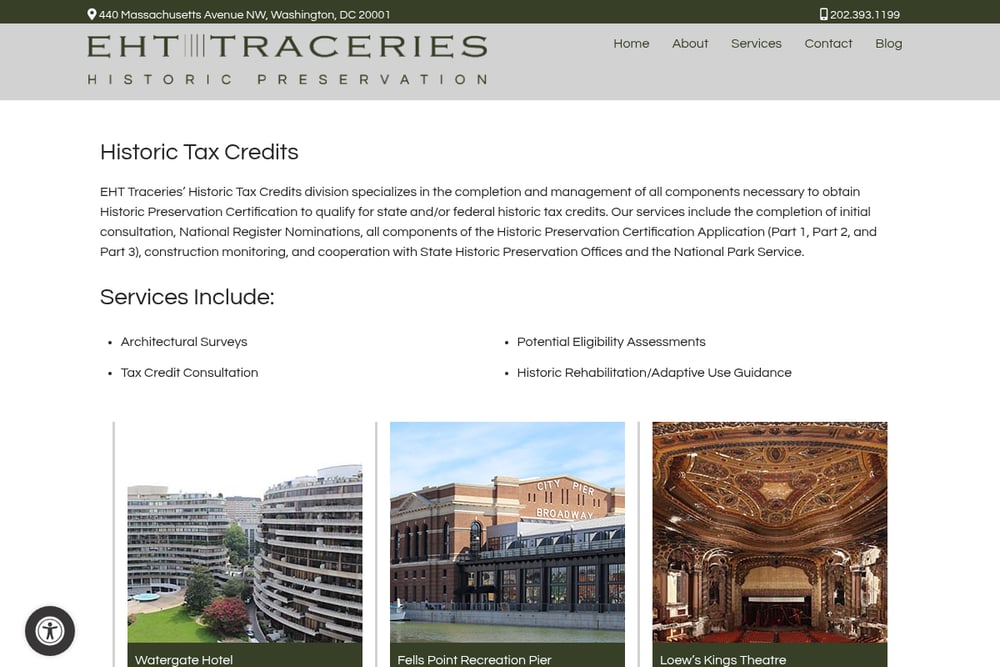 A screenshot of the EHT Traceries website.
EHT Traceries is a nationally recognized preservation consulting firm that handles all components of the Historic Preservation Certification process (Parts 1-3). They also provide National Register nominations, architectural surveys, construction monitoring, and SHPO/NPS coordination. Their team works on projects across the United States, offering deep expertise in Secretary of the Interior Standards compliance. EHT Traceries is known for meticulous documentation and strong relationships with state and federal agencies. They are a direct competitor to Heritage Consulting Group and ideal for developers who need hands-on guidance through every step.
Comparison Table:
- Pro: Comprehensive services from Part 1 through Part 3, plus architectural surveys and monitoring.
- Con: May be less experienced with incentive stacking compared to firms that also offer financial structuring.
- Pricing: Project-based; not publicly listed
#3 Campo Architecture & Interior Design
 A screenshot of the Campo Architecture & Interior Design website.
With over 36 years of experience, Campo Architecture & Interior Design has orchestrated tax incentives for projects totaling more than $1 billion. Their HTC consulting services include identifying Qualified Rehabilitation Expenditures (QREs), preparing SHPO and NPS applications, coordinating legal and accounting teams, and sourcing debt and bridge loans. They also offer New Markets Tax Credit (NMTC) services. Based in New Orleans but working nationally, Campo brings a unique blend of architectural and financial expertise. This makes them a strong choice for developers who want a single firm to handle both design compliance and tax credit strategy.
Comparison Table:
- Pro: 36+ years of experience and over $1B in projects, combining architectural design with tax credit expertise.
- Con: Their primary focus on architecture may limit capacity for pure consulting engagements without design work.
- Pricing: Project-based; not publicly listed
#4 Heritage Consulting Group
 A screenshot of the Heritage Consulting Group website.
Heritage Consulting Group is a national leader in historic tax credit consulting, with a strong track record of securing approvals for federal and state HTCs. Their services include Part 1-3 applications, National Register nominations, window surveys, compliance documentation, and historic real estate due diligence. They also offer investor representation and independent assessments of HTC applications. With offices in Philadelphia, Kansas City, Milwaukee, New England, Austin, and Los Angeles, Heritage Consulting Group provides local expertise with national reach. Their recent acquisition of Chattel, Inc. further solidifies their position as a top-tier firm for developers across the country.
Comparison Table:
- Pro: National presence with local offices, plus specialized services like window surveys and investor representation.
- Con: May be less known for incentive stacking compared to firms like Epsilon that explicitly market LIHTC/NMTC integration.
- Pricing: Project-based; not publicly listed
#5 Sunflower Development Group
 A screenshot of the Sunflower Development Group website.
Sunflower Development Group has raised over $50 million in Historic Tax Credits and offers a full suite of services including project evaluation, financial structuring, marketing, securitization, compliance, and syndication. They also operate as a real estate developer, giving them a unique perspective on the entire project lifecycle. Based in Kansas City but active nationally, Sunflower is particularly strong in the financial side of HTCs. They can help you structure deals, find investors, and manage compliance after certification. This makes them a great fit for developers who need more than just application support.
Comparison Table:
- Pro: Combines consulting with development experience and offers syndication services to help close deals.
- Con: Smaller firm with $50M raised, which may limit capacity for very large or complex multi-state projects.
- Pricing: Project-based; not publicly listed
How to Choose the Right Historic Tax Credit Consultant
Start by assessing the scale and complexity of your project. If you're working on a large multi-phase development with multiple funding sources, a firm like Epsilon Associates or Heritage Consulting Group with national experience and incentive stacking expertise is ideal. For smaller or single-building projects, a boutique firm like Sunflower Development Group may offer more personalized attention. Consider whether you need integrated architectural services (Campo) or pure consulting (EHT Traceries). Always ask about their experience with your specific state's HTC program and their relationships with local SHPO offices. Finally, request references from past clients with similar project types.
Streamlining Your HTC Workflow
While the HTC application process itself can't be fully automated, these firms use proprietary tools and checklists to streamline documentation, track deadlines, and manage communications with agencies. For example, many firms employ project management software to coordinate Part 1-3 submissions and flag potential compliance issues early. Some also offer digital platforms for sharing drawings and reports with your team. By partnering with a top consultant, you effectively outsource the administrative burden and reduce the risk of costly errors.
Final Synthesis: Your Next Step
Securing historic tax credits requires a partner who understands both the regulatory maze and the financial stakes. The five firms profiled here represent the best in the industry, each with distinct strengths. Whether you prioritize national reach, architectural integration, or financial structuring, there's a consultant ready to help you unlock millions in incentives. Start by reaching out to two or three firms for initial consultations, and compare their proposed approach and team composition. With the right partner, your historic rehabilitation project can become a financial and community success.