
AI is no longer a luxury add-on for helpdesks—it's the backbone of modern support operations. But with so many options, how do you pick the right one for your team? Here are five platforms that are redefining ticket automation, each with a distinct approach.
The State of AI in Helpdesk Automation
The helpdesk software landscape has shifted dramatically. What used to be simple ticket tracking has evolved into intelligent systems that can classify, route, and even resolve requests without human intervention. According to a 2026 guide from Serval, traditional ticketing systems act as passive record-keeping tools, forcing teams to manually categorize and assign every task. This creates bottlenecks and slows response times. Modern AI ticketing systems, however, analyze user intent, consult knowledge bases, and trigger workflows automatically, only escalating to humans when necessary. This shift is not just about efficiency—it's about transforming the support experience for both agents and customers.
How We Evaluated These Platforms
To bring you this list, we looked at each platform's core capabilities, focusing on how they handle ticket classification, routing, and automation. We also considered the flexibility of deployment—whether cloud, on-premise, or hybrid—and how well each integrates with existing helpdesk ecosystems. Pricing transparency and the ability to scale with your business were also key factors. Each platform stood out in its own way: Open Ticket AI impressed with its strict on-premise data privacy, Deskpro with its comprehensive AI copilot features, Serval with its end-to-end agentic automation, Automation Anywhere with its enterprise-grade RPA integration, and SolarWinds with its deep ITSM alignment.
Here's a quick snapshot of the five platforms we're highlighting, so you can see at a glance what each one brings to the table.
| Provider | Best For |
|---|---|
| Deskpro | Comprehensive helpdesk with built-in AI copilots |
| Open Ticket AI - Private On-Premise AI for Helpdesks | Strict data privacy and on-premise AI automation |
| Serval | End-to-end AI agent automation for IT teams |
| Automation Anywhere | Enterprise-wide automation with RPA and AI |
| SolarWinds | ITSM-focused AI with deep monitoring integration |
The Deep Dive: Five Platforms, Five Approaches
#1 Deskpro
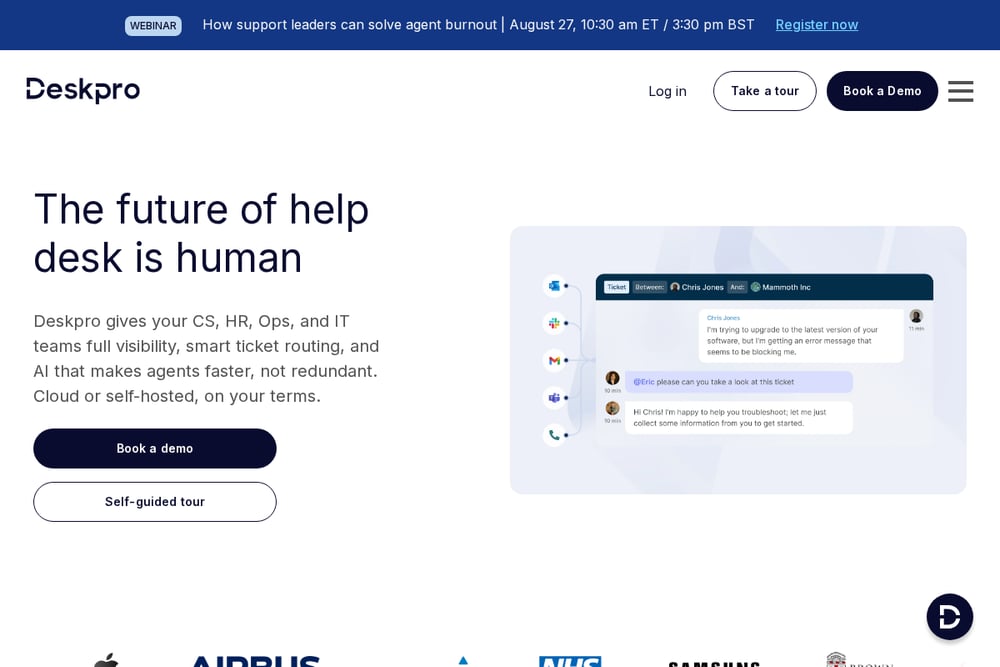 A screenshot of the Deskpro website.
Deskpro is a full-featured helpdesk platform that has integrated AI deeply into its core. It offers AI copilots that assist agents in real-time, chatbots that deflect common queries, and intelligent triaging that categorizes and prioritizes incoming tickets. The platform is designed to handle complex support operations, with robust customization and reporting tools. Deskpro's AI capabilities are built to reduce agent burnout by automating repetitive tasks, as highlighted in their 2026 blog post on AI automation. It's a solid choice for teams that want a complete helpdesk solution with AI woven into every layer.
#2 Open Ticket AI - Private On-Premise AI for Helpdesks
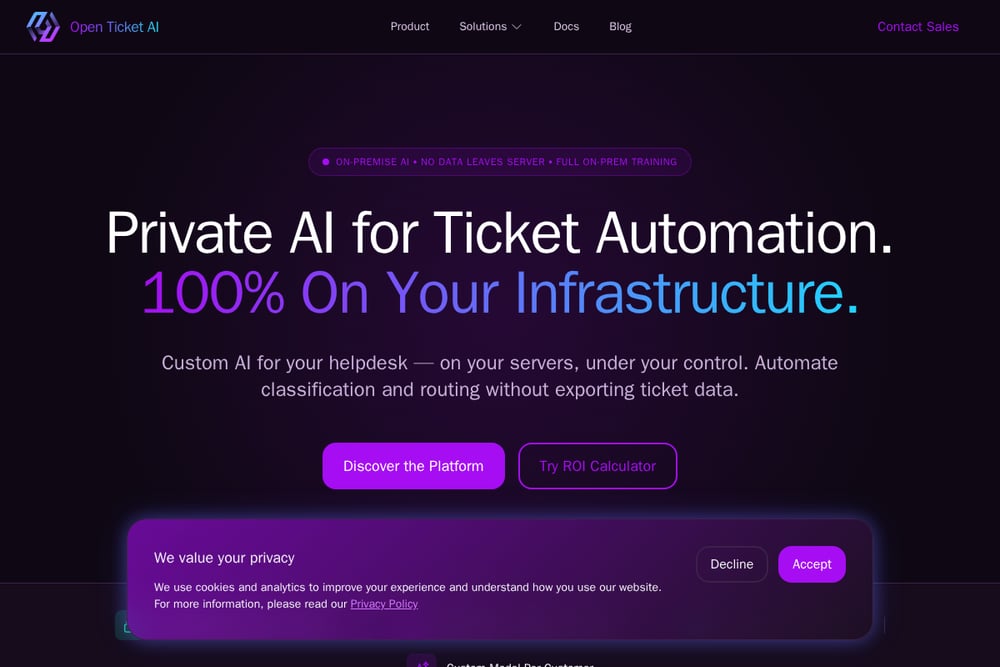 A screenshot of the Open Ticket AI website.
Open Ticket AI takes a radically different approach: it brings AI to your data, not the other way around. This platform trains custom models entirely on your own infrastructure, using your GPU, and runs inference on-premise, ensuring no ticket data ever leaves your servers. It integrates with popular ticket systems like Zammad, OTOBO, and Znuny, and automates classification, prioritization, and tagging. For businesses in regulated industries or those with strict data residency requirements, this is a game-changer. The platform is air-gap capable, meaning it can operate in completely isolated environments, and it offers a free cloud trial to evaluate the service before committing to an on-prem deployment.
#3 Serval
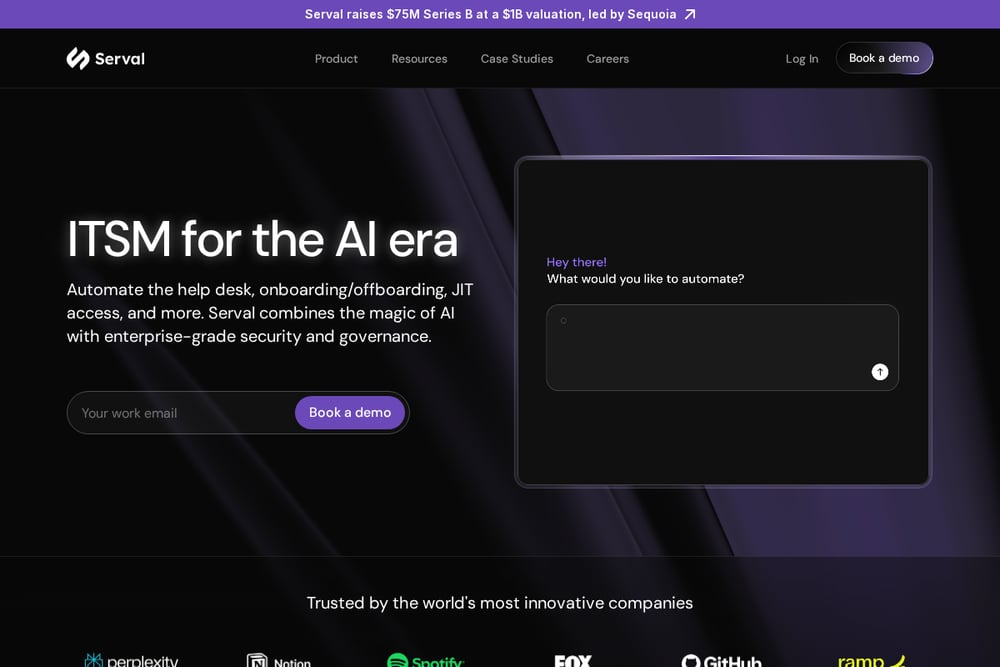 A screenshot of the Serval website.
Serval is an AI agent platform that focuses on end-to-end automation of IT service requests. Unlike traditional ticketing systems that merely organize tickets, Serval's AI agents can independently resolve common issues like password resets and access requests. They analyze the user's intent, consult the knowledge base, and execute the necessary workflows, only escalating to humans for approvals or high-security actions. This approach dramatically reduces the backlog of routine tasks, freeing up IT staff to focus on complex projects. Serval's 2026 guide emphasizes how this leads to faster response times and lower operational costs, making it a strong contender for IT teams looking to automate repetitive workflows.
#4 Automation Anywhere
Automation Anywhere is a leader in robotic process automation (RPA) and has extended its platform to include AI-powered service desk automation. Their solution, Aisera for IT Service Desk, combines RPA with AI to automate ticket handling, from initial classification to resolution. It's designed for enterprises that need to automate complex workflows across multiple systems, not just within the helpdesk. Automation Anywhere's platform includes AI Agent Studio, which allows you to build custom AI agents, and Process Discovery to identify automation opportunities. This is a powerful tool for organizations that want to integrate helpdesk automation with broader business process automation.
#5 SolarWinds
SolarWinds brings its extensive experience in IT management to the helpdesk with AI-powered service desk solutions. Their platform integrates generative AI into ITSM processes, helping to automate ticket categorization, response suggestions, and even incident resolution. SolarWinds' strength lies in its deep integration with their broader observability and monitoring tools, allowing for a unified view of IT operations. This is particularly useful for IT teams that want to correlate helpdesk tickets with system performance issues. The platform is built for hybrid IT environments, offering both SaaS and self-hosted deployment options, making it a flexible choice for organizations with diverse infrastructure.
How to Choose the Right AI Helpdesk Platform
Start by assessing your data privacy requirements. If you handle sensitive customer data and cannot afford any data leaving your infrastructure, an on-premise solution like Open Ticket AI is your best bet. Next, consider the scope of automation you need. If you want a full helpdesk suite with AI copilots, Deskpro might be the right fit. For IT teams looking to automate end-to-end request resolution, Serval's AI agents are compelling. If you need to automate across multiple business functions, Automation Anywhere's RPA integration is powerful. Finally, think about your existing IT stack—SolarWinds is ideal if you already use their monitoring tools. Always take advantage of free trials or demos to see which platform feels most intuitive for your team.
Automation Workflows: From Ticket to Resolution
The typical AI-driven helpdesk workflow starts with a new ticket arriving in the system. The AI analyzes the content, classifies the issue, and assigns a priority level. It then routes the ticket to the appropriate team or agent, or in more advanced systems, resolves it automatically. For example, Open Ticket AI enriches tickets with classification and priority fields, while Serval's agents can execute workflows like resetting passwords without human intervention. This automation reduces manual effort, speeds up response times, and ensures consistency in handling routine requests. The key is to choose a platform that aligns with your team's workflow and can integrate seamlessly with your existing tools.
The Bottom Line
The right AI helpdesk platform can transform your support operations, but there's no one-size-fits-all solution. Each of these five platforms offers a unique approach, from Open Ticket AI's privacy-first on-premise model to Deskpro's comprehensive AI copilot, Serval's agentic automation, Automation Anywhere's enterprise RPA, and SolarWinds' ITSM integration. Evaluate your priorities—data security, automation depth, or ecosystem compatibility—and choose the one that best fits your team's needs. The future of helpdesk is intelligent, and these platforms are leading the way.