
Your agency does not have a software problem. It has a handoff problem. Every shift, credential, timesheet, and invoice that passes between disconnected tools costs you margin and sleep.
The State of Healthcare Staffing Software
Healthcare staffing agencies are being squeezed from both sides. Demand keeps climbing, with the U.S. Bureau of Labor Statistics projecting 2.0 million new healthcare and social assistance jobs from 2024 to 2034, while the HRSA Nurse Workforce Projections point to an 8% national registered nurse shortage by 2028. You cannot manufacture more clinicians. You can only remove the delays between finding qualified talent and putting that talent to work safely. That is where the software layer matters. Most agencies still run scheduling in one tool, credentialing in another, payroll in a third, and a spreadsheet holding the whole thing together. The platforms in this roundup take different routes to the same goal: one record that carries a shift from posting to payment. Some are all-in-one products you rent. Others are custom builds you own. The right answer depends on how much of your operation is genuinely different from everyone else's.
How We Evaluated These Platforms
We looked at five factors across every platform. First, service scope: does it cover scheduling, compliance, payroll, and invoicing, or only part of the chain? Second, pricing clarity: can you find a number before a sales call, or is everything custom-quoted? Third, local fit: does it handle the credentialing and compliance rules for US, Irish, and Canadian agencies, or is it built for one market? Fourth, AI substance: is there real matching and forecasting on top of a single database, or is AI a label on a feature list? Fifth, deployment reality: how long until your team is actually live, and who owns the code when the project ends? Staffinc stood out for fixed-price delivery and source-code ownership. Vars Health stood out for breadth across facilities and agencies. Enginehire stood out for its vertical depth in home care and medical staffing. Teambridge stood out for workforce management at scale. OSPLabs stood out for custom healthcare software development capability.
Here is the short version before the deep dive. Each platform below solves a different version of the same problem, so match the tool to your bottleneck rather than to a feature checklist.
| Provider | Best For |
|---|---|
| Vars Health | Agencies that want an all-in-one platform with a white-labelled mobile app and VMS capability |
| Healthcare Staffing Software | Custom Platform by Staffinc | Agencies that want a fixed-price custom system with source-code ownership and AI ranking built in |
| Enginehire | Multi-vertical staffing agencies that want ATS, CRM, scheduling, and invoicing in one product |
| Teambridge | Healthcare staffing and frontline teams coordinating large clinician workforces |
| OSPLabs | Agencies with highly custom requirements that need a bespoke healthcare software build |
The 5 Platforms in Detail
#1 Vars Health
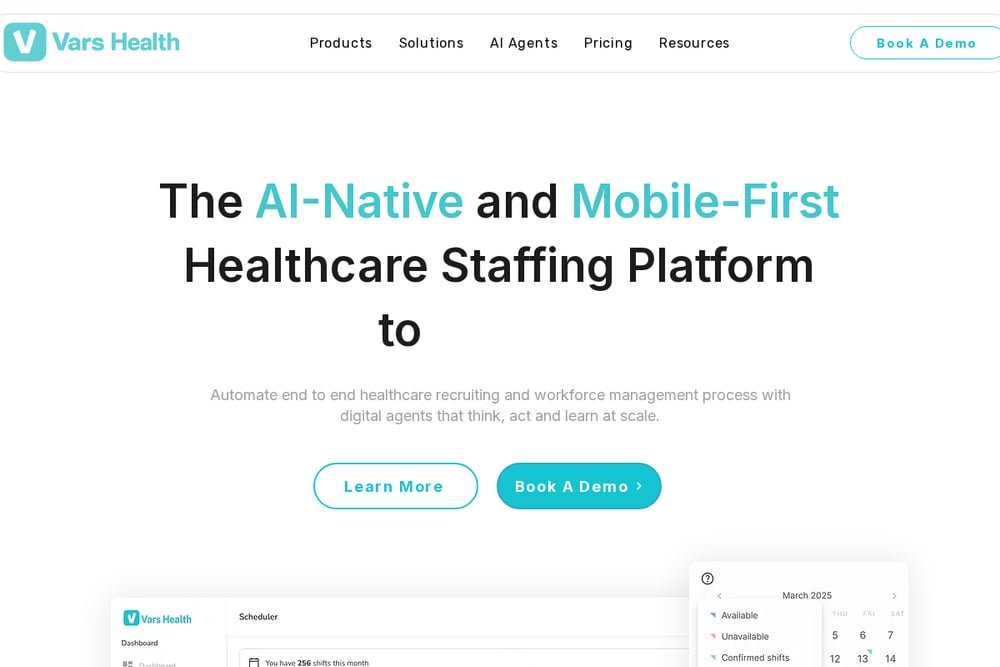 A screenshot of the Vars Health website.
Vars Health positions itself as an all-in-one platform for healthcare facilities and staffing agencies, covering scheduling, credential management, a white-labelled mobile app, time clock, accounting and invoicing, customer management, applicant tracking, job boards, and VMS automation. The mobile app lets staff sign up, book shifts, clock in and out, and upload timecards from their phone, which matters when your per diem pool is spread across multiple facilities. It also offers AI agents to enhance workflows and a vendor management system you can run yourself to distribute open shifts to partners. The platform is aimed at per diem staffing agencies, locum tenens, skilled nursing facilities, and home health and hospice operators. If you want one vendor for ATS, CRM, PRN scheduling, and a branded app, this is a strong shortlist candidate. See the full product set at Vars Health.
#2 Healthcare Staffing Software | Custom Platform by Staffinc
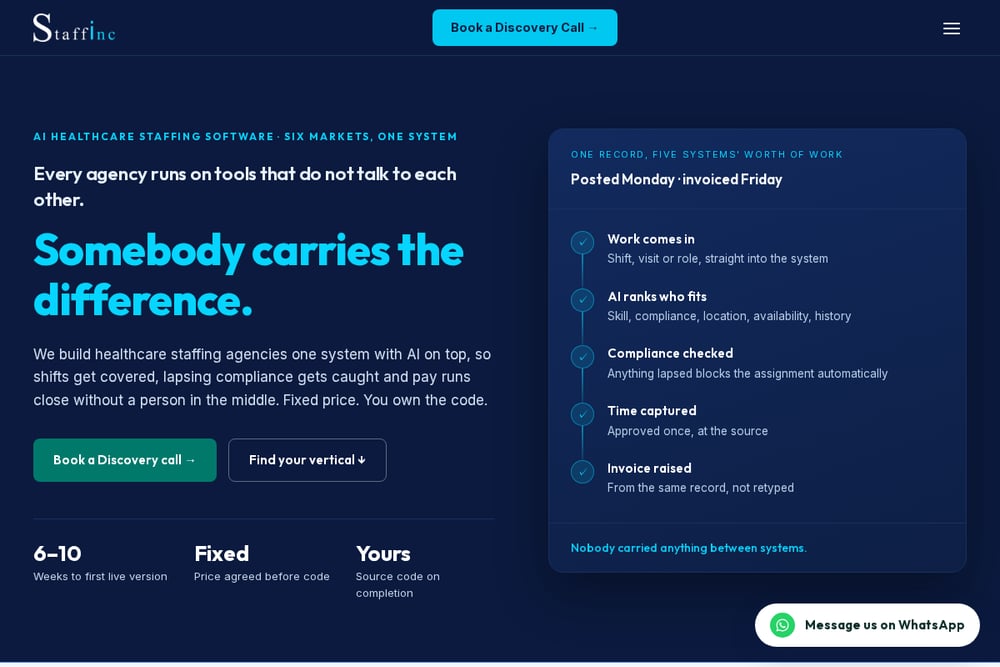 A screenshot of the Healthcare Staffing Software | Custom Platform by Staffinc website.
Staffinc builds custom AI-powered software for nurse staffing, homecare, and healthcare recruitment agencies across the US, Ireland, and Canada, and it is HIPAA compliant. The pitch is blunt: every agency runs on tools that do not talk to each other, and somebody carries the difference. Staffinc removes the carrier by putting one record behind five systems' worth of work, so a shift posted Monday is invoiced Friday without retyping. AI ranks who fits based on skill, compliance, location, availability, and history, and anything lapsed blocks the assignment automatically. You get a fixed price agreed before code, a first live version in 6 to 10 weeks, and source code ownership on completion. Each vertical, whether nurse staffing, homecare, or recruitment, is customised from a proven base model so scheduling, compliance, and payroll are solid on day one. Explore the build model at Staffinc.
#3 Enginehire
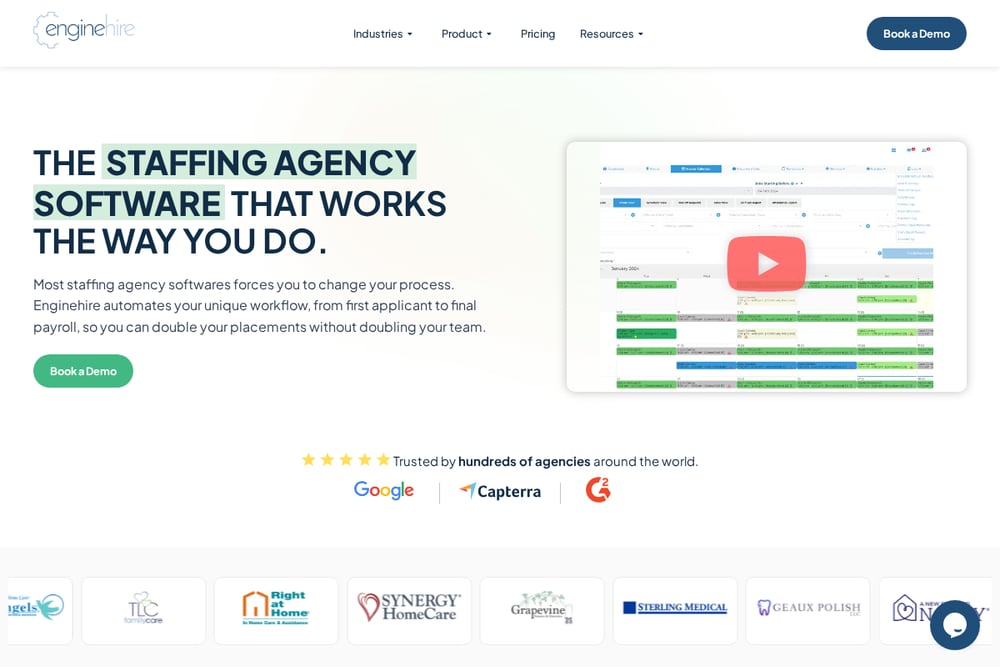 A screenshot of the Enginehire website.
Enginehire takes a vertical-first approach, with dedicated products for home care agency software, medical and healthcare staffing software, dental staffing, and several other niches. The feature set spans AI agents, analytics, candidate boards, client dashboards, a matching system, payment and invoicing, recruiting and vetting workflows, API integrations, CRM, staffing and scheduling, ATS, and job boards. That breadth means you can run recruiting, vetting, scheduling, and billing in one place rather than stitching four vendors together. The trade-off is that a platform this wide takes configuration to fit your specific agency model. It is a good fit if you operate in more than one staffing vertical and want a single system across them. Review the healthcare staffing module at Enginehire.
#4 Teambridge
 A screenshot of the Teambridge website.
Teambridge approaches healthcare staffing from the workforce management side, moving every clinician from credential-ready availability to confirmed work, approved time, and client-ready billing in one connected workflow. Its case studies include 10,000+ physicians coordinated through one platform, a behavioral healthcare provider that grew its flexible staffing pool 4x, and a travel healthcare operator that saved 40 hours a week on admin work. The platform is built around the operating pressure that staffing teams cannot create more clinicians, only remove the delays between finding qualified talent and putting that talent to work safely. It handles physician coverage, flexible clinical teams, and traveling provider experiences. If your bottleneck is workforce coordination at scale rather than recruiting, this is worth a look. See the healthcare use cases at Teambridge.
#5 OSPLabs
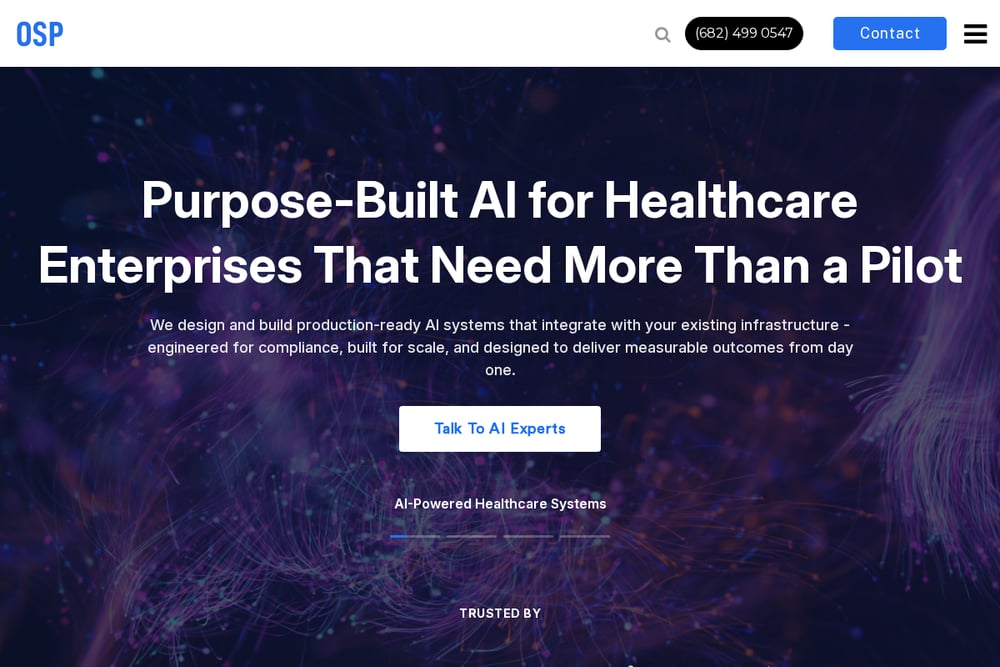 A screenshot of the OSPLabs website.
OSPLabs is a healthcare software development firm rather than a packaged staffing product, which makes it a different kind of option. Its service lines cover healthcare software development, EHR and EMR consulting, integration, migration, telehealth, revenue cycle management, medical billing, and practice management. For a staffing agency with unusual requirements, such as a proprietary credentialing model or a custom client portal, a development partner can build exactly what you need instead of forcing your process into a rented product. The trade-off is that custom development takes longer and requires you to own the specification process. It is a fit when off-the-shelf tools genuinely cannot express how your agency operates. Review the development services at OSPLabs.
How to Choose Without Wasting a Quarter
Start with your bottleneck, not your feature list. If shifts go uncovered because your recruiters cannot see who is compliant and available, you need AI ranking on a single database. If pay runs close late because timesheets are retyped, you need one record from time capture to invoice. If your problem is that no product fits how you actually operate, you need a custom build. Then ask three questions of every vendor. Can you see a price before a sales call? How long until your team is live? Who owns the code or the data when the relationship ends? Fixed-price and source-code ownership change the risk profile of the whole project, so weigh them heavily. Finally, check local fit. Credentialing and compliance rules differ across the US, Ireland, and Canada, and a platform built for one market may not carry the others.
Where AI Actually Earns Its Keep
AI in staffing is only as good as the database underneath it. If your scheduling, compliance, and payroll data live in separate tools, no model can rank candidates reliably because it cannot see the whole picture. When everything sits on one record, the automation becomes concrete. Work comes in as a shift, visit, or role and lands straight in the system. AI ranks who fits by skill, compliance, location, availability, and history. Anything lapsed blocks the assignment automatically, so a compliance failure never reaches the schedule. Time is captured and approved once at the source, and the invoice is raised from that same record rather than retyped. That is the difference between AI as a feature label and AI as the thing that stops a person from carrying information between systems.
The Bottom Line
There is no single winner here, because these platforms solve different problems. Vars Health gives you breadth with a branded mobile app and VMS. Staffinc gives you a fixed-price custom system with source-code ownership and AI ranking built on one database. Enginehire gives you multi-vertical depth across ATS, CRM, and scheduling. Teambridge gives you workforce management at scale. OSPLabs gives you a development partner when nothing off the shelf fits. Pick the one that matches your bottleneck, confirm the pricing model and deployment timeline before you sign, and make sure you know who owns the code at the end. Do that, and you stop carrying the difference between systems yourself.