
If your practice is still juggling card terminals, manual reconciliation, and sky-high merchant fees, it's time to rethink how you get paid. These five platforms are built to help you collect more at the point of care—without adding chaos to your front desk.
The State of Healthcare Payments in 2026
Patient financial responsibility keeps climbing, and so does the pressure on providers to collect efficiently. Generic payment processors weren't designed for the complexities of healthcare—think HSA/FSA cards, high transaction volumes, and strict HIPAA rules. That's why specialized platforms are stepping in, offering EHR-integrated solutions that cut fees and streamline the entire payment journey. Whether you run a small clinic or a large hospital system, the right payment partner can mean the difference between a healthy revenue cycle and a leaky one.
How We Evaluated These Platforms
We looked at each solution through the lens of a busy practice manager: Does it integrate with the EHR you already use? Does it support multiple payment methods, from card-present to online links? Is it HIPAA compliant and secure? And crucially, does it help you collect more at the point of care while reducing the administrative burden on your staff? We also considered pricing transparency and how well each platform fits different practice sizes and specialties.
Here's a quick snapshot of the five platforms we're diving into, so you can see at a glance what each one brings to the table.
| Provider | Best For |
|---|---|
| TrustCommerce Healthcare Payment Solutions | Large practices and health systems needing a secure, omni-channel payment platform |
| Better Day Payments — Payment processing built for healthcare | Healthcare providers wanting to cut card fees and streamline point-of-care collections |
| OSPLabs Healthcare Payment System | Practices seeking a fully customized payment and revenue cycle management solution |
| Weave Healthcare Payment Processing | Small to mid-sized practices wanting a simple, integrated payment and communication platform |
| DrChrono Integrated Medical Billing | Primary care and behavioral health practices wanting an all-in-one EHR and billing solution |
The Five Platforms, Up Close
#1 TrustCommerce Healthcare Payment Solutions
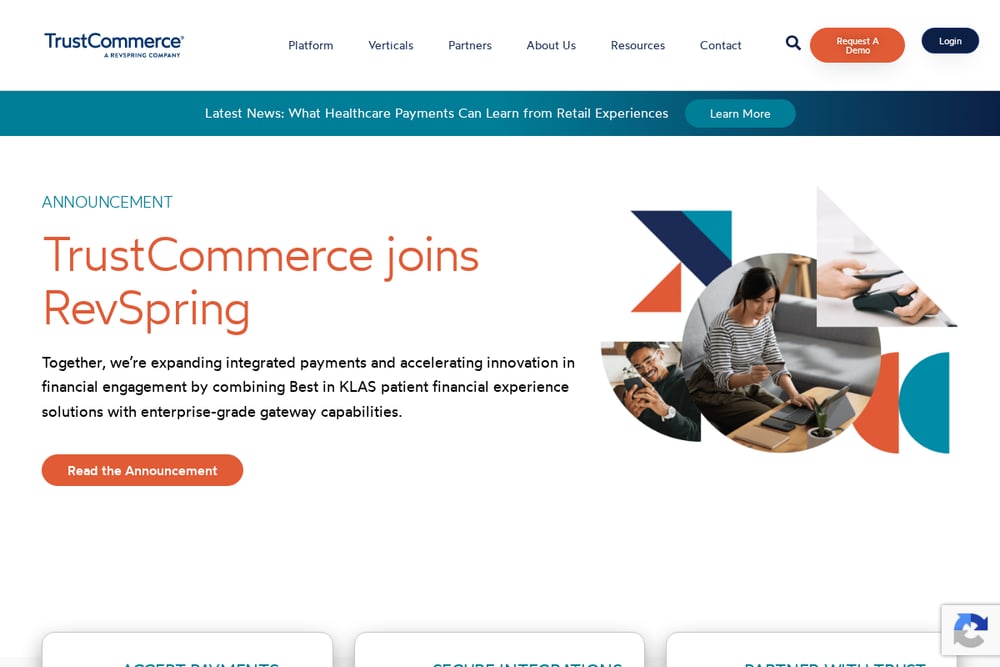 A screenshot of the TrustCommerce Healthcare Payment Solutions website.
TrustCommerce is a heavyweight in healthcare payments, offering a centralized platform that integrates with major EHRs like Epic, Veradigm, and athenahealth. Their proprietary gateway and applications give you a truly omni-channel experience, so patients can pay however they prefer—touch-free, online, or in person. They emphasize elite-level security with tokenization and validated P2PE, which is a huge plus for HIPAA compliance. If you're a larger practice or health system that needs a robust, scalable solution, TrustCommerce is built for you. Their focus on patient engagement means you can improve the payment experience without adding complexity for your staff.
#2 Better Day Payments — Payment processing built for healthcare
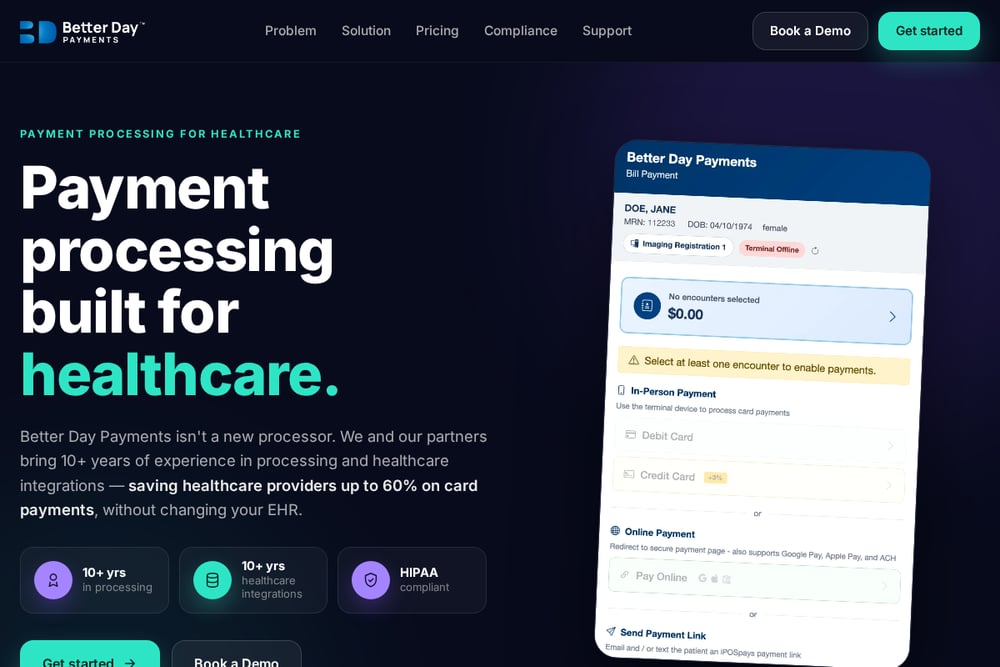 A screenshot of the Better Day Payments website.
Better Day Payments isn't a new processor—they bring 25+ years of experience and $4B+ in processing volume to the table, and they're laser-focused on healthcare. Their platform integrates directly with your EHR via HL7/FHIR, so you can accept card-present, online, and link-based payments without changing your workflow. They claim to save providers up to 60% on card fees, which is a game-changer for practices bleeding money on every transaction. Plus, they support Apple Pay, Google Pay, ACH, and HSA/FSA, and they automate reconciliation so your staff can stop re-keying payments. If you want to collect more at the point of care and pay less on every card, this is the solution to watch.
#3 OSPLabs Healthcare Payment System
 A screenshot of the OSPLabs Healthcare Payment System website.
OSPLabs offers a customized healthcare payment system that's part of a broader suite of revenue cycle management tools. They're not just about payments—they also provide denial management, claim analytics, and AI-driven engines to optimize your entire revenue cycle. Their payment system is designed to integrate seamlessly with your existing EHR, and they have deep expertise in Epic and other major platforms. If you're looking for a partner that can handle both payments and the broader billing ecosystem, OSPLabs is a strong contender. They're particularly well-suited for practices that want a tailored solution rather than a one-size-fits-all product.
#4 Weave Healthcare Payment Processing
 A screenshot of the Weave Healthcare Payment Processing website.
Weave is known for its all-in-one patient communication platform, and its payment processing is built to complement that. It's designed for small and mid-sized practices that want to modernize how they collect payments without a huge IT lift. Weave supports online, contactless, and mobile payments, and it integrates with your EHR to keep everything in sync. The platform also includes features like automated billing and collections, which can help you get paid faster. If you're a smaller practice looking for a user-friendly, patient-centric payment solution, Weave is a solid choice.
#5 DrChrono Integrated Medical Billing
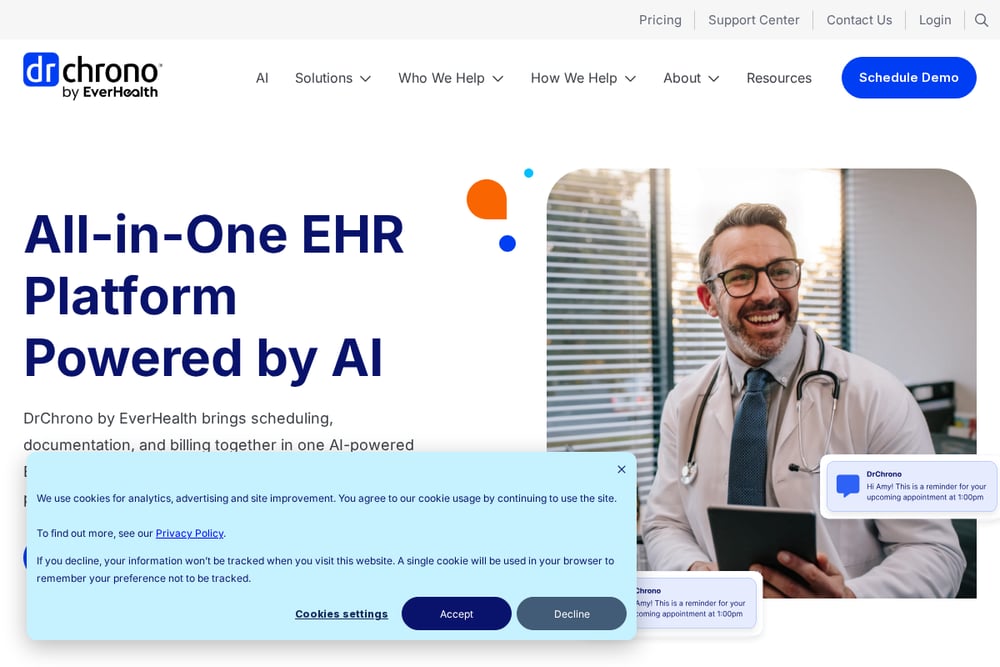 A screenshot of the DrChrono Integrated Medical Billing website.
DrChrono is an EHR and practice management platform that includes integrated medical billing as a core feature. Their approach is to embed billing directly into the EHR workflow, reducing errors and denials by automating the process. They offer a patient portal, telehealth, and revenue cycle management tools, making it a comprehensive solution for practices that want everything in one place. DrChrono is particularly strong for primary care and behavioral health practices, with specialty-specific features. If you're looking to replace multiple systems with a single, integrated platform, DrChrono is worth a look.
How to Choose the Right Payment Platform for Your Practice
Start by looking at your current pain points: Are you losing money on card fees? Is your staff spending hours on manual reconciliation? Do patients leave without paying because the checkout process is clunky? Then, consider your EHR—make sure the platform integrates with the system you already use, whether that's Epic, Oracle, or something else. Think about the payment methods your patients expect, from Apple Pay to HSA/FSA, and whether the platform supports them out of the box. Finally, weigh the cost: some platforms charge lower per-transaction fees but may have higher upfront costs, so calculate your total cost of ownership. And don't forget to ask about HIPAA compliance and security features like tokenization.
Automating Your Payment Workflow
The best platforms automate the entire payment journey: from the moment a patient checks in, the system pulls the encounter details from your EHR, calculates the patient's responsibility, and presents a payment option—whether that's a terminal at the desk, a secure online link, or a text message. Once the payment is made, it automatically posts back to your EHR and reconciles with your end-of-day reports. This eliminates manual re-keying, reduces errors, and speeds up your revenue cycle. Look for platforms that offer automatic reconciliation and real-time reporting, so you always know where your money is.
The Bottom Line
Healthcare payment processing is no longer a back-office afterthought—it's a critical part of your revenue cycle and patient experience. Whether you're a small practice or a large health system, there's a platform on this list that can help you collect more, pay less, and streamline your operations. The key is to find one that fits your specific needs, integrates with your EHR, and doesn't add complexity to your staff's day. Take the time to evaluate your options, and you'll be well on your way to a healthier bottom line.