
Getting past Google Play's 14-day closed testing rule shouldn't feel like a guessing game. These five services help you line up real testers, keep them engaged, and walk into production access with confidence.
Why Closed Testing Became a Make-or-Break Step
If you registered a personal Google Play developer account after November 2023, you can't just publish to production. Google requires a closed test with at least 12 testers for 14 consecutive days before you can even apply for production access. That single policy reshaped the Android launch playbook overnight.
The problem? Most solo developers don't have 12 friends willing to install an app, open it daily, and stay opted in for two full weeks. Testers drop off. Retention flatlines. Telemetry looks thin. And when you finally submit the production access questionnaire, Google's reviewers can tell the difference between a real test and a rushed one.
That's where specialized services come in. They coordinate verified human testers on physical Android devices, track opt-in retention, and help you assemble reviewer-ready documentation. Some lean on speed. Others lean on advisory depth. The right fit depends on how much hand-holding you want and how close you are to submission.
How We Evaluated These Services
We looked at service scope first. Some providers focus narrowly on tester coordination, while others bundle account setup, D-U-N-S guidance, rejection recovery, and store listing support into one engagement. Broader scope matters if you're starting from scratch.
Pricing clarity came next. Transparent per-app pricing with no hidden fees makes budgeting easier, especially when you're comparing a $15 flat rate against a consultative engagement. We also weighed tester quality and retention mechanics. Verified human testers on physical devices, continuous opt-in tracking, and authentic Play Services telemetry all signal a more legitimate testing cohort.
Finally, we considered local fit and policy alignment. US-based developers often want a service that understands Google Play's 2026 policy language, responds within a reasonable SLA, and provides documentation that holds up under reviewer scrutiny. Each service below stood out on a different combination of these factors.
Here's a quick look at how these five services compare on scope, pricing model, and the type of developer they serve best.
| Provider | Best For |
|---|---|
| Testers Community | Developers who want fast tester onboarding and a live progress dashboard |
| Google Play 14-Day Closed Testing Assistance & Production Access Guidance | Developers who want testing plus full production access advisory |
| Fast Testers | Budget-conscious developers who want a no-frills testing service |
| AppTesterHub | Cross-platform developers who want stack-specific testing and a policy audit |
| App Hive | Developers who want to learn the process before hiring a service |
The 5 Services in Focus
#1 Testers Community
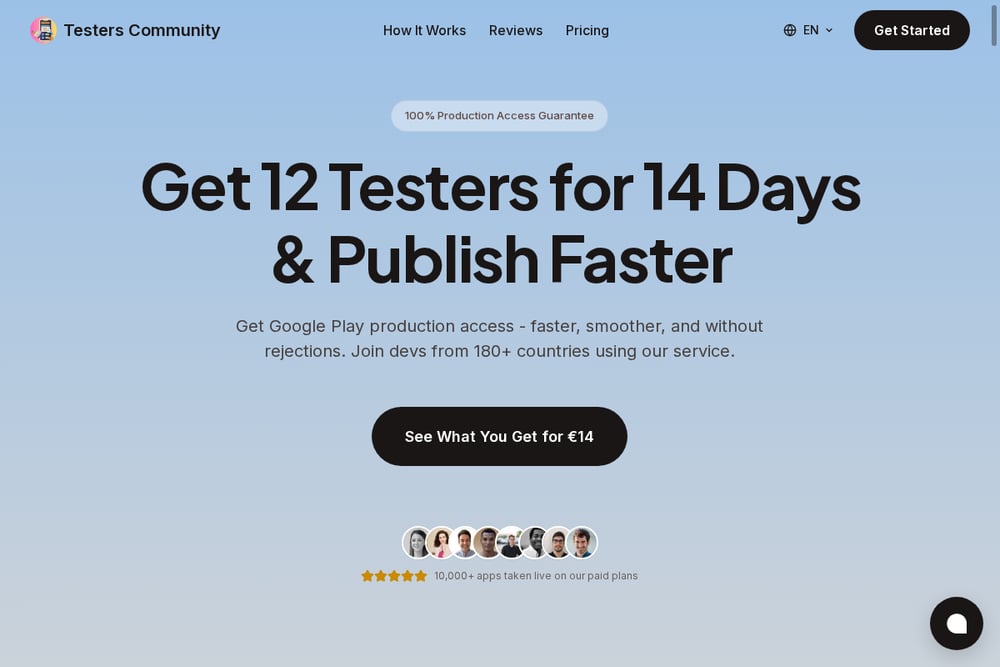 A screenshot of the Testers Community website.
Testers Community positions itself as a high-volume testing service with a live dashboard that shows your 14-day progress, active testers, and feedback reports in real time. The platform claims over 10,000 apps published and a 99.9% success rate, with testers starting within six hours on the Starter plan. Pricing is straightforward at €14 per app for 15 Android testers, and the Pro tier adds more testers and reports. If you want speed and a production access guarantee backed by a money-back promise, this is a strong fit. The dashboard transparency is a nice touch for developers who like to watch the numbers move.
#2 Google Play 14-Day Closed Testing Assistance & Production Access Guidance
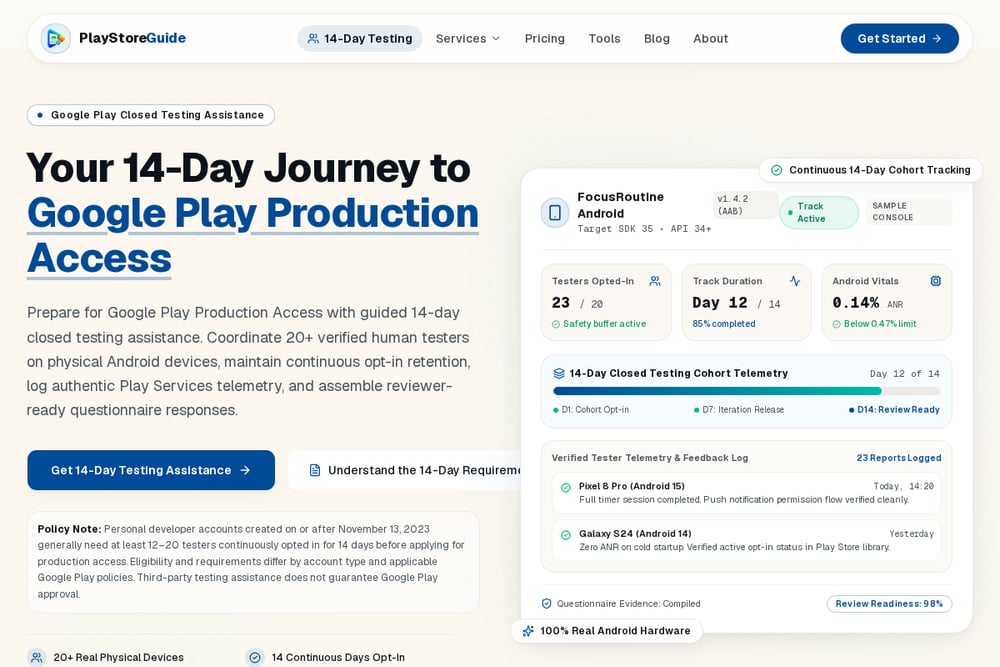 A screenshot of the Google Play 14-Day Closed Testing Assistance & Production Access Guidance website.
PlayStoreGuide is an independent technical consultancy, not just a tester marketplace. It coordinates 20+ verified human testers on physical Android devices, maintains continuous opt-in retention, and logs authentic Play Services telemetry throughout your 14-day cohort. What sets it apart is the advisory layer: account setup and D-U-N-S guidance, production access questionnaire preparation, rejection recovery, and store listing support all sit under one roof. The service explicitly aligns with Google Play 2026 policy language and provides reviewer-ready documentation. If you want a partner who understands the compliance side as deeply as the testing mechanics, this is the one to call.
#3 Fast Testers
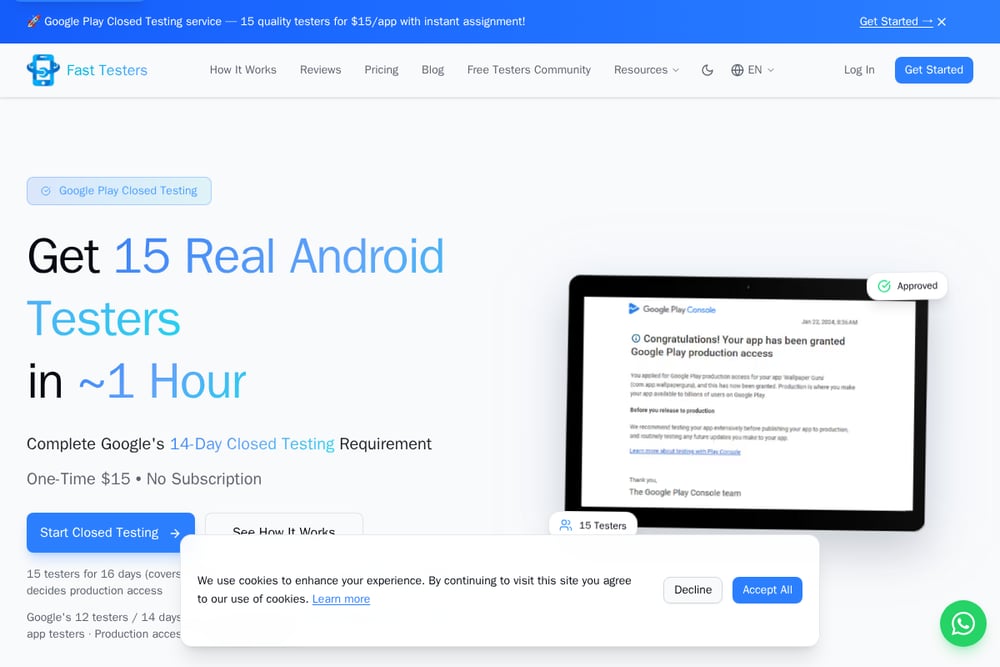 A screenshot of the Fast Testers website.
Fast Testers keeps things simple: 15 testers for 16 days for $15, with a refund policy attached. The company is operated by Hassil LLC and publishes a detailed closed testing guide that walks through the 12-tester rule, the 14-day timeline, and common rejection reasons. That educational content is genuinely useful if you're new to the process and want to understand what Google actually checks. The service itself is lean and transactional, which suits developers who already know the drill and just need reliable testers. Support responds within one to two business days.
#4 AppTesterHub
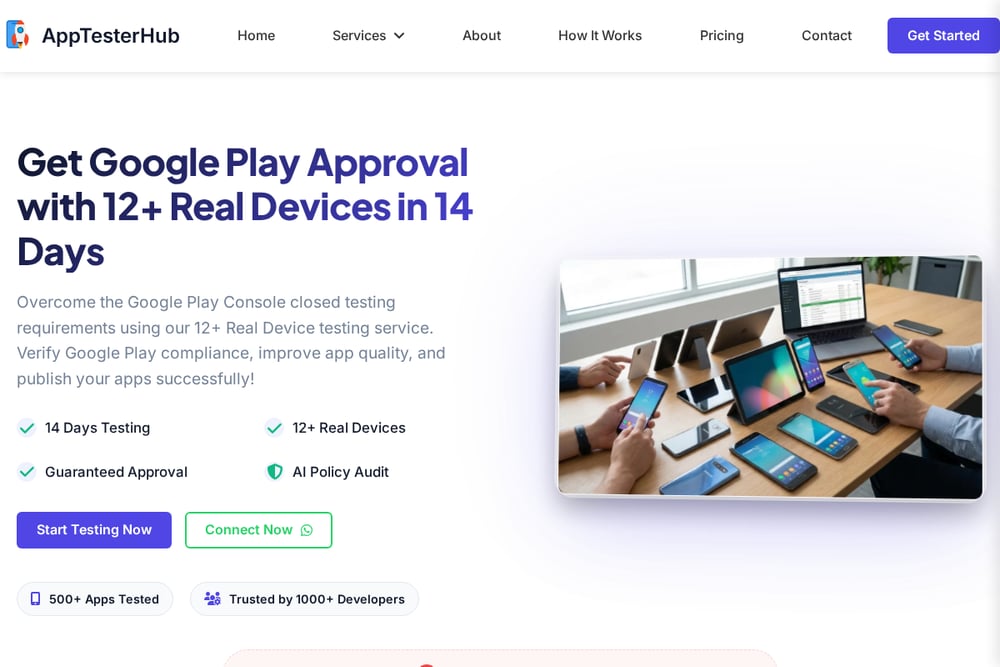 A screenshot of the AppTesterHub website.
AppTesterHub offers 12+ real devices over 14 days with a guaranteed approval promise and an AI policy audit included. The service covers a range of tech stacks including Flutter, React Native, Kotlin, Java, and hybrid frameworks like Ionic and Capacitor, which makes it a good match if your app uses a specific cross-platform toolchain. The team behind it comes from app development and QA backgrounds, so the testing approach leans technical. With 500+ apps tested and a video tutorial for setup, it's approachable for first-timers. The AI policy audit adds a useful pre-submission check.
#5 App Hive
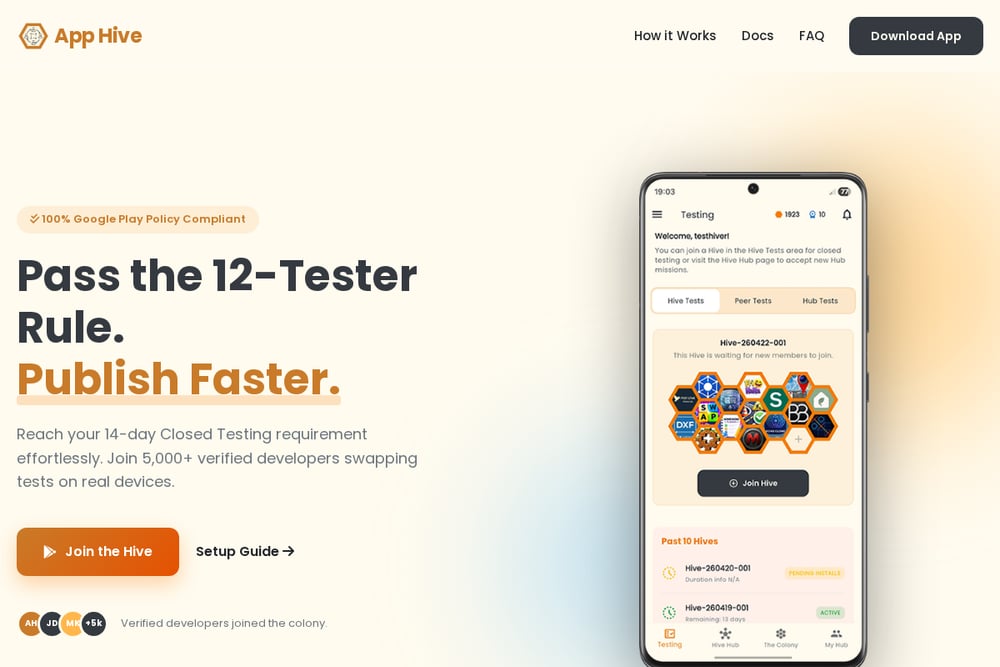 A screenshot of the App Hive website.
App Hive approaches closed testing from an educational angle, publishing a detailed guide on the 12-tester rule, the 14-day timeline, and the most common reasons Google rejects production access. The content emphasizes legal best practices like optimizing your store listing early, forcing a feedback loop, and joining peer-to-peer tester communities. If you prefer to understand the mechanics yourself before outsourcing, App Hive's resources give you a solid foundation. The service is best suited for developers who want guidance and community options rather than a fully managed testing cohort. It's a good starting point before you commit to a paid provider.
How to Pick the Right Testing Partner
Start by asking what you actually need. If you already have a polished app and just need 12+ testers for 14 days, a lean service like Fast Testers or Testers Community gets you there quickly. If you're still sorting out account setup, D-U-N-S verification, or a previous rejection, you'll want the broader advisory scope that PlayStoreGuide provides.
Next, check the tester quality signals. Verified human testers on physical devices, continuous opt-in retention, and authentic Play Services telemetry are the markers of a legitimate cohort. Ask how the service handles tester drop-off and whether they track daily engagement. A dashboard that shows real-time progress is a good sign.
Finally, look at the documentation support. Google's production access questionnaire asks specific questions about your testing process, feedback loop, and changes made. A service that helps you assemble reviewer-ready answers saves you a rejection cycle. Match the service to your stage, not just the price tag.
Where Automation Fits Into Your Testing Workflow
You can't automate real human testers, but you can automate the tracking around them. Set up a simple retention log that records daily opt-ins, session counts, and crash-free rates. Use Google Play Console's closed testing reports to export telemetry weekly. If your service provides a dashboard, cross-check it against your own Console data so you're not relying on a single source.
For the questionnaire, build a template early. Document what feedback you received, what you changed, and how you verified the fix. Automation here means consistency, not shortcuts. Reviewers want to see a genuine feedback loop, and a well-maintained log proves it. Pair that with a calendar reminder for day 14 so you submit your production access application without delay.
The Bottom Line on Closed Testing Services
The 14-day closed testing rule isn't going away, and treating it as a checkbox exercise is the fastest way to get rejected. The five services here each solve a different slice of the problem. Testers Community gives you speed and visibility. PlayStoreGuide gives you depth, compliance guidance, and reviewer-ready documentation. Fast Testers keeps it cheap and simple. AppTesterHub caters to specific tech stacks with a policy audit. App Hive helps you learn the ropes before you spend.
Pick based on where you are in the journey. If you're close to submission and just need reliable testers, go lean. If you're navigating account setup, rejections, or a complex app, go with a consultancy that understands the policy language. Either way, start early, track everything, and treat your 14-day cohort like the real launch rehearsal it is.