
When a patient's financial crisis follows them home, it can undo the progress made in the hospital. You know that stress over debt, housing, or unpaid bills directly impacts recovery rates and readmissions. But your care team—chaplains, social workers, nurses—are
Why Financial Care Is Becoming a Core Part of Patient Recovery
Hospitals are waking up to a hard truth: you can treat the body, but if a patient goes home to a financial crisis, they are far more likely to be readmitted. Financial stress directly impacts a patient's ability to follow care plans, afford medications, or keep follow-up appointments. Traditional hospital chaplaincy and social work teams are trained in emotional and spiritual care, but they rarely have the tools to address structured financial coaching. That is where specialized financial care programs come in. They fill a critical gap by helping patients stabilize their finances, reduce debt, and build budgeting skills—all while staying aligned with the hospital's care model. The result is better outcomes, lower readmission rates, and a more holistic approach to healing.
How We Ranked These Programs
We evaluated each program based on five key criteria: integration with hospital care teams, trauma-informed approach, scalability across patient populations, proven outcomes (such as savings or client numbers), and accessibility for underserved groups. Programs that could be directly embedded into existing chaplaincy or social work workflows scored higher. We also prioritized programs that offer staff training, not just patient-facing services, because equipping your team multiplies the impact.
Here is a quick comparison of the five programs to help you see which one fits your hospital's needs best.
| Provider | Best For |
|---|---|
| Corewell Health Financial Assistance | Hospital-specific charity care and payment plans |
| OhioHealth Financial Assistance and Charity Care | Connecting patients to community resources alongside hospital billing help |
| United Way Suncoast Financial Coaching | General community financial coaching with proven results |
| Financial Chaplain Group | Faith-based, trauma-informed financial coaching integrated into hospital care teams |
| San Francisco Smart Money Coaching | Confidential, city-based financial coaching for residents and employees |
Deep Dive: The Top 5 Financial Care Programs for Hospitals
#1 Corewell Health Financial Assistance
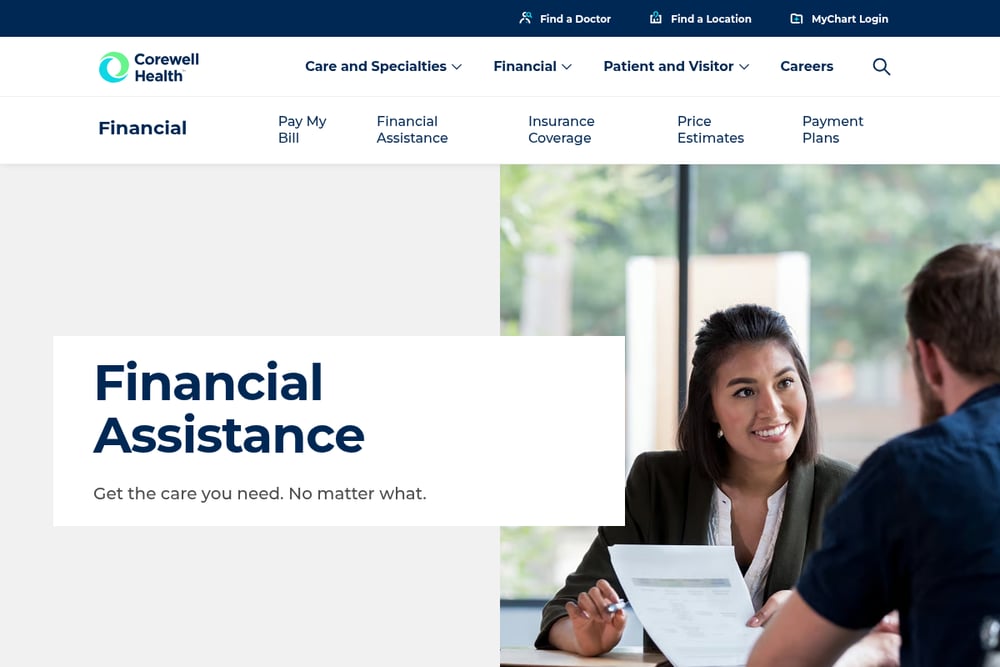 A screenshot of the Corewell Health website.
Corewell Health offers a comprehensive financial assistance program that helps patients navigate charity care eligibility, insurance plans, and interest-free payment plans. You can talk directly with a financial counselor in your area to explore options like Medicaid eligibility or other coverage plans. The program also provides a confidential financial assistance application and a plain language summary of eligibility policies. This is a direct, hospital-integrated solution for patients facing medical bills, but it focuses narrowly on hospital debt rather than broader financial crises.
#2 OhioHealth Financial Assistance and Charity Care
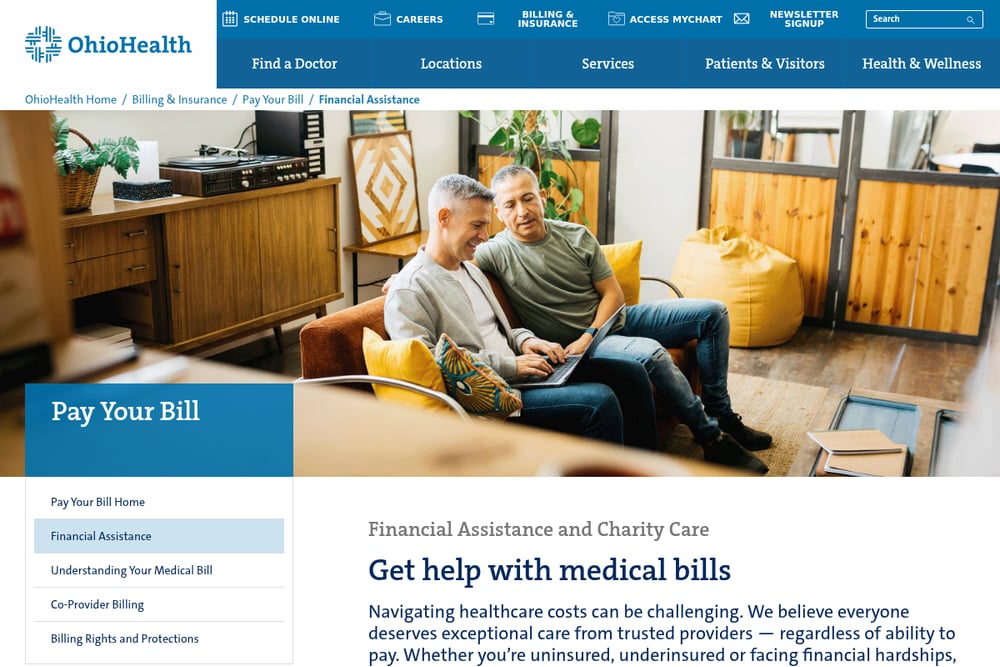 A screenshot of the OhioHealth website.
OhioHealth provides a step-by-step financial application video guide to help you apply for charity care and financial assistance. They also connect you to a Community Resource Directory for essential services like food, housing, clothing, transportation, and job placement. This program is strong for linking patients to broader social services beyond just billing. However, it lacks the personalized, trauma-informed coaching that patients with deep financial trauma often need.
#3 United Way Suncoast Financial Coaching
 A screenshot of the United Way Suncoast website.
United Way Suncoast runs a volunteer-driven financial coaching program that helps you tackle budgeting, credit scores, debt management, and building financial confidence. More than 60% of participants report that coaching had an exceptional or substantial impact on their financial well-being. The program is free and accessible, but it is not specifically designed for healthcare settings or patients in crisis. You would need to refer patients externally, which can create a gap in continuity of care.
#4 Financial Chaplain Group
 A screenshot of the Financial Chaplain Group website.
Financial Chaplain Group, founded by Rosalind M. Simmons, offers a faith-based, trauma-informed financial care program that integrates directly with hospital chaplaincy and social work teams. They provide one-on-one financial coaching, staff training, and group classes to help patients stabilize financially and emotionally. With over 500 clients served and an average savings of $1,500 per client, this program is built specifically for healthcare settings. It bridges the gap between spiritual care and financial stability, helping your team focus on healing while addressing the financial crisis that can derail recovery.
#5 San Francisco Smart Money Coaching
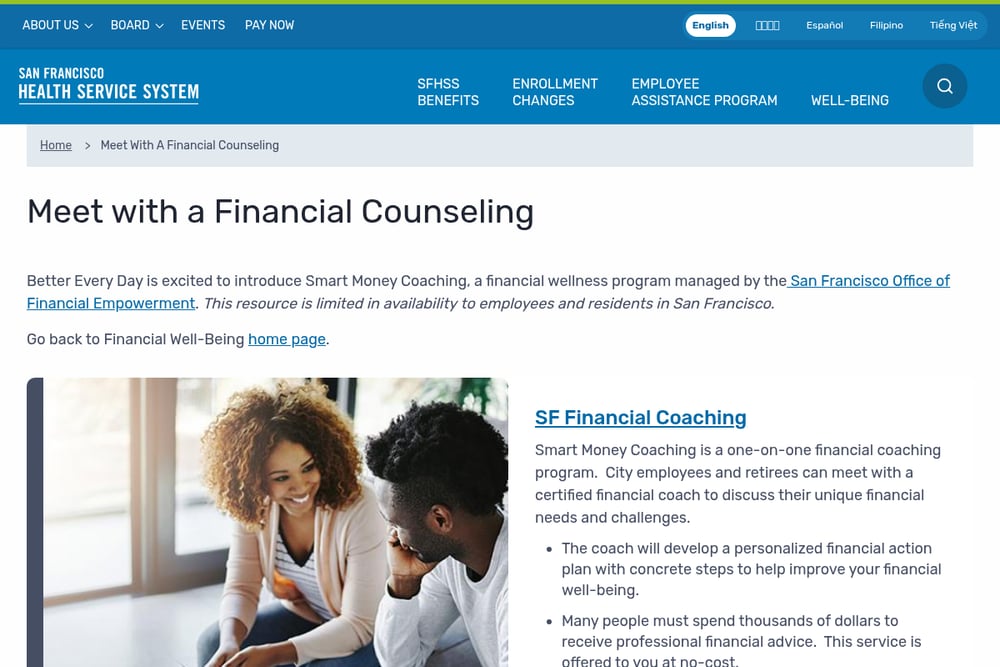 A screenshot of the San Francisco Smart Money Coaching website.
Smart Money Coaching, managed by the San Francisco Office of Financial Empowerment, offers confidential financial coaching for goal setting, budgeting, debt resolution, and credit building. It is available to employees and residents of San Francisco, making it geographically limited. The program is strong for personalized coaching but is not tailored to the unique stressors of a hospital patient population. You would need to refer patients out, and it lacks the clinical integration that makes programs like Financial Chaplain Group effective in a hospital setting.
How to Choose the Right Financial Care Program for Your Hospital
Start by assessing your patient population. Do you serve a high number of women rebuilding after hardship, veterans, or homeless patients? If so, a trauma-informed, faith-based program like Financial Chaplain Group may be the best fit. Next, consider your existing care model. If you already have a strong chaplaincy or social work team, look for a program that trains your staff rather than replacing them. Also, think about scalability. Can the program serve both one-on-one and group settings? Finally, check for proven outcomes. Programs that track savings, client numbers, and readmission rates give you data to justify the investment.
Automate Your Financial Care Referral Workflow
You can streamline how patients access financial care by setting up a simple automation. When a chaplain or social worker identifies a patient with financial stress, trigger an automated email or text to the financial care provider with the patient's consent. Use a tool like Zapier to connect your EHR system to a secure intake form. Then, schedule a follow-up reminder for the care team to check in on the patient's progress after 30 days. This keeps the loop closed without adding manual work.
The Bottom Line on Financial Care in Hospitals
Financial care is no longer a nice-to-have—it is becoming a standard part of patient recovery. Whether you choose a hospital-integrated charity care program or a faith-based coaching model like Financial Chaplain Group, the key is to close the gap between discharge and stability. Your care team cannot do it alone, but with the right program, you can ensure that patients leave the hospital with both a healing body and a stable financial foundation. Start by evaluating your current referral pathways, then pick the program that aligns with your mission and patient needs.