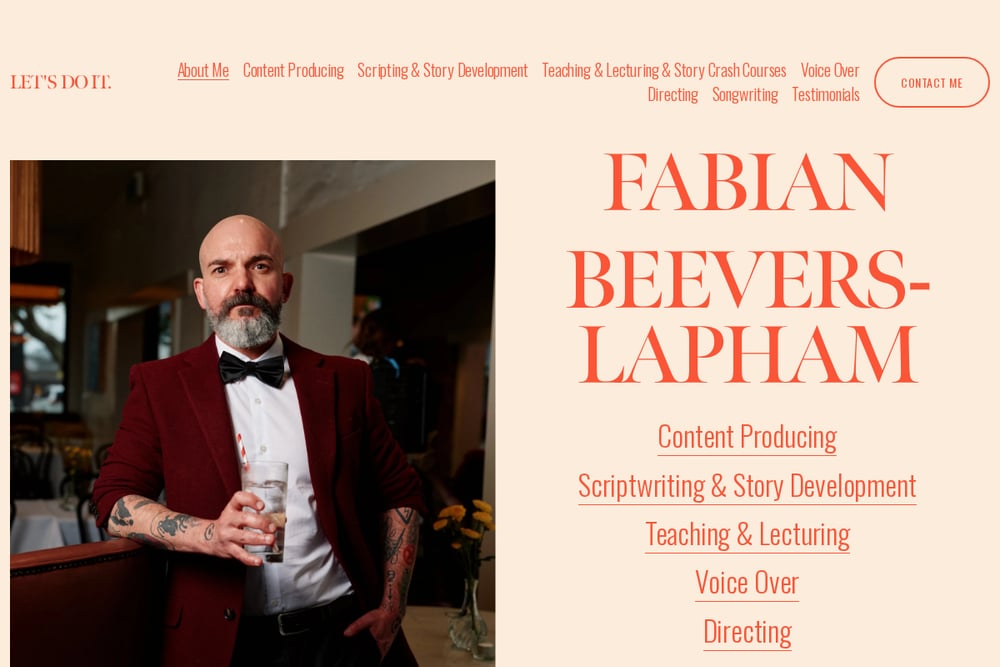
Fabian Beevers-Lapham is an Australian scriptwriter and story developer who works across ads, shorts, and music videos. You can find his work at fabianbeeverslapham.com. In this email interview, he walks through how a brief becomes a finished draft, why he anchors pricing to guild rates, and what businesses should sort out before they hire a writer.
Question 1: What does your scriptwriting process look like from the first brief to a finished draft?
Beevers-Lapham says the starting point varies widely by client. "Prior to script consultation, some clients make a little pitch deck for their idea, some have a rough outline, some have already started scripting, others have only gotten as far as vocalising their idea. And there's no wrong way to go about it."
That flexibility extends to ad work, where briefs may include product info, target demographics, and duration, though he notes even ad briefs can be skeletal. The finished draft, he says, should resemble the client's original idea fully realized in a way that is both compelling and marketable. He offers the full range of scripting services, so clients can choose a soup-to-nuts script or structural, thematic, and general feedback while they write it themselves.
Question 2: How do you price scriptwriting and story development work?
Even in the corporate sector, Beevers-Lapham defers to union rates. "I'm situated in Australia, so I use the rates set by the Australian Writers' Guild. If you're hiring me from America, this is in your favor, as our guild rules and rates aren't quite as robust as yours." He adds that he is happy to work from American guild rates if that suits the client's situation better.
For readers comparing quotes, that is a concrete anchor: ask which rate card a writer is using, and whether they will match a client's local guild standard.
Question 3: What makes a script hold attention instead of getting skimmed?
Beevers-Lapham draws a line between grabbing attention and keeping it. "Any chump can grab an audience's attention, but that it takes skill and sincerity to keep it. That entails great ideas but also, critically, craft."
On craft, he lists sturdy structure, engaging characters, polished dialogue, clear themes, and correct formatting as the ingredients of good pacing. He also argues for originality, especially now. "A great screenplay should also have a spark of originality that is unique to its writer - especially in the age of AI slop, when people are frothing to see not only human craft, but human excellence."
His closing point is about how writers treat the work itself. "Don't think of your screenplay as a mere means to an end, think of it as a piece of art unto itself." He applies the same standard to ads: "A good scripted ad should be entertaining unto itself regardless of the product or service you're selling. I don't care where a consumer is on the marketing funnel, they deserve to be entertained before you try and take their money."
Question 4: How do you adapt the same story for video, voice-over, and live delivery?
Adaptation, he says, is driven by both the medium and the idea. Some ideas are exclusive to one format. He points to the music video he directed for Melody Moon's "Carried Away", whose increasingly absurd visuals, shot by DOP Matt Wood, would carry a different vibe in another medium. Other material travels well with minimal adjustment, like his short "Due Date", which began as an audio sketch but works better with visuals, thanks in large part to storyboarder and artist Kal McShortall.
The practical takeaway for businesses: decide early whether the core story is format-specific or portable, and budget for the adaptation work rather than assuming one script covers every channel.
Question 5: What should a business have ready before hiring a scriptwriter?
Beevers-Lapham's first answer is budget clarity. "A good idea on how much you have to spend on your script development, and an equally good idea of how far that will get you as per industry standard rates." He also recommends researching what belongs in the contract to protect both sides, including IP ownership, timely payment at industry rates, and an agreement that neither party feeds the material into AI.
He warns against mismatched expectations about what a screenwriter does. He recalls a CEO with a strong animated-series idea who asked how he would approach the project; when Beevers-Lapham gave a ballpark sense of world and tone, the CEO replied rudely that the answer lacked a market analysis of similar products. "Like, a) that's not what he asked for, and b) that's not my job. That was a red flag for me. Not so much because of his warped expectations, but because he was rude about it."
His summary is simple: "Prepare to have a little understanding and a little courtesy for your writer, but y'know… you should do that for everyone else too."
Key Takeaways
- Briefs can arrive at any stage, from a spoken idea to a partial script; there is no single correct starting point.
- Pricing should be anchored to a guild rate card, with the Australian Writers' Guild as Beevers-Lapham's default and American guild rates as an option.
- Holding attention requires structure, character, dialogue, theme, formatting, and originality, not just a strong hook.
- Adaptation depends on whether the idea is format-specific or portable; plan and budget for it.
- Before hiring, settle budget, contract terms, IP ownership, and realistic expectations about the writer's role.
For more on Fabian Beevers-Lapham's scriptwriting and story development work, visit fabianbeeverslapham.com.