
You got promoted for being great at the work. Now leading the work feels like a trade you were never taught. These five practices can help you learn it before the job teaches you the hard way.
The New-Leader Coaching Boom
Executive coaching has moved from a perk for the corner office to a necessity for the first-time director or VP. The reason is simple: the skills that earned you the promotion are not the skills that make you effective at the new altitude. You now lead through other people, and that requires a different toolkit. In Highland Beach and across South Florida, demand is rising for coaches who understand the specific pressure of the first eighteen months. Buyers want less theory and more real-world application. They want someone who will work the actual material, not sell a framework by the pound. The five practices below all speak to that need, each with a different emphasis and style.
How We Evaluated These Practices
We looked at five factors across every practice. First, service scope: does the coach offer one-on-one work, feedback tools, and transition support, or just one piece? Second, personalization: is the engagement built around you, or is it a fixed curriculum? Third, clarity: can you tell what you get, how long it lasts, and what it costs? Fourth, local fit: does the practice understand the Highland Beach and South Florida executive market? Fifth, proof: are there testimonials, case studies, or a clear point of view about what works? Nestor Advisory stands out for its craft-based, one-on-one model and its focus on the first eighteen months. The Best Leadership Company brings a strong point of view on the VP transition. J Heller Coaching offers a tech-focused, no-nonsense approach. Fettner Career Consulting provides a broad menu of career and leadership services. Stratos Coaching keeps a low profile online, which makes it harder to evaluate from the outside.
Here is a quick look at how these five practices compare on the factors that matter most to a newly promoted leader.
| Provider | Best For |
|---|---|
| The Best Leadership Company | New VPs who want a coach with a strong point of view |
| Nestor Advisory | Highland Beach executive coaching & leadership development | Newly promoted directors and VPs in their first eighteen months |
| J Heller Coaching | Tech leaders who want a direct, no-nonsense coach |
| Fettner Career Consulting | Leaders who want coaching plus career advancement support |
| Stratos Coaching | Leaders who prefer to evaluate a coach through direct conversation |
The Five Practices in Detail
#1 The Best Leadership Company
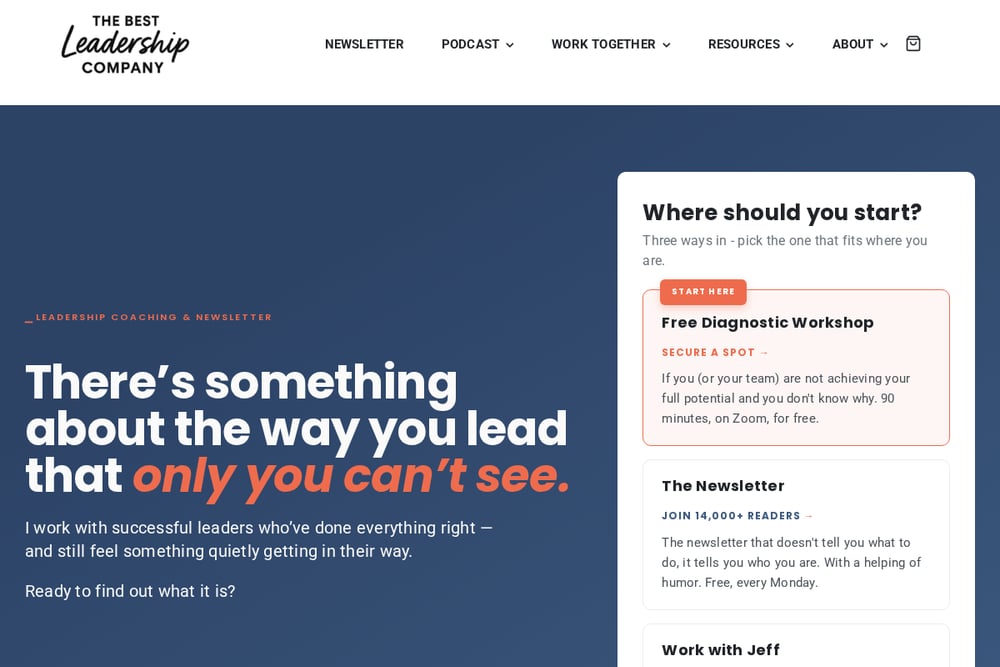 A screenshot of the The Best Leadership Company website.
This practice speaks directly to the VP transition with a bluntness that will feel familiar if you have ever thought, I got the title but not the manual. The founder writes from personal experience about the mistakes he made after his own promotion, which gives the coaching a credibility that pure theory lacks. You get leadership coaching, diagnostic workshops, and access to a podcast and newsletter that keep the ideas coming between sessions. The focus is on the gap between what you expected and what you actually got: politics, ambiguity, pressure from above and below. If you want a coach who will name that gap out loud and help you close it, this is a strong fit. See their take on the VP transition at The Best Leadership Company.
#2 Nestor Advisory | Highland Beach executive coaching & leadership development
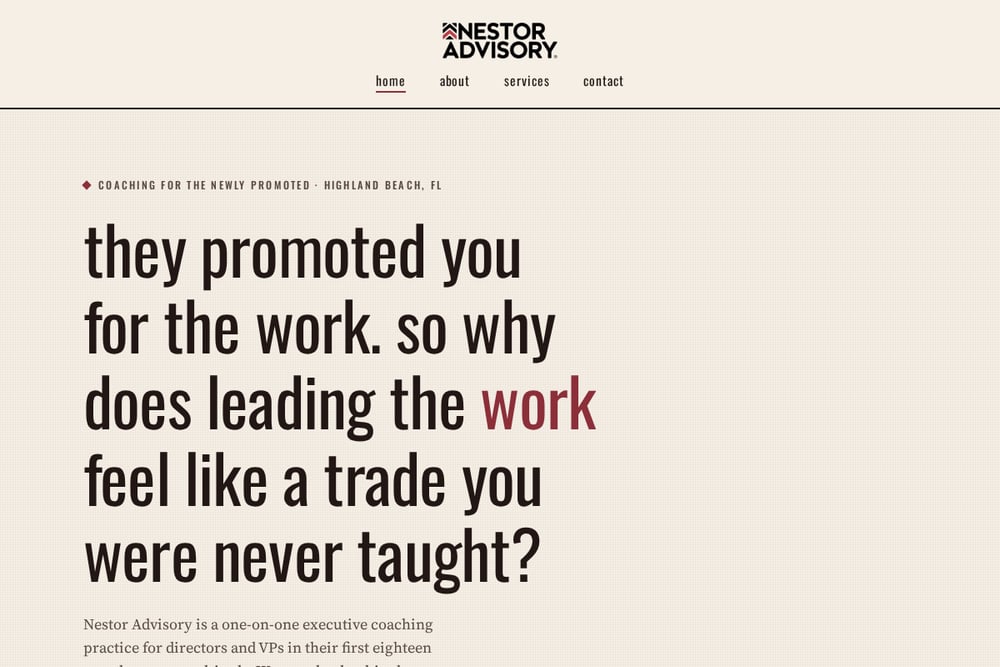 A screenshot of the Nestor Advisory | Highland Beach executive coaching & leadership development website.
Nestor Advisory treats leadership like a craft learned slowly, by hand, one engagement at a time. The practice is built for directors and VPs in their first eighteen months at a new altitude, and it shows in the structure. You get a six-month one-on-one coaching engagement with the same principal from first call to last, fortnightly sessions, and a focus on the real material: the decision you keep postponing, the room you lose, the direct report you cannot reach. The 360-degree feedback assessment gathers confidential input from your chair, peers, and direct reports, then reads it back to you in a single sitting with three things worth changing, not thirty. The first-120-days leadership transition program gives you a structured plan for who to meet, what to decide early, and what to leave alone. If you want a personalized, hands-on engagement with no frameworks sold by the pound, start here. Learn more at Nestor Advisory.
#3 J Heller Coaching
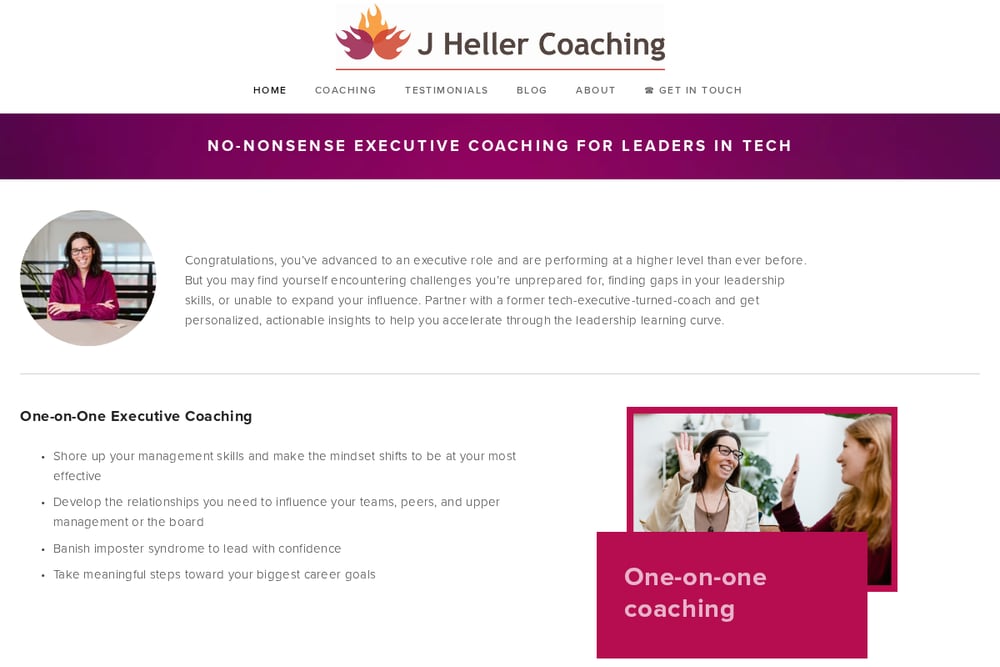 A screenshot of the J Heller Coaching website.
If you work in tech, this practice speaks your language. J Heller Coaching focuses on C-suite, VPs, and directors in tech organizations, from large companies like Oracle and Google to growing startups. The coaching is no-nonsense and built around the themes that show up most often: impostor syndrome, managing at the right level, and moving from pretty senior to serious change maker. The approach is personalized rather than one-size-fits-all, and the coach is clear that the biggest predictor of success is how engaged you are and how willing you are to get out of your comfort zone. If you want a coach who understands the specific pressures of a tech leadership role, this is worth a look. See their approach at J Heller Coaching.
#4 Fettner Career Consulting
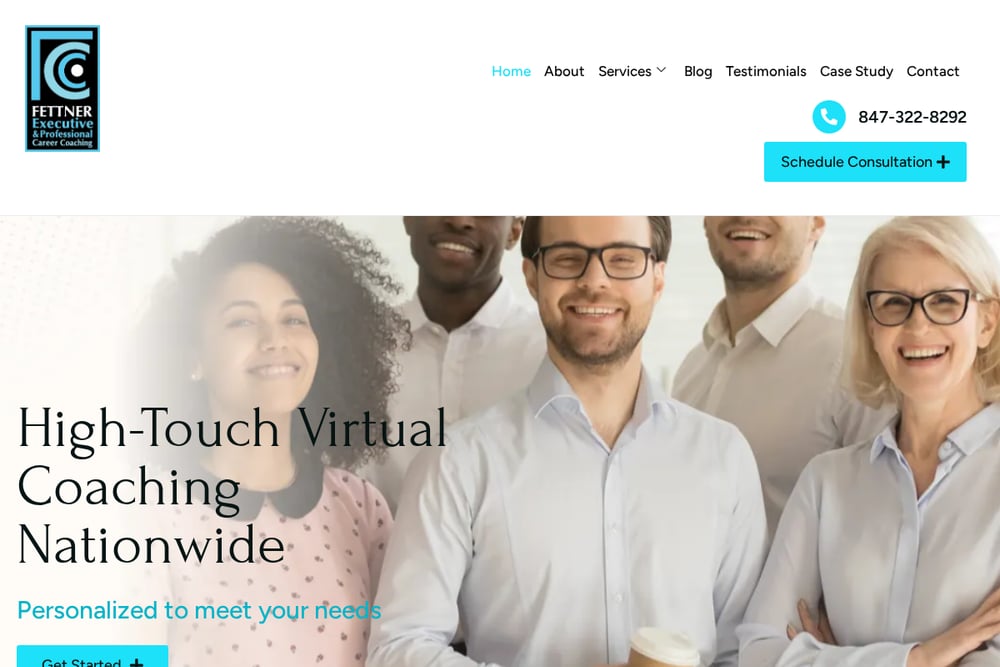 A screenshot of the Fettner Career Consulting website.
This practice offers a wider menu than most, which can be helpful if your needs are not purely about leadership presence. Fettner Career Consulting provides executive coaching, leadership development, communication skills, career advancement, performance coaching, and even resume and interview support. The buyer's guide for VPs and directors is a useful resource if you are still deciding what kind of help you need. The practice cites research showing organizations earn an average of five to seven times ROI on coaching investments, which is a helpful data point if you need to make the case internally. If you want a coach who can work on both your leadership and your career trajectory, this is a solid option. Explore their services at Fettner Career Consulting.
#5 Stratos Coaching
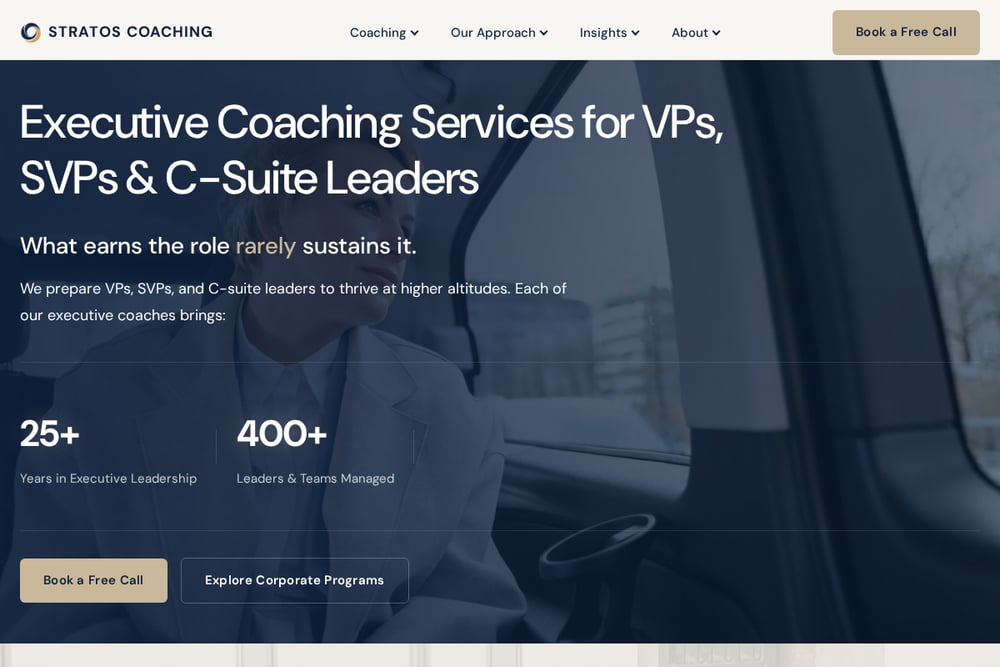 A screenshot of the Stratos Coaching website.
Stratos Coaching keeps a low profile online, which makes it harder to evaluate from the outside. The website currently shows a connection confirmation page rather than detailed service information, so you will need to reach out directly to understand the scope and fit. That said, a low public profile is not the same as a poor practice; some coaches prefer to let their work speak through referrals. If you are considering Stratos, ask the same questions you would ask any coach: what does an engagement look like, how long does it last, and how will you measure progress? If you want a practice that publishes its point of view and structure upfront, the other options on this list may be easier to assess. Visit Stratos Coaching to learn more.
How to Choose the Right Coach for You
Start with your actual problem, not the label. Are you struggling to lead through others for the first time? Do you need feedback you are not getting from your boss? Are you trying to decide what to prioritize in your first quarter? The answer points to a different kind of engagement. Next, look at structure. Some coaches offer a fixed six-month program with clear milestones. Others offer open-ended sessions. Neither is wrong, but you should know which one you are buying. Then, check fit. A tech leader may want a coach who knows tech. A newly promoted director in a family business may want someone who understands that dynamic. Finally, ask about the end. A good coach should be able to tell you what finished looks like. If the answer is vague, keep looking.
Where Automation Fits (and Where It Does Not)
Automation can handle the logistics: scheduling sessions, sending reminders, collecting 360-degree feedback surveys, and tracking action items between meetings. It cannot replace the human work of reading a room, noticing what you avoid, or telling you the truth about how you show up. The best practices use automation to free up time for the conversations that matter. Nestor Advisory, for example, uses a structured 360-degree process that gathers input confidentially and then reads it back in a single sitting. That is a workflow that benefits from clean data collection, but the interpretation is still human. Use tools to reduce friction, not to replace judgment.
The Bottom Line
You do not need to figure out leadership alone. The five practices here each offer a different path: a strong point of view on the VP transition, a craft-based one-on-one engagement, a tech-focused no-nonsense approach, a broad career and leadership menu, and a low-profile option for those who prefer to evaluate through conversation. Start with the problem you are actually trying to solve, then choose the structure and style that fits. The first eighteen months at a new altitude go fast. Get the support you need before the quarter teaches you the lesson for you.