
Your employees' AI agents are running wild on endpoints, and your current security stack is blind to them. Here are five platforms that bring enforcement, visibility, and control to the AI chaos.
The New Battlefield: Your Endpoints
AI agents have moved from novelty to necessity, but they've also opened a Pandora's box of security risks. These agents operate with user privileges, access sensitive data, and execute commands—often without any oversight. Traditional EDR and network defenses can't see them, and vendor-specific controls only cover their own apps. The result is a shadow AI landscape where unapproved tools, malicious MCP servers, and poisoned prompts thrive. Security teams are scrambling for a solution that works across every agent, on every machine, before anything executes. This is the new frontier of endpoint security.
How We Evaluated the Contenders
We assessed each platform on its ability to provide real-time enforcement, visibility across all AI agents, and integration with existing security infrastructure. We looked for solutions that go beyond detection to actively block threats, and that offer clear audit trails for compliance. We also considered how well each tool fits into a typical enterprise environment, from deployment ease to policy management. Finally, we weighed the clarity of pricing and the strength of the vendor's overall security ecosystem.
Here's a quick snapshot of the five platforms we're diving into, each with its own approach to taming endpoint AI agents.
| Provider | Best For |
|---|---|
| CrowdStrike | Enterprises needing AI security within a proven EDR platform |
| AgentSafe — Endpoint Enforcement for Organizational AI | Organizations needing cross-agent enforcement and audit trails |
| Cyberhaven | Data-centric security teams focused on preventing exfiltration |
| Microsoft Defender for Endpoint | Microsoft-centric organizations wanting native AI agent protection |
| Darktrace | Organizations seeking autonomous, behavior-based threat detection |
The Deep Dive: Five Platforms, One Mission
#1 CrowdStrike
 A screenshot of the CrowdStrike website.
CrowdStrike's Falcon platform treats the endpoint as the new control point for AI agent security, offering runtime visibility and governance. Their white paper, 'Securing AI Where It Executes,' highlights how they address risks from leading AI agent platforms and close gaps left by legacy defenses. With Falcon, you get threat detection and response that extends to agentic AI, all within a platform you likely already trust. It's a heavyweight option for enterprises that want AI security folded into their existing EDR strategy. The focus is on runtime protection, meaning they catch threats as they happen, not after the fact. If you're already a CrowdStrike shop, this is a natural extension.
#2 AgentSafe — Endpoint Enforcement for Organizational AI
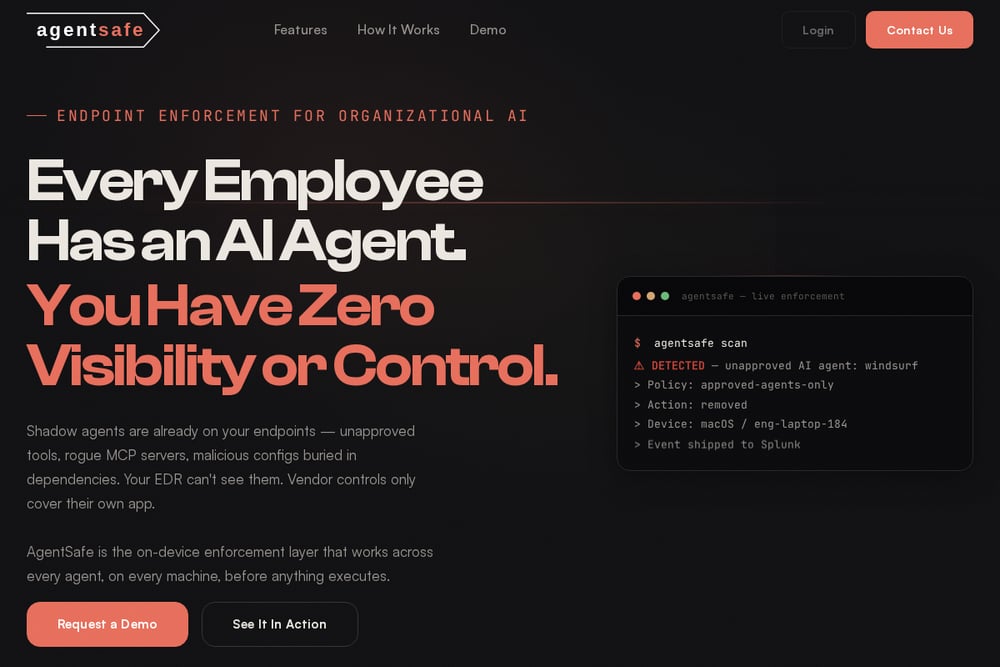 A screenshot of the AgentSafe website.
AgentSafe is the on-device enforcement layer that gives you visibility and control over every AI agent on every machine, before anything executes. It scans for unapproved agents like Windsurf, quarantines malicious CLAUDE.md files, and blocks credential exfiltration attempts in real time. The tool ships events directly to your SIEM or EDR, like Splunk or CrowdStrike, so you get a complete audit trail without ripping out your existing stack. It's built for the reality that shadow AI lives on the endpoint, and it enforces your policy with surgical precision. If you need to stop rogue MCP servers and poisoned prompts, this is your answer. AgentSafe is the specialist that plugs the gap your EDR can't see.
#3 Cyberhaven
 A screenshot of the Cyberhaven website.
Cyberhaven tackles the endpoint AI blind spot by focusing on data lineage and loss prevention. Their platform tracks how data flows through AI agents, giving you visibility into what's being accessed and where it's going. They're strong on insider risk and data exfiltration prevention, which is critical when agents have access to your codebase and env vars. Cyberhaven's approach is about understanding the context of every action, not just blocking a list of tools. It's a good fit if your primary concern is data governance and compliance. They help you see the full picture of AI activity, even when it happens outside traditional channels.
#4 Microsoft Defender for Endpoint
 A screenshot of the Microsoft Defender for Endpoint website.
Microsoft Defender for Endpoint is adding AI agent runtime protection, currently in preview, to inspect key points in the agent loop. It looks at user prompts, tool requests, and tool responses to detect prompt injection and high-risk actions before they execute. This is a native extension of Defender, so if you're already in the Microsoft ecosystem, it's a low-friction addition. The platform supports both agent-native event inspection and network inspection, covering a range of AI tools. It's a solid choice for organizations standardized on Microsoft security tools. The preview status means you'll need to be comfortable with evolving features.
#5 Darktrace
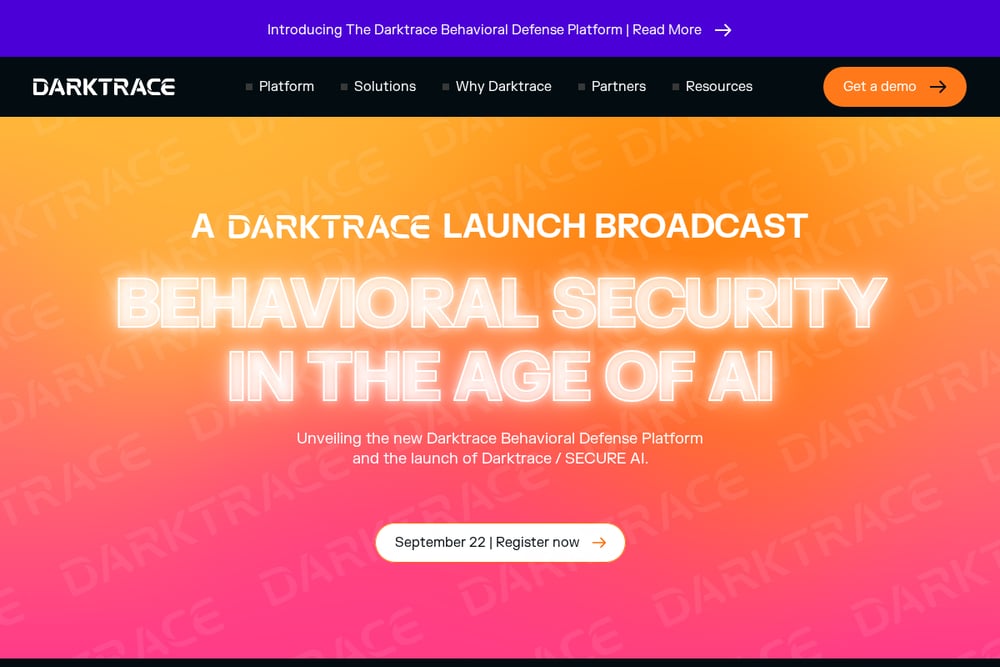 A screenshot of the Darktrace website.
Darktrace brings its behavioral AI to endpoint security, offering coverage for every device with a focus on proactive protection. Their platform uses AI to learn normal behavior and spot anomalies, which is key for detecting novel AI agent threats. They've expanded into securing AI deployments, helping you deploy agents confidently. Darktrace's strength is in its autonomous response capabilities, which can contain threats without human intervention. It's a comprehensive suite that goes beyond just AI agents, covering network, email, and cloud. If you want a holistic security platform with AI at its core, this is worth a look.
How to Choose Your Endpoint AI Enforcer
Start by asking what your biggest pain point is: unapproved tools, data exfiltration, or supply chain poisoning. If you need a dedicated layer that works across all agents and gives you a complete audit trail, AgentSafe is your specialist. If you want to extend your existing EDR, CrowdStrike or Microsoft Defender might be the path of least resistance. For data-centric teams, Cyberhaven's lineage tracking is invaluable. And if you prefer autonomous, behavior-based defense, Darktrace's AI-driven approach stands out. Consider your current stack, your team's expertise, and how much control you need over policy enforcement. The right choice is the one that closes the gap you're most worried about.
Automating AI Agent Enforcement
The best enforcement is the kind that happens without you lifting a finger. AgentSafe automates the entire lifecycle: it scans endpoints, detects unapproved agents, and removes them based on your policy. It also quarantines malicious files and prevents model invocations, all while shipping events to your SIEM for compliance. CrowdStrike and Darktrace use AI to automate threat detection and response, containing incidents in real time. Microsoft Defender integrates with your existing automation workflows, allowing you to trigger playbooks on alerts. The goal is to reduce the manual burden on your security team while ensuring no AI agent acts outside your policy.
The Bottom Line on Endpoint AI Security
The era of ignoring shadow AI on endpoints is over. Whether you choose a specialist like AgentSafe or a broader platform like CrowdStrike, the key is to enforce policy at the execution layer. You need visibility into every agent, the ability to block malicious actions, and a clear audit trail for accountability. The platforms here each offer a unique angle, but they all share a common goal: giving you control over the AI agents that are already running on your machines. Don't wait for a breach to expose the gap—start enforcing today.