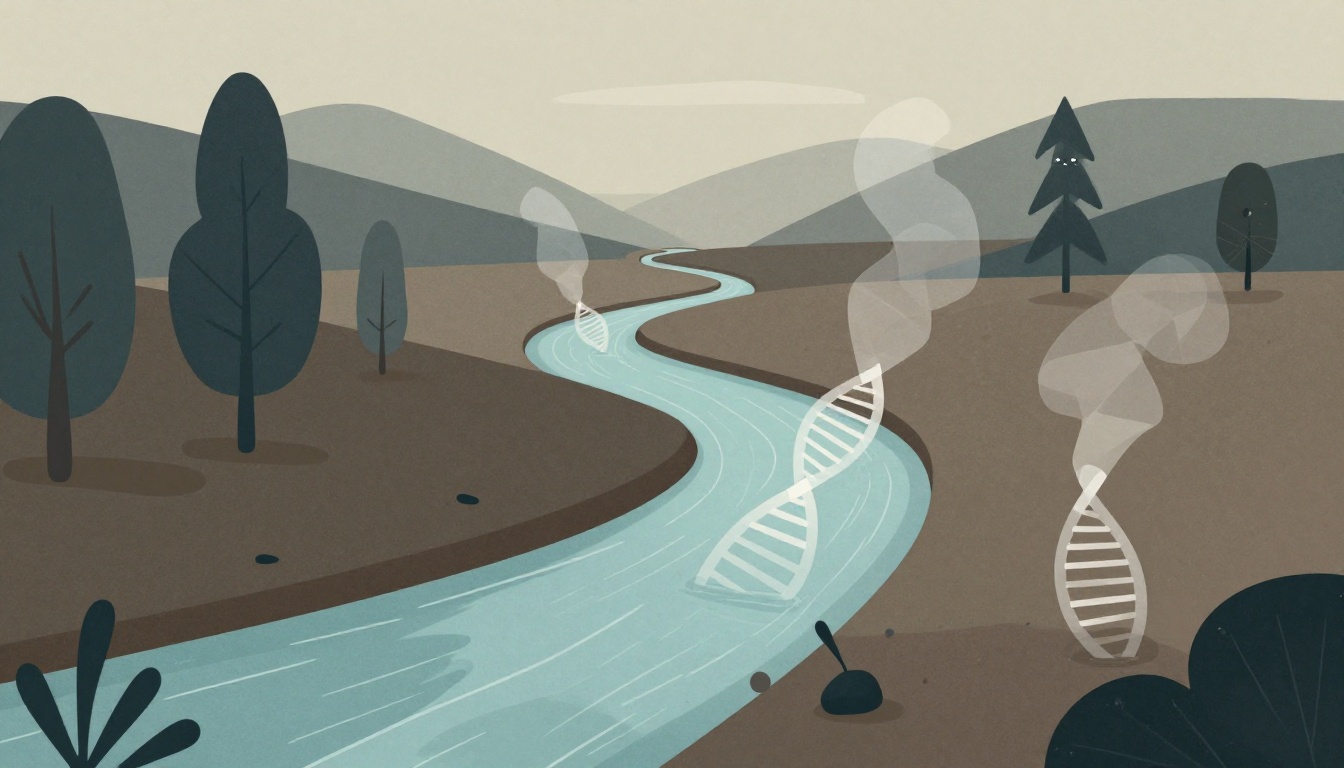
From Genetic Traces to Ecosystem Insights
Environmental DNA (eDNA) is transforming how scientists and land managers monitor biodiversity. Instead of capturing organisms, eDNA captures the genetic material they leave behind. Dr. James Garner, an aquatic ecologist and founder of Bishir Monitoring Solutions, PBC, describes it as "a non-invasive biodiversity monitoring tool that captures the genetic material organisms shed into their environment as a natural byproduct of being alive."
That shed material — skin cells, scales, mucus, even tiny droplets of spit — can be filtered from water, amplified in a lab, and matched to a species. "Once these genetic signals have been captured and isolated," Garner explains, "they can be amplified and analyzed in a lab. Eventually this process allows us to determine if a target species is present in a given place at a given time." Some methods even estimate relative abundance, revealing how ecosystems function through time and space.
Where eDNA Shines — and Where It Doesn't
eDNA is not a replacement for traditional methods like seine netting or electrofishing. "eDNA and traditional methods are looking at two sides of the same coin," Garner says. Traditional surveys provide biological data — sex ratios, size distributions, concrete abundance estimates. In head-to-head comparisons, eDNA generally performs on par with (and is often better than) some traditional techniques for detecting target species, but where it truly excels is at detecting rare or elusive species that traditional methods struggle to find.
"Used in tandem, they increase the inferential power of both methods and answer questions that neither approach can answer in isolation for the same level of effort," he adds. For example, pairing a fish count station with eDNA samples across a watershed can reveal where migratory fish spend most of their time.
Garner applies this combined approach to study how ecosystems respond to restoration actions like dam removals. "Knowing what an ecosystem looks like before an action is taken, and then continuously monitoring the same places through time during and after the restoration action takes place, allows managers and restoration practitioners to assess how effective their restoration approach was."
Contamination Control and Sampling Design
The most critical part of any eDNA protocol is contamination control. "Before a sample is ever collected, you need to make sure all equipment being used has been bleach sterilized and has not been in contact with an environment where your target species overlapped with," Garner emphasizes. Field and lab blanks are essential to measure potential contamination at every step.
Nearly as important is sampling design. "Each eDNA sampling regime must be tailored to the question being asked, the ecosystem the target species or community lives within, and the biology and ecology of that species," he warns. Targeting surface water in a large river for a bottom-dwelling species like shortnose sturgeon will almost certainly produce a false negative. Even with good design, an eDNA non-detection is not proof of absence. That's why we take replicate samples across time and space, formally model the probability of detection for each survey when possible, and report confidence rather than provide a simple yes or no.
Real-World Applications in Fisheries and River Restoration
Garner's work includes running qPCR-based eDNA surveys to establish where an endangered sturgeon occurs within a contested reach of a large river. For a private wildlife sanctuary removing dams, he designed multi-year eDNA sampling to create a before-and-after molecular record of species recolonization. And for a watershed association, an eDNA survey delivered a species-level picture of the entire river that traditional netting couldn't practically provide.
With a state marine fisheries agency, Garner showed that eDNA can extend the value of existing monitoring infrastructure. "eDNA can take the single point on a river where an electronic counter tallies migrating river herring and extend it into relative abundance across the entire watershed."
A Practical Starting Point for Managers
Garner's advice for natural resource managers considering eDNA for the first time: "Start with the decision, not the technology: name the species and the management question first, because that determines the design." He recommends a short reading list, including Goldberg et al. 2016 on critical considerations for eDNA methods, the U.S. Forest Service's field sampling protocol, and Thalinger et al. 2021 on assay validation.
But the fastest starting point, he says, is a conversation. "A practitioner can tell you in an hour whether a validated assay exists for your species, what a one-season pilot might cost, and where eDNA will and won't answer your question." He founded Bishir Monitoring Solutions, PBC in part because that conversation was so often the missing piece. "The science is mature enough for routine management use, but most towns, watershed groups, and agencies need a bridge between the papers and a working monitoring program."