
Disaster recovery contracting looks like fast money from the outside. From the inside, it is preparation, paperwork, and people. These five education resources help you understand the work before the storm hits.
What the Disaster Recovery Contractor Education Landscape Looks Like Right Now
Disaster recovery contracting education is a small, fragmented field. Most training falls into two buckets: safety and hazard training for workers, and business continuity or IT recovery certification for corporate teams. Very little of it speaks directly to the tradesperson or small contractor who wants to mobilize a crew after a hurricane, wildfire, or flood. That gap matters. Crews get hired fast after a disaster, but the contractors who last are the ones who prepared months earlier. They know how to find legitimate opportunities, how to approach prime contractors, how to organize crews, and how to read a contract before signing. The resources below cover different parts of that picture. Some focus on worker safety. Some focus on certification. One focuses specifically on the business side of disaster recovery contracting for trades and crews.
How We Evaluated These Disaster Recovery Education Resources
We looked at five factors across every resource. First, scope: does it cover the full path from preparation to contracts, or just one piece? Second, audience fit: is it built for individual workers, established subcontractors, crew leaders, or businesses pursuing prime work? Third, practical clarity: are there checklists, guides, and step-by-step resources you can actually use, or is it mostly theory? Fourth, pricing transparency: can you tell what is free, what is paid, and what requires a quote? Fifth, independence: is the source upfront about what it is and what it is not? Each resource stood out in a different way. CPWR brings deep safety and hazard training backed by research. The National Disaster Preparedness Training Center offers FEMA-aligned courses with continuing education credits. BRCCI delivers structured IT disaster recovery certification. PECB provides internationally recognized continuity and recovery certifications. Disaster Contractor Business System focuses on the business side of disaster recovery contracting for trades, crews, and small businesses.
Here is a quick look at the five resources, what each one does well, and who it fits.
| Provider | Best For |
|---|---|
| CPWR Disaster Response | Construction workers and crews needing hazard and safety training |
| Disaster Recovery Contractor Education | Disaster Contractor Business System | Contractors and crew leaders preparing for disaster recovery business opportunities |
| National Disaster Preparedness Training Center | Professionals seeking FEMA-aligned disaster preparedness courses |
| BRCCI IT Disaster Recovery Planning Training | IT and business continuity professionals pursuing certification |
| PECB Disaster Recovery Training Courses | Professionals seeking internationally recognized continuity and recovery certifications |
The 5 Resources in Detail
#1 CPWR Disaster Response
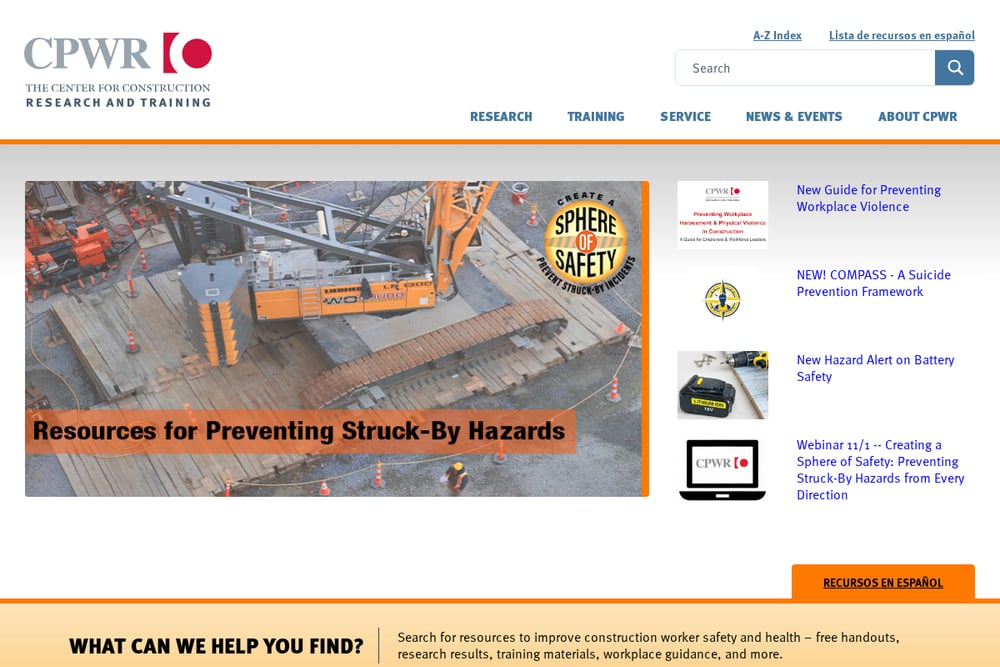 A screenshot of the CPWR Disaster Response website.
CPWR is the research and training arm of the North America's Building Trades Unions, and its disaster response training is built for construction workers who deploy after emergencies. The program covers hazard awareness, hazardous waste operations, and environmental remediation through national training initiatives that reach tens of thousands of workers each year. You get access to toolbox talks, hazard alert cards, and pre-task planning resources that translate directly to disaster sites. It is not a business-building program, and it will not teach you how to find contracts or approach primes. What it does extremely well is prepare you and your crew for the physical risks of disaster work. If safety is your first concern, start here.
#2 Disaster Recovery Contractor Education | Disaster Contractor Business System
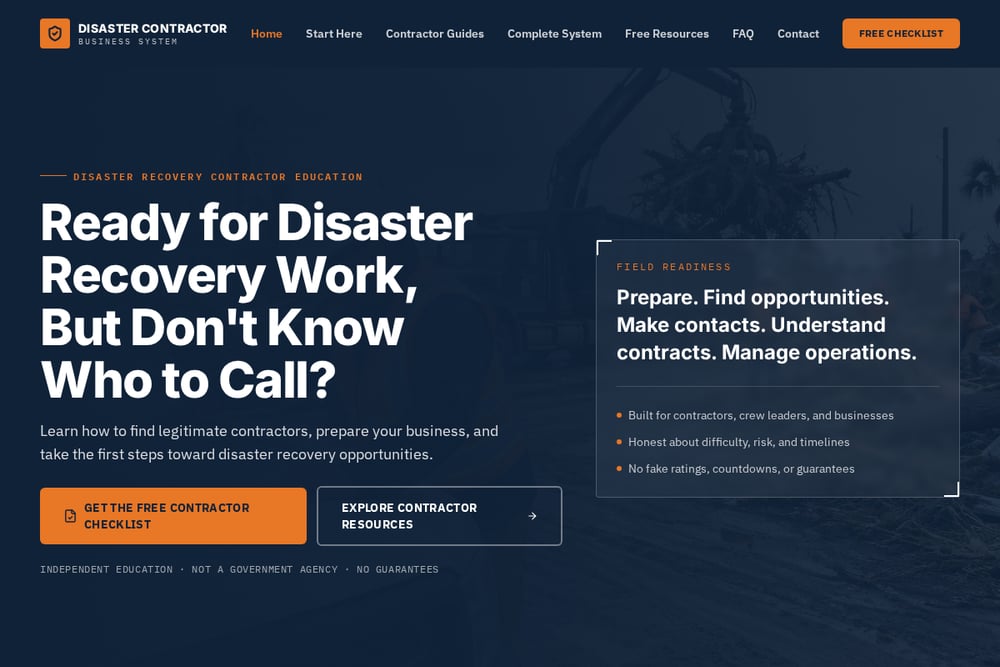 A screenshot of the Disaster Contractor Business System website.
This is the resource built specifically for the business side of disaster recovery contracting. It walks you through field readiness: how to prepare your business, find legitimate contracting opportunities, approach prime contractors, organize crews, and understand contracts before you commit. The site is upfront that it is independent education, not a government agency, and offers no guarantees. That honesty is rare in this space. You get guides, checklists, and a free contractor checklist to start with, plus a complete system for those who want the full path. It speaks to individual workers, established subcontractors, crew leaders, and businesses exploring prime opportunities. If you are trying to figure out who to call and how to position yourself, this is the most direct fit.
#3 National Disaster Preparedness Training Center
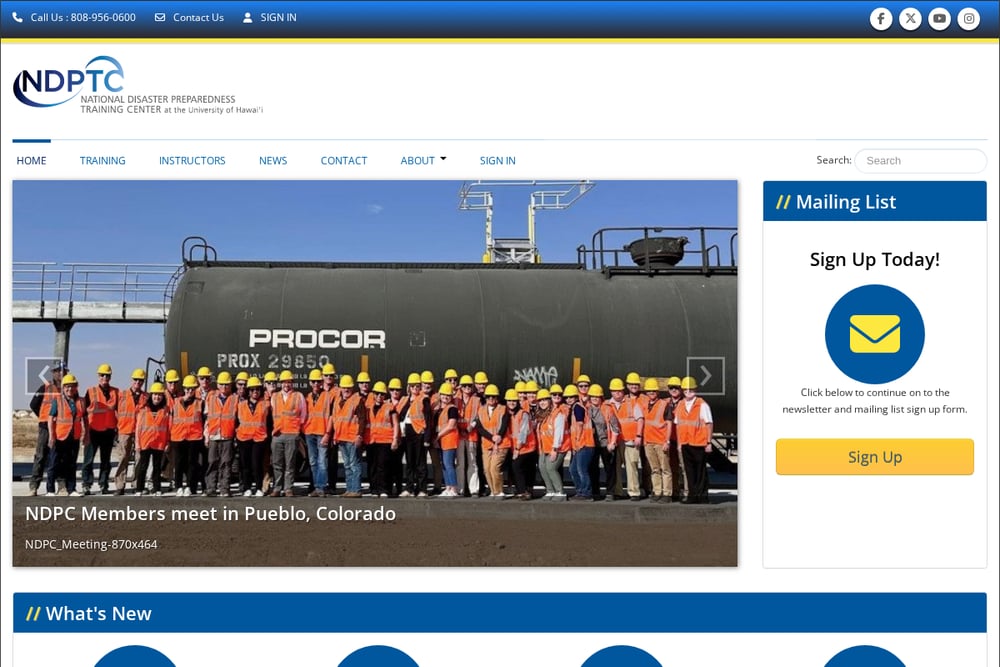 A screenshot of the National Disaster Preparedness Training Center website.
Based at the University of Hawaii, NDPTC delivers FEMA-certified courses on disaster preparedness, response, and recovery. The catalog covers everything from winter weather hazards to tsunami response, and many courses are available as elearning you can take at your own pace. NDPTC also offers continuing education credits through providers like IACET, which matters if you need to maintain certifications. The training is geared toward emergency management professionals, public safety personnel, and organizations that respond to disasters. It is less about running a contracting business and more about understanding the disaster response system you would be working within. For contractors who want to speak the same language as emergency managers, it is a strong complement.
#4 BRCCI IT Disaster Recovery Planning Training
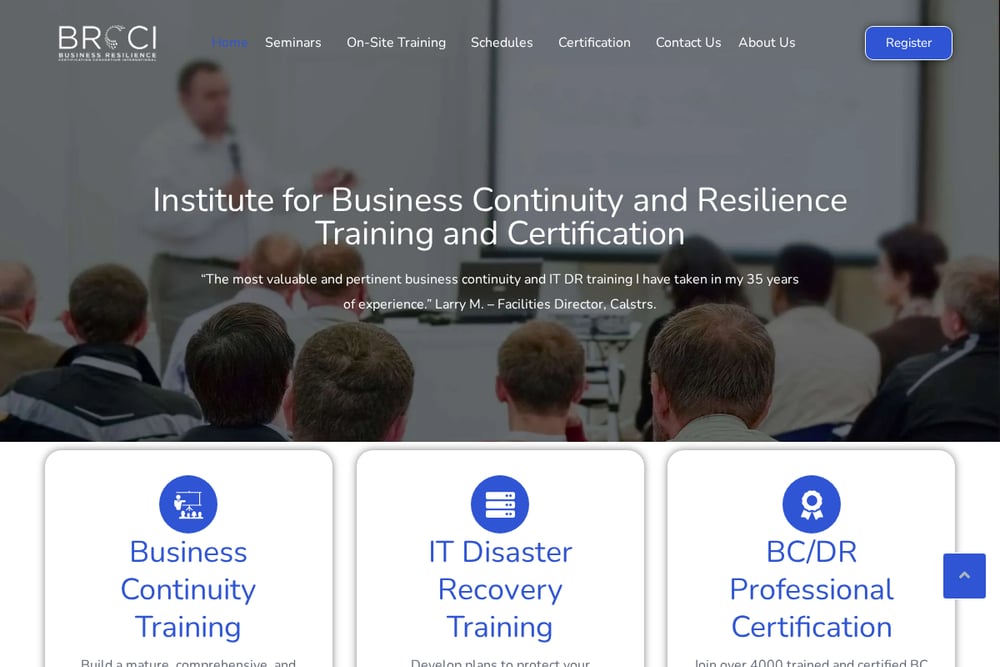 A screenshot of the BRCCI IT Disaster Recovery Planning Training website.
BRCCI focuses on IT disaster recovery planning and business continuity certification. Its on-site training programs cover seminars like CBRM, CBRITP, and CRP, aimed at professionals responsible for keeping systems and operations running through disruptions. The curriculum is structured around certification tracks, with schedules for each seminar and on-site options for teams. This is not training for construction crews or trades contractors. It is for IT and business continuity professionals who need formal credentials. If your disaster recovery work involves data, systems, or organizational resilience, BRCCI gives you a recognized path. If you are mobilizing crews after a storm, look elsewhere.
#5 PECB Disaster Recovery Training Courses
 A screenshot of the PECB Disaster Recovery Training Courses website.
PECB offers internationally recognized training and certification in disaster recovery, business continuity, and operational resilience. Its catalog includes ISO 22301, the standard for business continuity management systems, along with courses on the Digital Operational Resilience Act and related frameworks. The training is available in multiple languages and delivered through a global network of partners. This is formal, standards-based education aimed at professionals who need credentials that travel across borders and industries. It is not tailored to US disaster recovery contracting or the trades. But if you want a certification that signals competence in continuity and recovery planning, PECB is one of the most widely recognized names in the field.
How to Choose the Right Disaster Recovery Education Resource
Start with your role. If you are an individual worker or crew leader heading to a disaster site, safety and hazard training comes first, and CPWR is built for that. If you are trying to build or expand a contracting business around disaster work, you need business-side education, and Disaster Contractor Business System is the most direct fit. If you work in emergency management or public safety, NDPTC gives you FEMA-aligned courses and continuing education credits. If your focus is IT systems and organizational resilience, BRCCI and PECB offer structured certification paths. Think about what you need to prove, too. Some opportunities require formal certifications. Others just require that you understand the process and can show up prepared. Match the resource to the outcome you want, not the other way around.
Where Automation Fits Into Disaster Recovery Preparation
Disaster recovery work is unpredictable, but your preparation does not have to be. Use simple automation to stay ready. Set up alerts for disaster declarations in regions where you want to work. Keep a digital folder with your licenses, insurance certificates, bonding documents, and crew rosters so you can send them within hours, not days. Use a CRM or simple spreadsheet to track prime contractors you have contacted and follow up on a schedule. Build template emails for introducing your crew to primes. Automate reminders for safety training renewals and certification expirations. None of this replaces relationships, but it removes the scramble when an opportunity appears. The contractors who respond fastest are often the ones who prepared their systems before the storm.
The Bottom Line on Disaster Recovery Contractor Education
There is no single resource that covers everything. CPWR prepares you for the physical hazards. NDPTC helps you understand the emergency management system. BRCCI and PECB give you formal credentials in IT and business continuity. Disaster Contractor Business System fills the gap that most others ignore: the business side of disaster recovery contracting for trades, crews, and small businesses. If you are serious about this work, pick the resource that matches where you are right now. Then do the preparation before the next disaster, not after. That is what separates the contractors who get called back from the ones who never get started.