Machine learning teams rarely buy a labeling tool in isolation. They pick a platform that has to fit an existing pipeline, a review process, and a set of data modalities that keeps growing. The five platforms below come up often in those conversations. Each one approaches the problem from a different direction, and each is described here only in terms of what its own published material says it does.
How We Picked These Tools
These platforms were chosen because each publishes material describing how it supports data labeling, evaluation, or human-in-the-loop work for AI teams. The list is a plain ordering, not a quality ranking. No company is presented as better than another. Every claim below is tied to a quote from the company's own source page, and prices appear only where the source text states them.
| Provider | Best For |
|---|---|
| Scale AI | Teams that want data work bundled with evaluation and deployment support |
| Labelbox | Frontier labs and research teams that want agent-driven experiment and eval workflows |
| Label Studio | Teams that prefer an open source, highly customizable labeling setup |
| V7 | Teams applying AI workflows to document-heavy operational processes |
| SuperAnnotate | Teams doing their own evaluation of labeling vendors |
The 5 Tools in Focus
#1 Scale AI
 A screenshot of the Scale AI website.
Scale AI describes itself as working across the AI stack, from the data that trains models to the systems that put them to work. Its data offering is aimed at teams building at the frontier, with contributors sourced with precision and delivery held to a demanding bar. The company also runs private benchmarks and leaderboards for AI companies looking to measure model capability. It suits organizations that want a partner covering both data and deployment rather than a standalone labeling tool.
#2 Labelbox
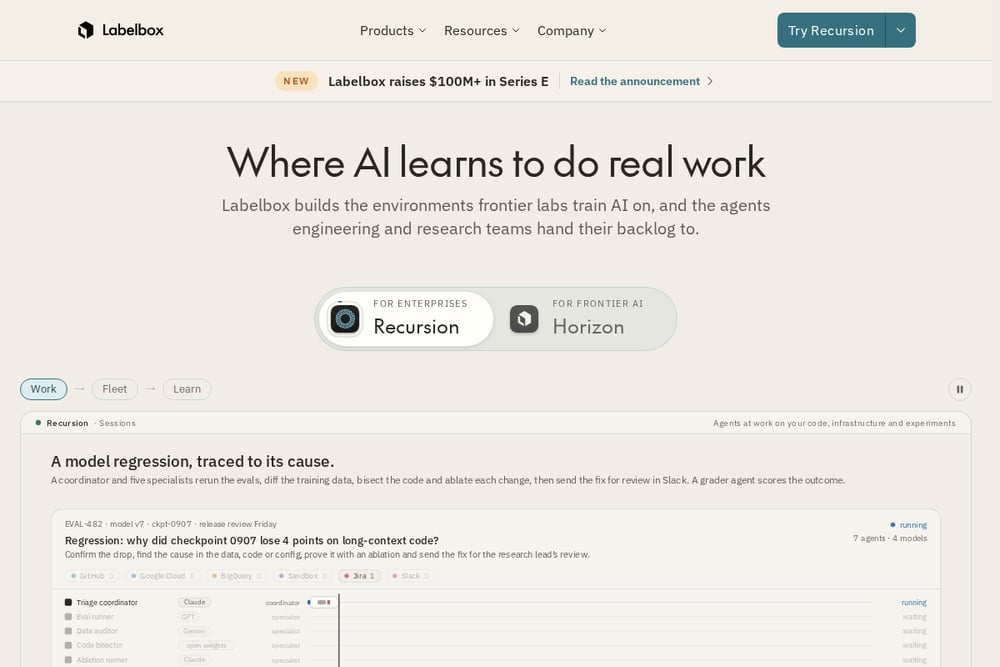 A screenshot of the Labelbox website.
Labelbox frames its offering as environments where AI learns to do real work, built for frontier labs and for engineering and research teams. Its Recursion product runs agents that pick up recurring jobs such as experiment sweeps, ablation runs, and model training, then report results back to the team. The platform is oriented toward teams that want automation around their research and evaluation loops, not just annotation screens. It suits organizations with substantial in-house ML engineering capacity.
#3 Label Studio
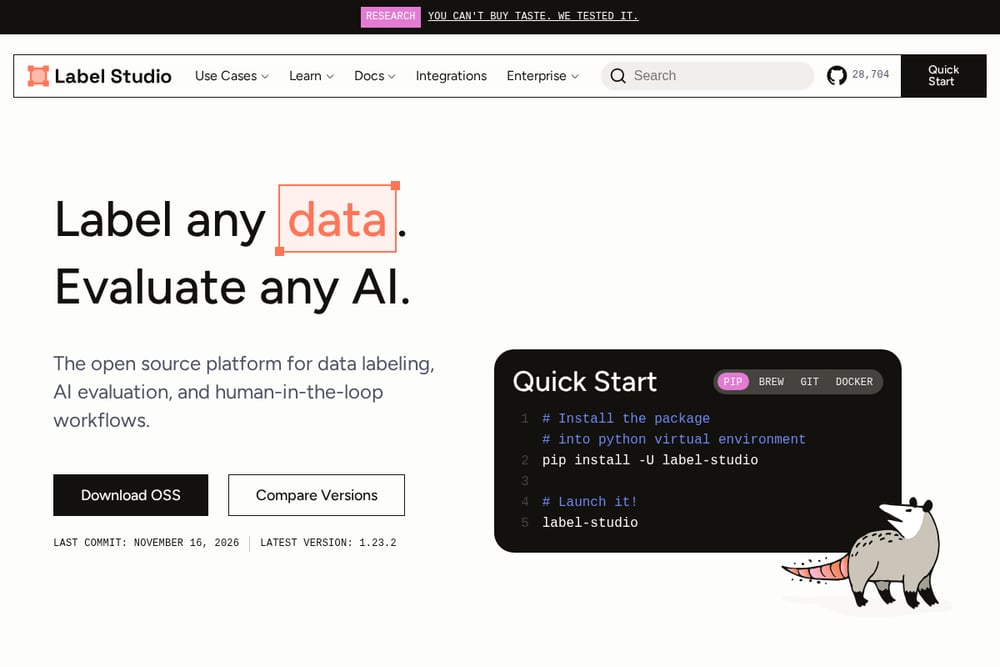 A screenshot of the Label Studio website.
Label Studio is an open source platform for data labeling, AI evaluation, and human-in-the-loop workflows. It supports a wide range of data modalities, from computer vision and documents to audio, time series, and multi-modal data. Teams can install it through common package managers or run it in Docker, and it exposes an API, Python SDK, and webhooks for wiring labeling into an existing pipeline. It suits teams that want a flexible, self-hosted foundation they can adapt to their own stack.
#4 V7
 A screenshot of the V7 website.
V7 presents itself as an operating system for repeatable work, with AI workflow-powered apps built on workflows, a context graph, and agent templates. Its published material emphasizes document-heavy processes in finance, insurance, and real estate, such as due diligence, underwriting, and policy checking. The company stresses security posture and data handling, stating that customer data is not used to train models. It suits teams whose labeling and review work is tied closely to document-centric business processes.
#5 SuperAnnotate
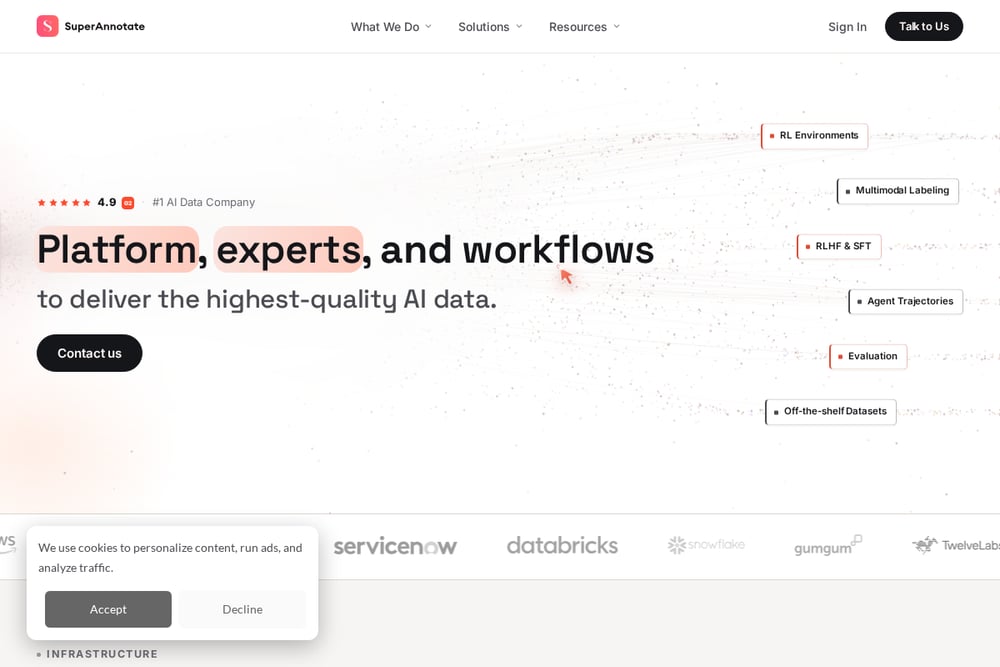 A screenshot of the SuperAnnotate website.
SuperAnnotate appears in this list as a platform that machine learning teams encounter when evaluating labeling options. The provided source page for the company did not include usable descriptive content, so no specific product claims are made here. Readers should consult the company's own materials for details on capabilities and fit. It is included so the list reflects the options teams commonly compare.
Which One Should You Choose?
Start with the shape of your existing pipeline. If labeling has to plug into code you already run, an open source platform with an API and SDK may fit more naturally. If your bottleneck is the research loop around experiments and evaluations, look at platforms that automate those recurring jobs. If your data lives inside document-heavy business processes, weigh vendors that emphasize workflow and security posture. Ask each vendor how data is handled and whether it is used for model training. Request a walkthrough against one of your own datasets rather than a generic demo, and confirm how review, QA, and human-in-the-loop steps are supported.
Final Thoughts
These five platforms reach the same problem from different angles. Scale AI leans toward frontier data work paired with evaluation and deployment. Labelbox leans toward agent-driven research and engineering workflows. Label Studio offers an open source, customizable base. V7 centers on document-heavy operational workflows with a strong security emphasis. SuperAnnotate is included for completeness, though its provided page did not yield verifiable product details. The right choice depends on where your team's friction actually sits, so compare them against your own pipeline rather than against each other.
Know a company that belongs on this list? Email us at editorial@peekwire.com.