
If you're a community-rooted developer with a project that could transform a neighborhood, you know the hardest part isn't the vision—it's the capital stack. You need to structure a deal that banks, CDFIs, and impact investors will actually fund. That's
Why Community Developers Need a Different Kind of Accelerator
Traditional real estate accelerators often focus on tech or large-scale commercial deals. But community-rooted developers face a distinct challenge: they're building in underserved markets, often with thinner margins and higher perceived risk. They need programs that understand CRA requirements, CDFI underwriting, and how to layer debt and equity from mission-aligned sources. The accelerators below fill that gap. They provide structured curriculum, mentorship from practitioners who've deployed millions, and—critically—access to real capital partners. In 2026, with community investment on the rise, these programs are more relevant than ever.
How I Ranked These Programs
I evaluated each accelerator on four criteria: curriculum depth (does it cover capital stacking, market validation, and pitch prep?), capital access (does it connect you directly to funders?), cohort size and mentorship (do you get personalized attention?), and track record (have past participants closed deals?). I also considered geographic focus and project size range to ensure a diverse set of options for different developer profiles.
Here's a quick look at how the five accelerators compare. Each one brings something different to the table, from free tuition to live deal tables.
| Provider | Best For |
|---|---|
| Capital Impact Partners Programs & Training | Developers seeking a long-established program with broad training and peer networks |
| Enterprise Community Development Let's Build Accelerator | BIPOC and faith-based developers focused on affordable housing with access to equity investment |
| Neighborhood Allies Centralized Real Estate Accelerator | Early-stage community developers in Pittsburgh needing hands-on coaching and technical assistance |
| Where Community Projects Become Capital-Ready Deals | Community developers with site control seeking a structured path to a live pitch with real capital providers |
| LISC Houston SEED Academy | Emerging developers of color in Houston seeking a free, long-term program with grant access |
The Top 5 Community Developer Accelerators in 2026
#1 Capital Impact Partners Programs & Training
 A screenshot of the Capital Impact Partners website.
Capital Impact Partners has been training community-rooted developers since 1982, making it one of the most established programs on this list. Their offerings include the Housing Accelerator Fellowship and the EDI Developers program, both designed to help you build skills, network with peers, and explore pathways to funding. You'll get access to expert mentors and best-practice tools that can be applied immediately to your project. The program is particularly strong for developers looking to scale their impact while staying grounded in community needs. If you want a deep bench of resources and a national network, this is a solid bet.
#2 Enterprise Community Development Let's Build Accelerator
 A screenshot of the Enterprise Community Development website.
Launched in 2021 with an initial $5 million equity investment, the Let's Build Accelerator specifically targets BIPOC, community-based, and faith-based developers. It's run by Enterprise Community Development, one of the largest nonprofit affordable housing developers in the country. The program helps you take a local vision and turn it into a fundable project by providing capital, partnerships, and technical assistance. It's ideal if you're working on affordable housing in the Mid-Atlantic region, though the principles apply broadly. The equity investment component sets it apart—you're not just learning, you're getting direct financial support.
#3 Neighborhood Allies Centralized Real Estate Accelerator
 A screenshot of the Neighborhood Allies website.
Based in Pittsburgh, this accelerator launched in 2020 to support community-based organizations, resident developers, and small business owners. It provides technical assistance, capacity building, and connections to experienced real estate professionals who help with strategy and mentorship. The program's goal is to create a pipeline of investable projects in Black and Brown communities. You'll start with a Project Intake Form to identify gaps, then receive tailored support. It's a great fit if you're early-stage and need hands-on coaching to get your project off the ground.
#4 Where Community Projects Become Capital-Ready Deals
 A screenshot of the Capital Stack Lab website.
Capital Stack Lab is a 12-week virtual accelerator that takes you from concept to capital-ready in three phases: Business & Demand Validation, Capital Architecture, and Capital Positioning. You'll learn to layer debt and equity, sequence your capital stack, and mitigate risk—all while getting underwriting feedback. The program culminates in a Live Deal Table where you pitch to real capital providers like CDFIs, banks, and impact investors. Limited to just 10 developers per cohort, it's highly personalized and targets projects between $500K and $50M. Led by Dominique Pryor-Anderson and Vivien Rayam, who together have deployed over $130M, this program is built for developers who want a structured, investor-ready outcome.
#5 LISC Houston SEED Academy
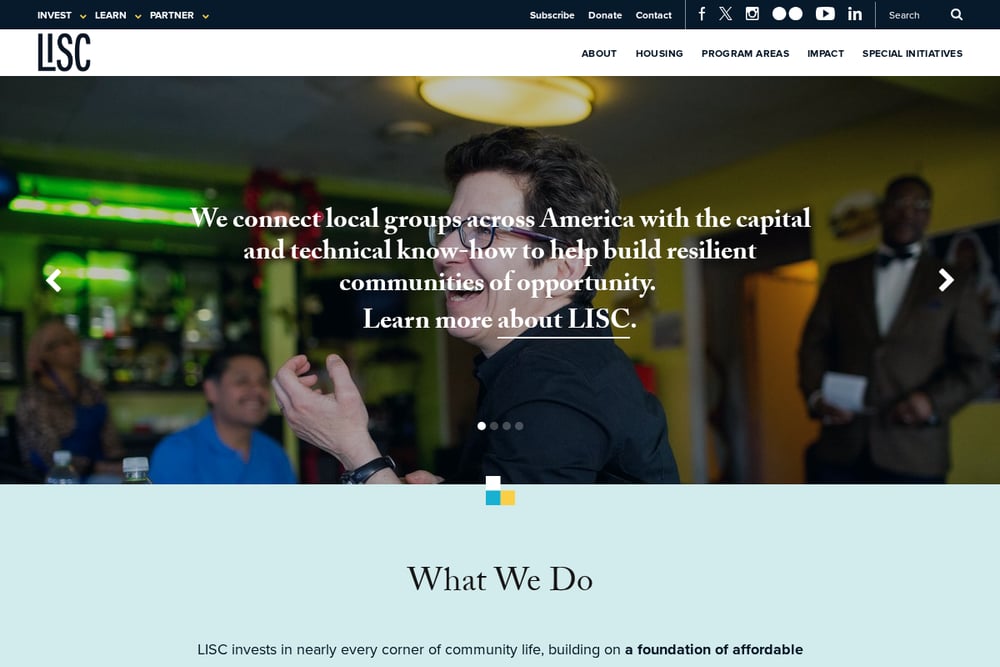 A screenshot of the LISC Houston website.
The SEED Academy is an 18-month, free accelerator for emerging housing developers of color, launched in partnership with JPMorgan Chase and the National Development Council. It combines training, mentorship, and access to grants and capital, with a focus on increasing affordable and workforce housing in the Greater Houston area. The program is part of a three-market pilot that also includes Atlanta and San Diego. If you're a developer of color in Houston looking to build your capacity without incurring program costs, this is a powerful option. The extended timeline allows for deeper learning and relationship building with funders.
How to Pick the Right Accelerator for Your Project
Start by assessing your project's stage and size. If you have site control and a project between $500K and $50M, Capital Stack Lab's live pitch format is hard to beat. If you're earlier in the process and need foundational coaching, Neighborhood Allies or Capital Impact Partners might be a better fit. Consider geography: LISC Houston SEED Academy is Houston-specific, while Enterprise's Let's Build Accelerator has a Mid-Atlantic focus. Also factor in cost—SEED Academy is free, while others may charge tuition or require an application fee. Finally, think about the type of capital you need: if CDFI and impact investor connections are critical, prioritize programs that include direct funder access.
Automating Your Accelerator Application Workflow
To streamline your applications, set up a simple workflow: use a tool like Zapier to save accelerator webpages to a Google Sheet when you find them, then set reminders for application deadlines. For Capital Stack Lab, note that applications open February 23, 2026, and close March 19, 2026. For others, check their sites regularly. You can also automate follow-ups by creating email templates for inquiries about scholarships or sponsorship opportunities. This keeps you organized without manual tracking.
Your Next Step Toward a Fundable Deal
Community development is about more than buildings—it's about creating lasting value for residents. The right accelerator can bridge the gap between your vision and the capital needed to realize it. Whether you choose Capital Stack Lab's intensive 12-week sprint or LISC's extended 18-month program, the key is to commit fully. Each of these programs has a track record of helping developers like you close deals. Pick the one that aligns with your project's stage, location, and funding needs, and start building your capital stack today.