
Curious about the startups and labs turning human brain data into the next generation of AI? These five US-based players are pushing the boundaries of NeuroAI, from open-source research to clinical applications.
The Rise of Brain-Trained AI
The field of NeuroAI is exploding, with experimental evidence showing that human brain data can supercharge machine learning, deep learning, and reinforcement learning models. Researchers are now building foundation models that learn from neural signals, promising more efficient and human-like AI. This space is attracting everyone from solo researchers to tech giants, each taking a unique approach to decoding the brain. For you, this means a rapidly evolving landscape where breakthroughs happen monthly, and the potential for real-world impact is immense.
How We Evaluated These NeuroAI Pioneers
We assessed each organization on research depth, technical innovation, and real-world applicability. We looked at the scale of their datasets, the novelty of their model architectures, and how accessible their findings are to the broader community. We also considered their focus areas, from fundamental theory to clinical translation, to give you a well-rounded view of the field.
Here's a quick snapshot of the five organizations we're highlighting, each contributing uniquely to the brain-AI intersection.
| Provider | Best For |
|---|---|
| Meta AI TRIBE v2 | High-resolution brain response prediction |
| Ouroboros Neurotechnologies | Fundamental Research at the Frontier of Neuroscience and AI | Maël Donoso | Foundational NeuroAI research and open-source code |
| Stanford AI-driven Foundation Models for Decoding Human Brain Imaging | Psychiatric and neurological diagnostics |
| Argonne NeuroX | Large-scale brain simulation with supercomputing |
| Bioptimus | Multimodal biology foundation models |
Deep Dive: The Five Pioneers
#1 Meta AI TRIBE v2
 A screenshot of the Meta AI TRIBE v2 website.
Meta AI's TRIBE v2 is a predictive foundation model that acts as a digital twin of human neural activity, trained on data from over 700 volunteers. It offers a 70x resolution increase over similar models, enabling zero-shot predictions for new subjects and tasks. This model is a game-changer for neuroscientists and clinical researchers, allowing them to test theories without human subjects. Meta has released the model, codebase, and an interactive demo, making it a powerful resource for the community. If you're looking to leverage brain insights for building better AI systems, this is a must-explore.
#2 Ouroboros Neurotechnologies | Fundamental Research at the Frontier of Neuroscience and AI | Maël Donoso
 A screenshot of the Ouroboros Neurotechnologies website.
Ouroboros Neurotechnologies is a one-person startup, or as founder Maël Donoso calls it, a 'one-brain army,' focused on fundamental research at the intersection of neuroscience and AI. Their Neuropoiesis program spans neural alignment, neural reasoning, and brain-trained foundation models, with publications in top venues like ICLR and Frontiers. They've also developed Neuropolis, an AI system for EEG-to-fMRI prediction that achieved significant results in brain decoding. Their work on 'Human Brain Zero' and 'Toward Brain-Trained Humanoid Robots' shows a bold vision for the future. If you're interested in the theoretical foundations of NeuroAI, this is a unique and inspiring source.
#3 Stanford AI-driven Foundation Models for Decoding Human Brain Imaging
 A screenshot of the Stanford Explore Technologies website.
Stanford researchers have developed a unified AI architecture that integrates foundation models with AI techniques for efficient fMRI data analysis, specifically for psychiatric disorders. This invention addresses the scalability and adaptability challenges of conventional fMRI analysis, which often relies on extensive labeled datasets. Their models can identify neurobiological markers and predict symptom severity with minimal labeled data, making it a scalable and versatile tool. This technology is ideal for precision diagnostics and targeted treatments in psychiatry and neurology. If you're in healthcare or research, this could be a valuable asset for decoding complex brain imaging data.
#4 Argonne NeuroX
 A screenshot of the Argonne Leadership Computing Facility website.
Argonne National Laboratory's NeuroX project is a foundation neuroscience AI model developed at the Argonne Leadership Computing Facility. It leverages supercomputing resources to train models on massive datasets, pushing the boundaries of what's possible in brain simulation. NeuroX aims to provide a foundational model that can be used for a wide range of neuroscience research, from understanding brain function to developing new treatments. The project is part of Argonne's broader mission to accelerate scientific discovery through high-performance computing. If you're looking for large-scale computational approaches to brain modeling, this is a key player.
#5 Bioptimus
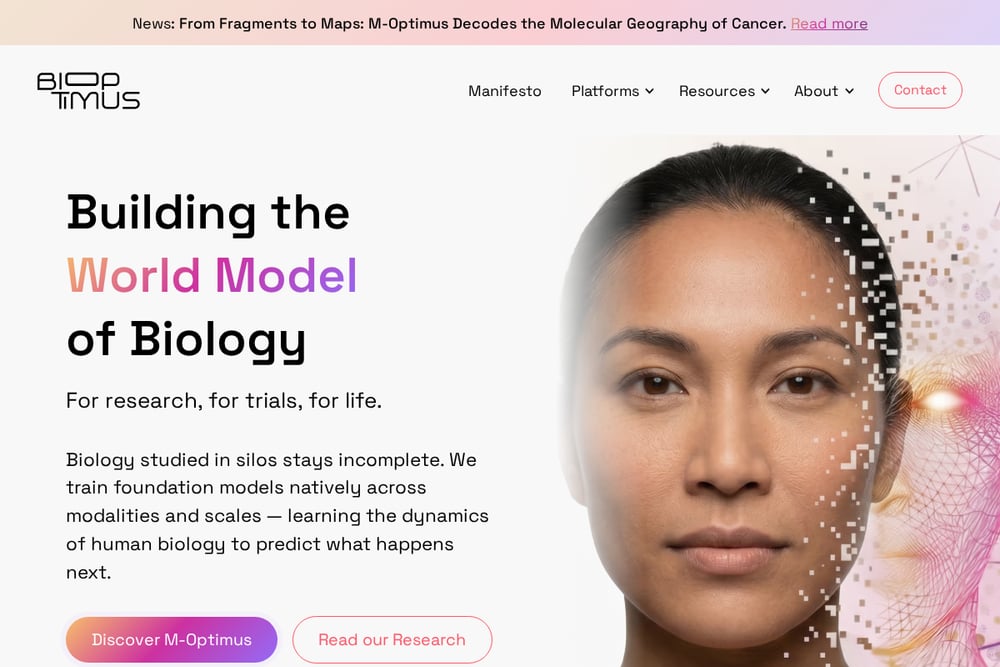 A screenshot of the Bioptimus website.
Bioptimus is building the 'world model of biology,' training foundation models natively across modalities and scales, from cell to tissue to organ. Their models, like H-Optimus and M-Optimus, are designed to predict biological dynamics, with applications in drug discovery and personalized medicine. They have a strong team of ML researchers and biologists from top institutions like Google Brain and Meta, and they're trusted by 16 of the top 20 pharma companies. Their STELA initiative generates deeply profiled, clinically linked patient data at scale, which is crucial for training robust models. If you're interested in applying brain-inspired AI to broader biological systems, Bioptimus is a leader.
How to Choose the Right NeuroAI Partner
When you're evaluating these organizations, think about your specific needs. Are you looking for open-source tools and research to build upon, or do you need a clinical diagnostic solution? Consider the scale of data and compute each one uses—Meta and Argonne have massive resources, while Ouroboros offers a more focused, theoretical approach. Also, look at their publication records and whether they release code, as this indicates how accessible their work is. Finally, consider the application area: if you're in healthcare, Stanford's work might be most relevant; if you're in drug discovery, Bioptimus could be the fit. Each of these pioneers has a unique strength, so align their focus with your goals.
Automating Brain-Inspired AI Workflows
You can integrate brain-trained AI models into your workflows to automate complex tasks. For instance, use Meta's TRIBE v2 to simulate brain responses to stimuli, reducing the need for human subjects in early-stage research. Ouroboros's open-source code can be adapted to train your own models on brain data, automating feature extraction and improving model performance. Stanford's foundation models can automate the analysis of fMRI data, flagging potential biomarkers for psychiatric conditions. By leveraging these tools, you can streamline research processes and accelerate discovery.
The Future of NeuroAI Is Collaborative
The NeuroAI landscape is vibrant and diverse, with each of these five organizations contributing a unique piece to the puzzle. From Meta's massive-scale models to Ouroboros's foundational theories, the field is advancing rapidly. Whether you're a researcher, clinician, or developer, there's a resource here for you. The key is to stay curious and experiment with these tools, as the next breakthrough could come from any of them. As brain-trained AI continues to evolve, collaboration between these pioneers will likely drive the most impactful innovations.