When the Wall Doesn't Match the Guide
Art fair booth planning often starts with a hanging guide, but the reality on site is rarely an exact match. Ajit, founder of Mount My Art, has exhibited at many fairs with his wife and says the dimensions in guides are almost never accurate. "In all the fairs my wife and I have done, no wall has ever matched the dimensions in the hanging guide," he says. "Walls are always a few centimetres off, usually narrower, because of the width of the panels."
Stands are sold by wall width, so height is often overlooked by both sides, yet Ajit points out that height matters when hanging art. "The visual centre of a piece depends on it," he explains. "Hang too high or too low and you make the work harder to view, and you change how the stand lighting falls on it."
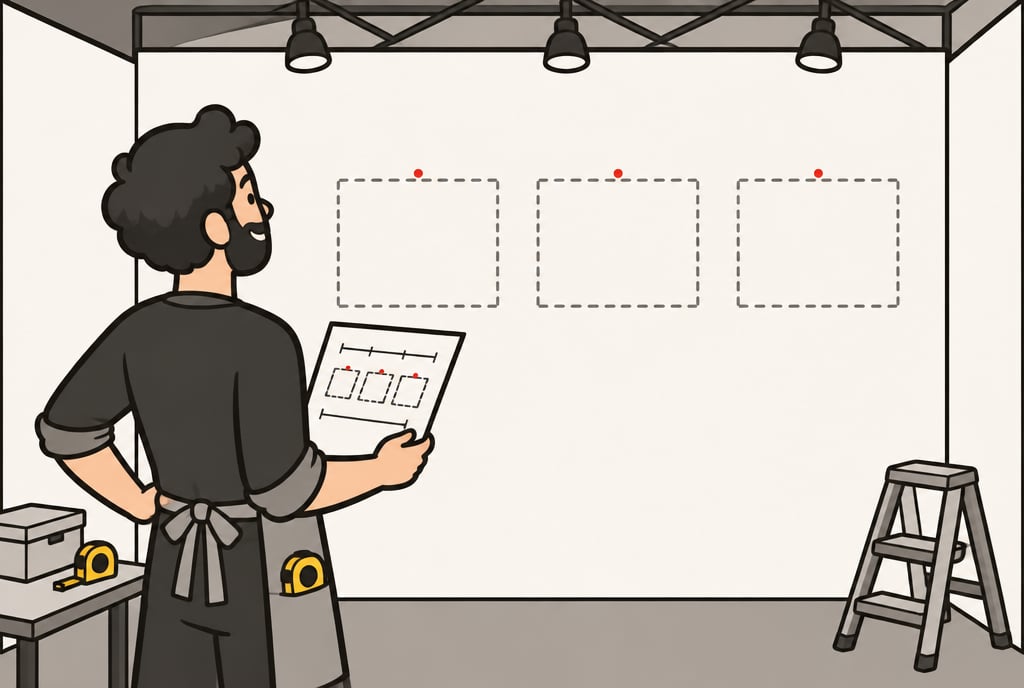
As an installer for his wife's work, Ajit plans ahead because they have children waiting at home and cannot afford to experiment on the day. He measures every piece, lays them out as his wife wants, and calculates nail points in advance, knowing he will have to redo the sums once he measures the real walls. "I've found a calculation error halfway through a hang and had to recalculate several pieces," he recalls. "Once I forgot the printout and had to start again on site."
This experience led to the creation of Mount My Art. "My wife arranges the work and tries different layouts, and it gives me exact nail points from the stand sizes in the fair guide," Ajit says. "At the fair, I measure the real walls, enter them, and every nail point is recalculated straight away. No more scribbling and calculators."
What Hanging Guides Leave Out
Beyond dimensions, Ajit notes that hanging guides and online checklists cannot cover everything. "A hanging guide gives you your stand size and where you are on the floor plan," he says. "It can't tell you about the lighting in the venue or how visitors naturally move through the aisles, and you can only judge both on the day." Both factors influence how an artist should orient their layout. "Your focus pieces are the ones that draw people into the stand, so they need to sit where visitors' eyes naturally go."
Even with thorough planning, changes may be necessary. "You may need to swap a few paintings, or mirror the whole booth by moving everything from the left wall to the right," Ajit says. "Done by hand, that is so painful that many artists stick with the layout they planned, knowing it isn't the best one." With Mount My Art, artists can adjust layouts on their phone at the fair, or even swap entire walls, and get new nail points immediately. Ajit calls this "organised spontaneity."
The First-Timer's Mistake: Filling Every Centimetre
When laying out a booth for the first time, Ajit observes that many artists try to use every bit of space. "First-time exhibitors often want to fill every centimetre of their space," he says. "What isn't shown can't be sold, or so the thinking goes." His advice is to give the stand and the work room to breathe. "That is what separates a market stall from a gallery or exhibition presentation," he explains. "A crowded stand lets visitors see everything you've made, but it also feels cluttered and makes choosing harder."
To connect with a piece, Ajit believes a person needs to look at it without the next one competing for attention. "Once someone connects with your work, you can talk to them and bring out other pieces you think will appeal, based on that conversation."
Practical Takeaways for Artists
- Measure the real walls on site and be prepared to recalculate nail points. Guides are rarely exact.
- Account for height, not just width, because it affects visual centre and lighting.
- Plan ahead but stay flexible—use tools that let you adjust layouts quickly on the day.
- Observe lighting and visitor flow before finalising your orientation.
- Resist the urge to fill every space; give artwork room to breathe to create a gallery-like experience.
Mount My Art is currently in beta for solo artists, with solutions for collectives and galleries to follow. For more information, visit Mount My Art.
For further reading on art fair preparation, see The Art Fair Company and Art Business News.