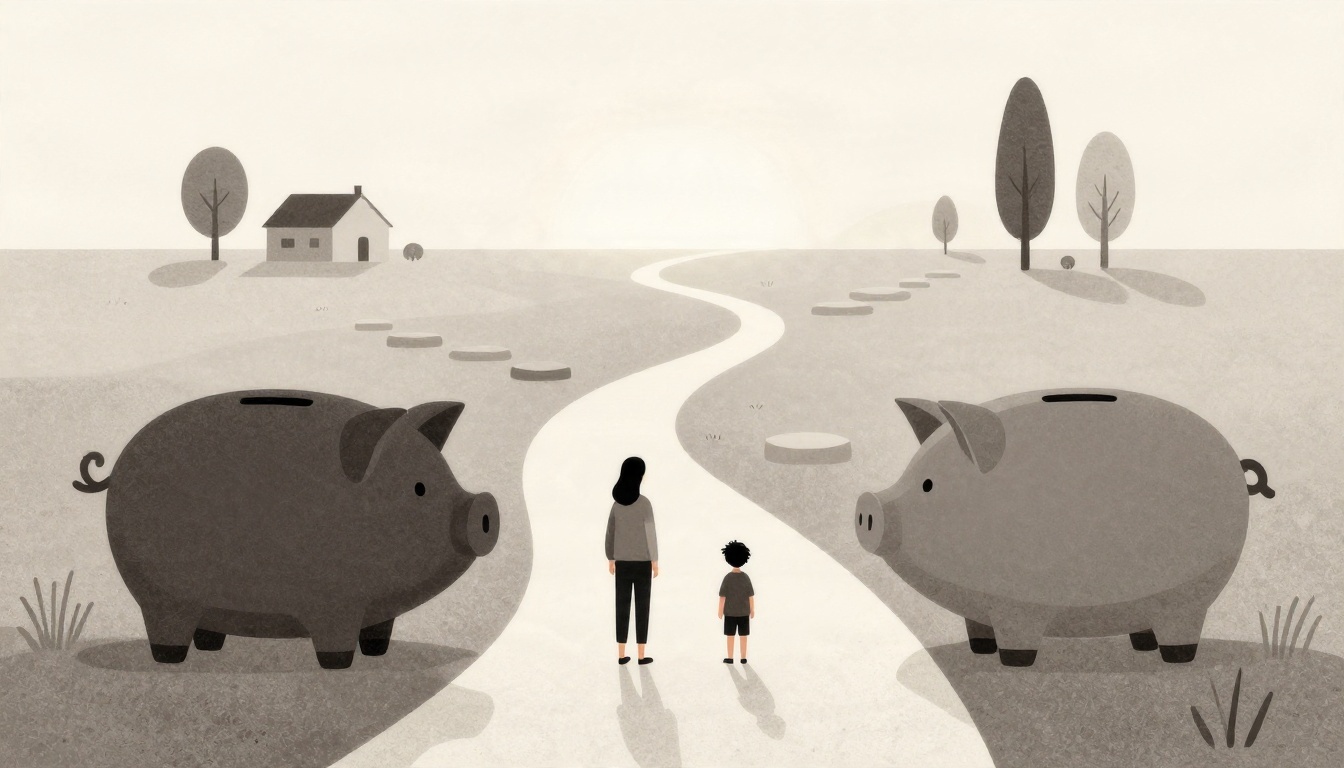
Beyond the Piggy Bank: What Standard Money Advice Misses for Families
Most family financial education starts with the same four words: earn, save, invest, give. It is a tidy framework, easy to teach, and widely repeated. But when Jonathan Wildy, whose work is featured through Altazimuth Academy, was asked when the usual advice about teaching kids about money failed to fit a real family, he did not reach for a case study. He reached for his own household.
When the Standard Playbook Breaks Down
The familiar guidance, he said, is to "just put money away for a retirement and a rainy day and there will always be money." That framing assumes a fairly linear financial life. His was not.
"When It cost us about $250K to have kids it was quite the blow to our finances," he said. "Then started businesses and those took real money so the money going into businesses and homes were our investments and those don't have a well defined 4% rule when you look at contributions and returns or a vacancy or emergency repair."
The 4% rule, a common shorthand for retirement withdrawals, assumes a diversified portfolio with reasonably predictable returns. Business income and rental properties behave differently. "We couldn't look at an average 8% return for sure," Wildy said. "Some years were amazing. Airbnbs took time or needed updates."
Add a trust and a deliberate decision to build a legacy beyond the couple's own retirement, and the standard mold no longer fits. What replaced it, in his telling, was a method rather than a rule: "Planning and knowing how to work out a future to build backwards truly is what is needed and understanding are you moving forward and gaining momentum is critical."
What the Search Results Leave Out
Wildy is direct about the value of the first lessons most families encounter. "The easiest advice for kids is earn, save, invest, and maybe give-back," he said. "That is the Dave Ramsey, and all other first lesson."
His concern is what comes after. "But they don't teach them there is a whole future of stewardship of that money for yourselves, and generations," he said. "If you are starting early in life you should be able to set your family and future generations up to be wealth leaders in the world."
That ambition comes with an honest caveat. "Few will take the opportunity to do so," Wildy said. "The information is there. The ability to do so is now more prevalent than ever. It may take a generation or two."
The hardest part, in his view, is not the mechanics but the continuity. "Teaching them, and continuing to instill the values so completely that one generation doesn't squander it or that it is set-up in such a way that it cannot be lost." This is the territory of estate planning and family governance, subjects that rarely appear in a child's first money lesson.
The Assumptions Parents Make Too Quickly
Asked what parents decide too fast when they begin teaching money at home, Wildy named two beliefs. The first: "It's too early to teach them and let them have fun and the kids will figure it out like we did." The second, which he called "worse": "we don't understand it… we can't teach them."
Both conclusions end the conversation before it starts. The first defers learning to chance. The second treats financial literacy as a credential rather than a practice.
Practical Takeaways
- Stress-test the standard rule. A 4% withdrawal rate or an 8% average return may not describe a household with business income, rental property, or irregular expenses. Build projections around your actual cash flows.
- Plan backwards from the future you want. Rather than forecasting forward from today, start with the legacy or retirement you are aiming for and work out what it requires.
- Track momentum, not just balances. Wildy treats the question of whether a family is moving forward and gaining momentum as critical, which matters when year-to-year returns are uneven.
- Teach stewardship, not just accumulation. Saving is the first lesson; deciding how money is held, passed on, and protected across generations is the longer curriculum.
- Do not wait for certainty. The two assumptions Wildy flags, that it is too early or that parents are unqualified, are the ones most likely to delay a child's financial education entirely.
For families searching for how to teach kids about money, the interview suggests the search should not stop at the first set of rules. The more useful question may be what kind of financial future the family is trying to build, and who is being prepared to steward it.