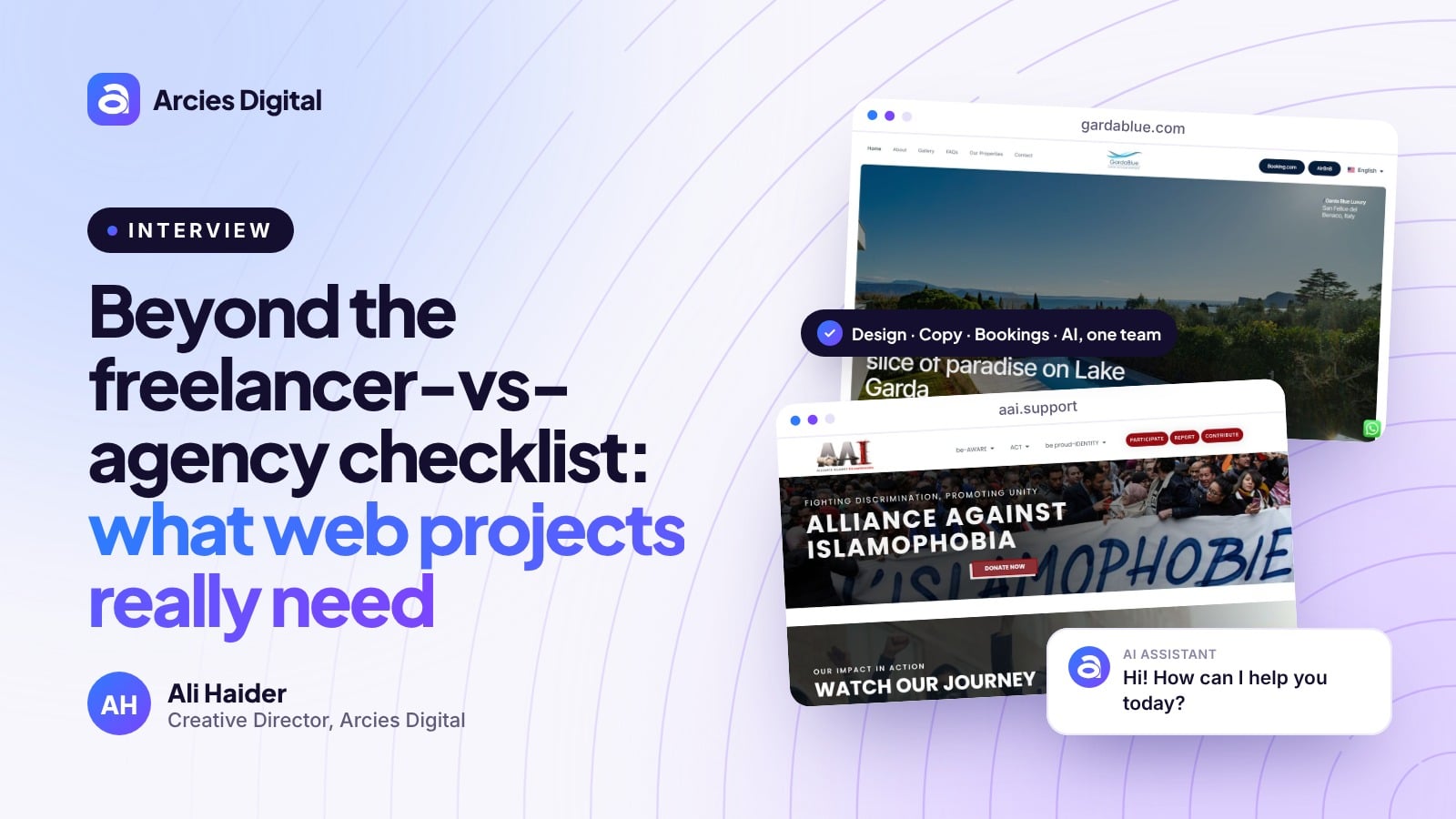
Beyond the Freelancer-vs-Agency Checklist
Most advice about hiring a web designer frames the choice as a simple binary: a freelancer for small jobs, an agency for big ones. Ali Haider, Creative Director at Arcies Digital, argues that framing misses what most projects actually require. In a short written interview, he described projects that looked like one-person jobs on paper but needed several disciplines at once, and he named the questions that rarely appear on pages ranking for "hire a web designer."
When the usual advice doesn't fit
Haider pointed to a holiday-rental owner who needed three multilingual property websites, each linked to Airbnb, Booking.com and Vrbo. "On paper it looked like a small freelancer job. In reality it needed design, copy in several languages, booking integrations and ongoing updates, which is more than one person can comfortably juggle."
A second example involved a non-profit that needed a full website plus an AI chatbot to answer visitors' questions around the clock. "The usual advice treats 'website' and 'AI' as separate hires. Having one team build both meant the chatbot was trained on the same content and launched alongside the site, not bolted on months later."
He summarized the pattern plainly: "The advice assumes a project is one skill. Most real projects quietly need three or four." That observation is a useful corrective for owners who scope a project by counting deliverables rather than by mapping the skills each one demands.
What the ranking pages leave out
Asked what keeps surfacing in first conversations that the top search results omit, Haider listed five recurring gaps:
- What happens after launch: "who updates the site, fixes things and keeps it fast and secure."
- Content: "who writes the words and sources the photos. It's the number one reason launches slip, and it's rarely in the quote."
- *How the site will actually bring in enquiries (SEO, ads, social), not just how it will look."
- Ownership: "who holds the domain, hosting and logins at the end."
- *Time zones and communication, especially for international clients: how often they'll hear from us and how quickly."
These are practical, checkable items. An owner can ask about each one before signing anything, and the answers will say more about fit than a portfolio alone. The content point is especially worth pressing on: a quote that excludes copywriting and photography is not a cheaper quote, just an incomplete one.
What owners lock in too early
On the freelancer-versus-studio decision, Haider said owners tend to commit to details before the underlying questions are settled:
- "The platform, often because a friend uses it, before anyone has looked at what they sell and who will run the site."
- "A fixed page list and a template, before the goals and the customer journey are clear."
- "The cheapest quote, comparing day one prices instead of the cost over two or three years, including their own time."
- "A launch date, before the content exists."
His advice inverts the usual order: "lock in the goal and the budget range first, and let the scope follow." That sequencing gives a freelancer or a studio something concrete to respond to, and it makes competing quotes easier to compare on like-for-like terms.
Practical takeaways
For owners preparing to hire, the interview suggests a short pre-brief checklist. Define the goal and a budget range before discussing platforms or page counts. Ask who will handle content, post-launch maintenance, and ownership of domain, hosting and logins. Ask how enquiries are expected to arrive, not only how the site will look. And compare costs over two or three years rather than at day one.
For studios, the implication is that the first conversation is where trust is won or lost. Naming the unglamorous parts — content, handover, upkeep, communication cadence — distinguishes a studio from a quote generator. Haider's examples show why: the projects that fit a multi-disciplinary team are often the ones that looked simple at the start.
Arcies Digital describes itself as working across websites, branding, content and AI. More about the studio is available at arciesdigital.com. For readers weighing options, neutral starting points include Google's guidance on hiring a website designer and the U.S. Small Business Administration's digital presence resources.