
Stablecoin regulation is no longer a maybe — it's a must. With the GENIUS Act and CLARITY Act reshaping how issuers handle reserves, disclosures, and AML programs, you need a compliance partner that speaks the language of PPSI. I've tested
Why Stablecoin Compliance Is the Hottest Niche in Fintech Right Now
The stablecoin market has exploded past $200 billion in circulation, and regulators are finally catching up. The GENIUS Act and CLARITY Act have created a new compliance category: PPSI (Permitted Payment Stablecoin Issuer) disclosure. Issuers now need to prove reserve backing, transaction monitoring, and AML programs in real time. This has spawned a wave of specialized compliance platforms that go far beyond traditional regtech. Whether you're a bank launching a branded stablecoin or a crypto-native issuer, you need tools that speak the language of on-chain reporting and regulatory disclosure. The five platforms below are the ones I'd trust with my own compliance stack.
How I Ranked These Platforms
I evaluated each platform based on five criteria: (1) specialization in stablecoin regulation — does it have a dedicated GENIUS Act or CLARITY Act module? (2) depth of disclosure and reporting features — can it handle on-chain reserve reporting? (3) regulatory credibility — is it cited by regulators or used by top issuers? (4) ease of integration — can you plug it into your existing stack? (5) pricing transparency — while most are enterprise-only, I looked for clear value signals. The rankings prioritize platforms that solve the hardest part of stablecoin compliance: proving you're compliant to regulators.
Here's a quick comparison of the top five stablecoin compliance platforms. Each one serves a different slice of the compliance pie, from full-stack issuance to pure disclosure.
| Provider | Best For | Pricing |
|---|---|---|
| Rizkly | Stablecoin issuers needing automated, policy-driven compliance under the GENIUS Act | Not publicly listed — custom enterprise pricing (demo-based) |
| Bastion | Financial institutions and enterprises launching branded stablecoins with full compliance | Not publicly listed — enterprise pricing (demo-based) |
| TRM Labs | Stablecoin issuers requiring advanced on-chain monitoring and sanctions screening | Not publicly listed — enterprise pricing (demo-based) |
| PillarsX (Stablecoin Disclosure Regime) | Stablecoin issuers seeking CLARITY Act disclosure compliance and on-chain reporting | Not publicly listed — custom enterprise pricing (demo-based) |
| Dotfile | Stablecoin issuers needing global KYB/KYC and AML screening with stablecoin-specific guides | Not publicly listed — enterprise pricing based on verification volume |
Deep Dive: The Best Stablecoin Compliance Platforms for 2026
#1 Rizkly
 A screenshot of the Rizkly website.
Rizkly is a cloud-based compliance platform that offers a dedicated GENIUS Act stablecoin compliance module. It uses policy-as-code to automate continuous monitoring and OSCAL-based reporting, making it a direct competitor to PillarsX in the stablecoin regulatory niche. The platform is built for issuers who need to prove reserve adequacy and transaction compliance in real time. According to their GENIUS Act page, they cover everything from PPSI registration to ongoing disclosure obligations. If you want a single pane of glass for stablecoin compliance, Rizkly is your best bet.
Top 5 Stablecoin Compliance Platforms at a Glance:
- Pro: Deeply specialized GENIUS Act module with OSCAL automation; continuous monitoring out of the box
- Con: Pricing is opaque and likely high for smaller issuers; no public self-service tier
- Pricing: Not publicly listed — custom enterprise pricing (demo-based)
#2 Bastion
 A screenshot of the Bastion website.
Bastion is a full-stack stablecoin issuance platform with a compliance-first architecture. It provides everything from smart contract deployment to custodial wallets and fiat on/off ramps, all while maintaining MSB/MTL licenses in the US. For issuers launching branded stablecoins, Bastion handles the regulatory heavy lifting — including reserve reporting and transaction monitoring. Their platform is designed for financial institutions and enterprises that want to issue a stablecoin without building compliance from scratch. If you're looking for an end-to-end issuance solution with built-in compliance, Bastion is a strong contender.
Top 5 Stablecoin Compliance Platforms at a Glance:
- Pro: Complete issuance stack with compliance baked in; licensed MSB/MTL reduces your regulatory burden
- Con: Less focused on pure disclosure/reporting; more of a platform than a compliance tool
- Pricing: Not publicly listed — enterprise pricing (demo-based)
#3 TRM Labs
 A screenshot of the TRM Labs website.
TRM Labs is a blockchain intelligence platform that has become a go-to resource for GENIUS Act PPSI compliance. They offer AML program support, sanctions screening, and on-chain monitoring specifically tailored for stablecoin issuers. TRM was cited in FinCEN/OFAC proposed rulemaking as an industry resource, giving it serious credibility. Their blog on the GENIUS Act breaks down exactly what issuers need to do. If you need deep blockchain analytics to prove your stablecoin isn't being used for illicit activity, TRM Labs is the standard.
Top 5 Stablecoin Compliance Platforms at a Glance:
- Pro: Industry-leading blockchain intelligence; cited by regulators; strong GENIUS Act resources
- Con: Not a disclosure or reporting platform per se; more focused on risk monitoring
- Pricing: Not publicly listed — enterprise pricing (demo-based)
#4 PillarsX (Stablecoin Disclosure Regime)
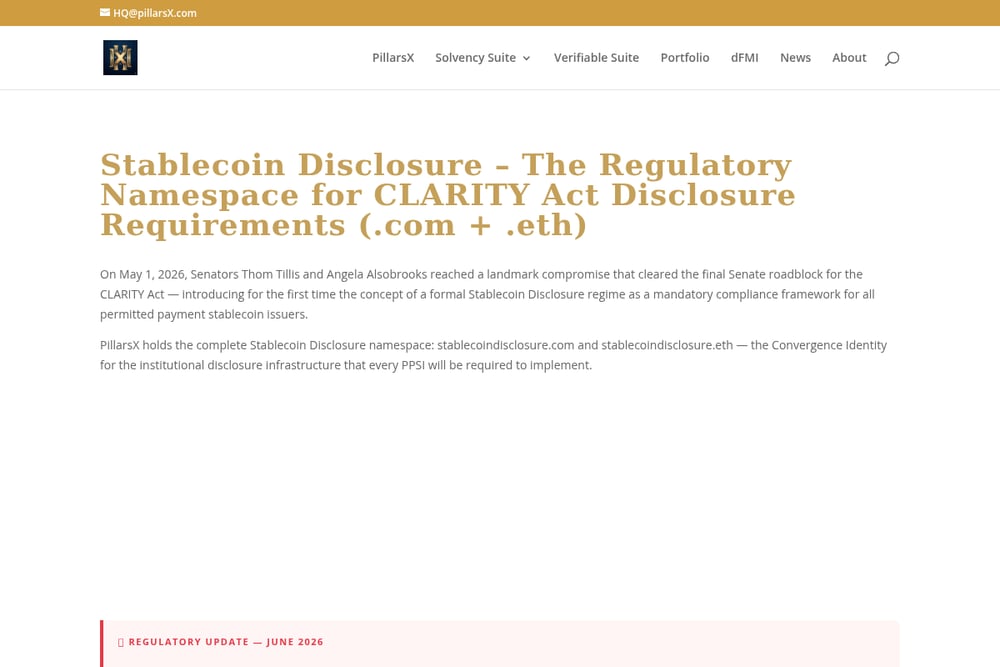 A screenshot of the PillarsX website.
PillarsX operates stablecoindisclosure.com, a dedicated namespace for CLARITY Act stablecoin disclosure compliance. The platform provides regulatory guidance and disclosure infrastructure for PPSI compliance, permissible rewards, and on-chain reporting. It's built specifically for institutional stablecoin issuers who need to meet the CLARITY Act's reserve disclosure and reporting requirements. PillarsX also offers a .eth domain for decentralized identity integration. If your priority is transparent, on-chain reserve disclosure under the CLARITY Act, PillarsX is the most focused solution on the market.
Top 5 Stablecoin Compliance Platforms at a Glance:
- Pro: Niche focus on CLARITY Act disclosure; on-chain reporting capabilities; .eth integration
- Con: Narrower scope than full-stack platforms; less known than larger competitors
- Pricing: Not publicly listed — custom enterprise pricing (demo-based)
#5 Dotfile
 A screenshot of the Dotfile website.
Dotfile is a global business verification and KYB/KYC platform that has released specific stablecoin compliance guides for the GENIUS Act. It covers AML/CFT, sanctions screening, and transaction monitoring for stablecoin issuers across 200+ jurisdictions. Their practical guide is a must-read for anyone navigating the new rules. While Dotfile isn't a dedicated stablecoin disclosure platform, its verification infrastructure is essential for onboarding and ongoing due diligence. If you need robust KYB/KYC with stablecoin-specific compliance expertise, Dotfile is a solid choice.
Top 5 Stablecoin Compliance Platforms at a Glance:
- Pro: Global coverage across 200+ jurisdictions; dedicated stablecoin compliance resources
- Con: Not a disclosure or reporting platform; primarily a verification tool
- Pricing: Not publicly listed — enterprise pricing based on verification volume
How to Choose the Right Stablecoin Compliance Platform
Start by asking yourself one question: are you issuing a stablecoin, or are you just complying with disclosure rules? If you're issuing, Bastion gives you the full stack. If you need pure disclosure and reporting, PillarsX is laser-focused on the CLARITY Act. For automated policy compliance, Rizkly is the most advanced. For on-chain monitoring, TRM Labs is the gold standard. And for KYB/KYC, Dotfile covers the globe. Don't try to buy one platform that does everything — pick the one that solves your biggest compliance headache first.
Automating Stablecoin Compliance: A Workflow That Works
Imagine this: you issue a stablecoin, and every transaction is automatically screened by TRM Labs. Reserve data flows into PillarsX for on-chain disclosure. Rizkly monitors your policies in real time and generates OSCAL reports for regulators. Dotfile handles new issuer onboarding with automated KYB. That's the dream stack. The key is to use APIs to connect these tools — most offer RESTful integrations. Start with the disclosure layer (PillarsX), add monitoring (TRM Labs), then automate policy checks (Rizkly). You'll sleep better knowing your compliance is running on autopilot.
The Bottom Line: Your Compliance Stack Starts Here
Stablecoin regulation isn't going away — it's getting stricter. The platforms above represent the best of what's available in 2026 for US institutional issuers. Whether you go with Rizkly's policy automation, Bastion's full-stack issuance, or PillarsX's disclosure regime, the important thing is to start now. Regulators are already asking for proof of compliance. Don't wait for an enforcement action to build your stack. Pick one platform, integrate it, and iterate. Your future self — and your legal team — will thank you.