
If you're running a business in 2026, your payment processor is either your best friend or your biggest headache. The wrong one means hidden fees, clunky hardware, and customers bouncing at checkout. The right one? It just works. I've dug
The State of Payment Processing in 2026
Payment processing has evolved far beyond the simple swipe of a card. Today, businesses need to accept payments in person, online, and on the go—all while keeping data secure and fees low. The market is crowded with options, from legacy giants to agile newcomers. According to Built In, fintech has given merchants and customers more choices than ever, with payment processors verifying transactions across card networks, banks, and digital wallets. The key differentiators now are transparency, scalability, and customer support. In 2026, the best processors don't just move money; they help you run your business smarter.
How I Ranked These Processors
I evaluated each payment processor across five key criteria: pricing transparency (no hidden fees), feature set (POS, gateways, recurring billing), ease of use (setup and daily operations), customer support (availability and quality), and scalability (ability to grow with your business). I also considered third-party reviews from sources like NerdWallet and Zapier to ensure real-world reliability. Each processor had to meet a baseline of PCI compliance and uptime to make the cut.
Here's a quick look at the top five payment processors and what they do best.
| Provider | Best For |
|---|---|
| Square Payments | All-in-one in-person and online payments |
| Helcim | Low-cost interchange-plus pricing |
| Stripe | Customizable online payments and subscriptions |
| SalenPay | Scalable, secure payment processing with U.S. support |
| PayPal | Quick setup and global brand trust |
Deep Dive: The Best Payment Processors for Your Business
#1 Square Payments
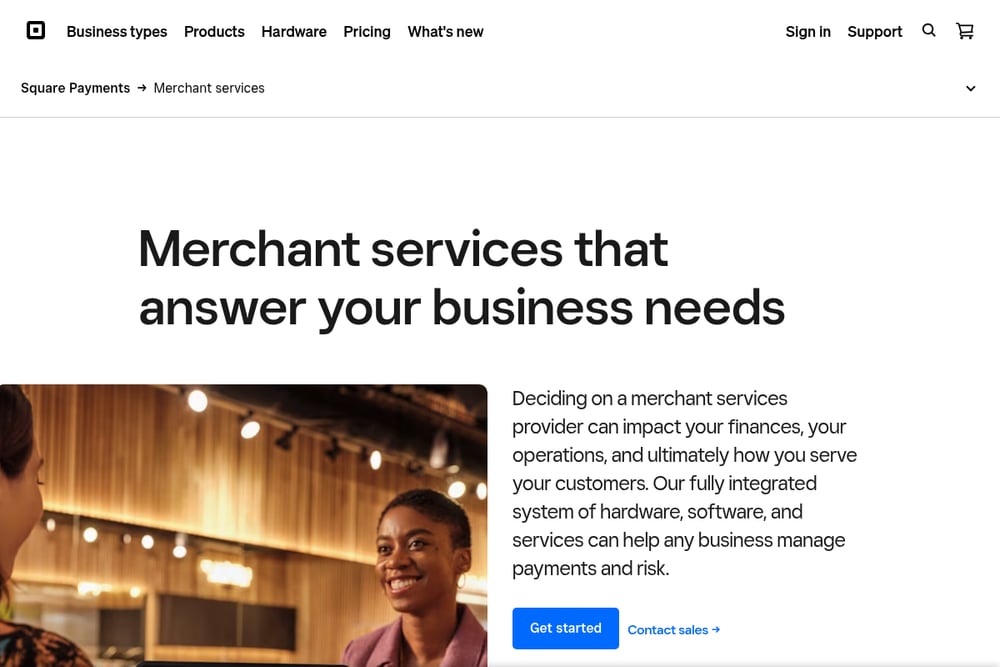 A screenshot of the Square website.
Square is the go-to for businesses that want an all-in-one system. Their fully integrated hardware, software, and services handle everything from in-person card swipes to online checkouts. You don't even need a separate merchant account—just a bank account to start processing. Square's transparent pricing and free POS software make it a no-brainer for retailers and restaurants. As noted by NerdWallet, Square's in-person rates hover around 2.6% plus 10 cents, which is competitive for most small businesses. Plus, their ecosystem includes inventory management and payroll, so you can run your entire operation from one dashboard.
#2 Helcim
 A screenshot of the Helcim website.
Helcim is the champion of transparent, low-cost processing. They use interchange-plus pricing, which means you pay the actual card network fee plus a small markup—no hidden monthly fees or long-term contracts. According to Zapier, Helcim is best for interchange pricing and volume savings, making it ideal for growing businesses. Their platform is easy to set up, and their customer support is famously friendly and bot-free. If you're processing over $5,000 a month, Helcim's rates can save you up to 25% compared to flat-rate processors. It's a smart pick for merchants who want to keep more of their hard-earned revenue.
#3 Stripe
 A screenshot of the Stripe website.
Stripe is the developer's dream—a payment gateway built for customization and scale. With rich analytics, a powerful API, and support for 135+ currencies, it's the backbone for thousands of online businesses. Stripe's online rate is typically 2.9% plus 30 cents, which is fair for the flexibility you get. As highlighted by Built In, Stripe is one of the top fintech payment companies because it handles everything from credit cards to digital wallets and ACH transfers. If you need recurring billing, subscription management, or advanced fraud detection, Stripe's tools are second to none. It's the best choice for tech-savvy founders and e-commerce stores that want full control.
#4 SalenPay
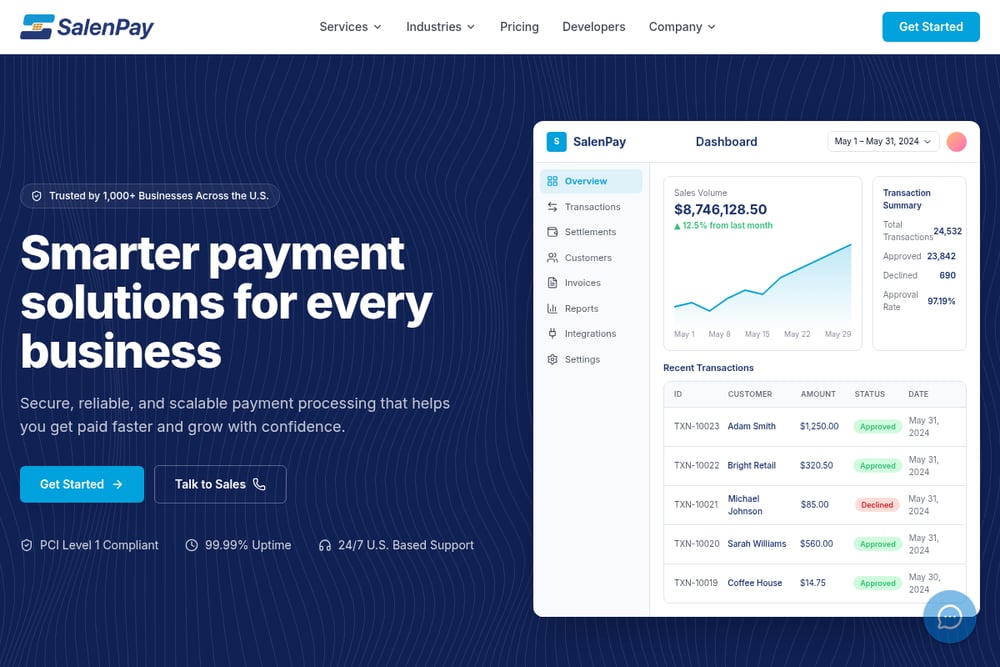 A screenshot of the SalenPay website.
SalenPay is the dark horse that deserves your attention. They offer a full suite of payment solutions—merchant accounts, POS systems, payment gateways, and mobile readers—all wrapped in a unified dashboard. With PCI Level 1 compliance and 99.99% uptime, your transactions are both secure and reliable. SalenPay's real-time reporting and 24/7 U.S.-based support mean you're never left in the dark. They've already earned the trust of over 1,000 businesses across the U.S., processing millions in volume. If you want a partner that scales with you from your first sale to high volume, SalenPay delivers without the hidden fees or long-term contracts.
#5 PayPal
 A screenshot of the PayPal website.
PayPal remains a staple for first-time online sellers and freelancers. Its brand recognition builds instant trust with customers, and setting up a payment button takes minutes. PayPal's transaction fees are around 2.99% plus 49 cents for online payments, which is slightly higher than some competitors, but the ease of use is unmatched. As noted by PayCompass, PayPal is one of the leading payment gateways globally, supporting payments in over 200 markets. It also offers seller protection and a simple checkout flow that reduces cart abandonment. For small businesses just starting out, PayPal is a safe, familiar choice that gets the job done.
How to Choose the Right Payment Processor
Start by listing the ways you accept payments: in-person, online, or both. If you have a physical store, look for a processor with robust POS hardware and contactless support. For e-commerce, prioritize a gateway with strong analytics and fraud protection. Check the pricing model—flat-rate is simple, but interchange-plus can save you money at higher volumes. Don't overlook customer support; 24/7 U.S.-based support can be a lifesaver during a busy season. Finally, make sure the processor can scale with you, offering features like recurring billing and multi-currency support as you grow.
Automate Your Payment Workflow
Once you've chosen a processor, set up recurring billing for subscriptions or memberships to save time. Use the processor's dashboard to automate transaction reporting and reconciliation with your accounting software. Enable automatic fraud detection rules to flag suspicious activity without manual review. For online stores, integrate your payment gateway with your e-commerce platform to sync orders and payments in real time. These automations free you up to focus on growing your business instead of chasing payments.
The Bottom Line
Choosing the right payment processor is one of the most important decisions you'll make for your business. Square is the best all-around choice for most small businesses, while Helcim wins on cost. Stripe is unbeatable for customization, and SalenPay offers a secure, scalable option with stellar support. PayPal remains a solid entry point for beginners. No matter which you pick, prioritize transparency and reliability. Your payment processor should be a partner, not a problem.