
If your team ships code faster than your security reviews can keep up, these five platforms are changing how you find and prove vulnerabilities.
The Shift from Checklists to Reasoning
Autonomous security research is moving beyond simple scanners that match payloads against a checklist. The new wave of tools reasons about your application's logic, learns what boundaries your product trusts, and then tries to cross the ones that shouldn't hold. This means they find the subtle authorization flaws, broken permission checks, and state-change abuses that generic scanners miss. They also prove exploitability with hard evidence, so you know what to fix first. For teams shipping fast, this continuous offensive testing is becoming essential.
What We Evaluated
We looked at each platform's ability to reason about business logic, not just scan for known vulnerabilities. We considered how well they prove exploitability with evidence, how they fit into fast-moving development cycles, and whether they offer continuous coverage rather than point-in-time snapshots. We also weighed the clarity of their output for non-security stakeholders and their governance features for production use. Each platform stood out in different ways, from XBOW's public proof against top hackers to Escape's focus on API security and Cobalt's human-led hybrid approach.
Here's a quick look at how these five platforms compare on the factors that matter most.
| Provider | Best For |
|---|---|
| XBOW | Teams wanting proven, autonomous exploit validation at scale |
| UnboundCompute | Autonomous Security Research for Web Apps and APIs | Fast-shipping teams needing continuous, evidence-backed boundary testing |
| Escape | API-heavy teams needing business-logic-aware security testing |
| Cobalt | Teams wanting a hybrid of human expertise and autonomous speed |
| Picus Security | Enterprises focused on continuous security control validation |
The Platforms, Explored
#1 XBOW
 A screenshot of the XBOW website.
XBOW is the autonomous hacker that proved itself by ranking #1 on HackerOne and finding a critical Microsoft flaw on its own. It chains vulnerabilities into real attack paths, proving exploitability before a finding reaches your team. With 150+ security teams trusting it, XBOW offers full autonomy with governance features like SOC 2 and ISO 27001 compliance. You point it at a URL, and it explores like a real attacker, giving you proof you can act on. It's built for teams that want the depth of a top human researcher without the wait.
#2 UnboundCompute | Autonomous Security Research for Web Apps and APIs
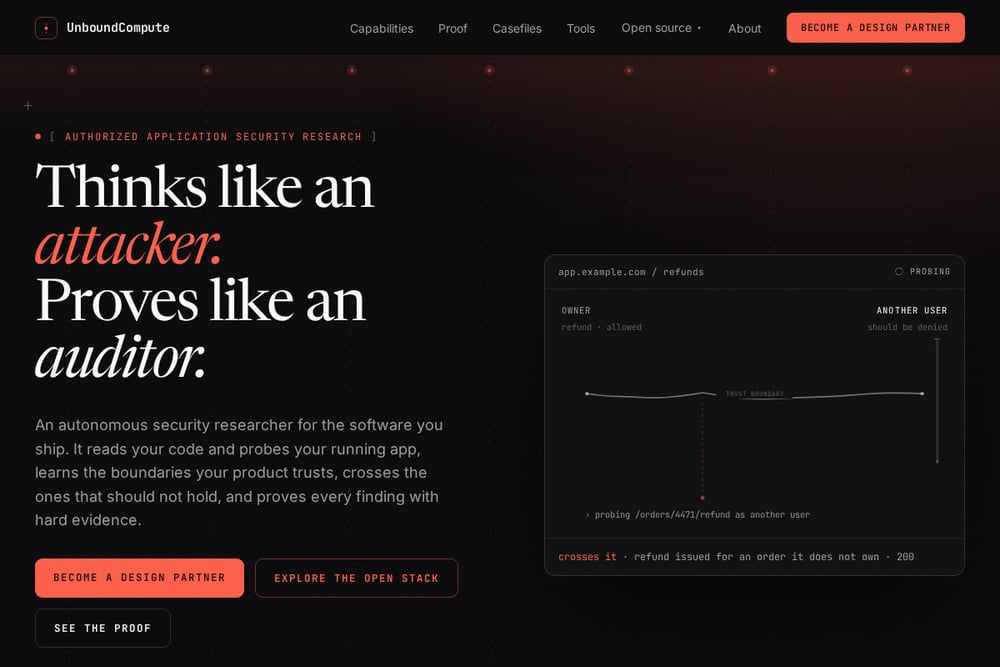 A screenshot of the UnboundCompute website.
UnboundCompute is an autonomous security researcher that learns the boundaries your product trusts and crosses the ones that shouldn't hold. It's built for teams shipping faster than security can keep up, especially those with multiple tenants, complex authorization, or money and state changes like refunds and quotas. Unlike generic scanners, it reasons about your application, so it finds the crossing that matters and shows you it's real with hard evidence. The console gives you a clear briefing of what happened, how it knows, and what to do next. If a broken permission check would cost you a customer or a headline, this is for you.
#3 Escape
 A screenshot of the Escape website.
Escape offers business-logic-aware DAST and AI-powered pentesting that learns your business and proves exploitability. It focuses on securing applications at the business logic level, which is where most serious flaws hide. You get continuous AI pentesting that delivers reports auditors and engineers can act on. Escape also covers attack surface management and external network pentesting, so you see the full picture. It's a solid choice for teams that want deep API security and clear, actionable findings.
#4 Cobalt
 A screenshot of the Cobalt website.
Cobalt combines human-led pentesting with autonomous validation, giving you the best of both worlds. Their Autonomous Pentest runs fast, autonomous tests for every release and new threat, while their AI-powered platform, Cobalt Sage AI, powers every engagement. You can also tap into specialized tests for AI/LLM, web apps, APIs, and cloud environments. It's a flexible credit model that scales to your needs, making it easy to integrate into your workflow. If you want expert oversight with automation, Cobalt fits the bill.
#5 Picus Security
 A screenshot of the Picus Security website.
Picus Security brings autonomous pentesting through a swarm of specialized AI agents that independently determine scope and execute validated attacks. They chain vulnerabilities into multi-stage attack paths and identify choke points, with every action auditable. Picus also offers breach and attack simulation, so you can validate your security controls continuously. It's designed for enterprise teams that need to align with frameworks like MITRE ATT&CK and DORA. If you want to validate your defenses, not just find flaws, Picus is a strong option.
How to Choose the Right Platform
Start by asking what you need most: proof of exploitability, coverage of business logic, or validation of your security controls. If you want a proven autonomous hacker that finds and proves critical flaws, XBOW is your pick. If you're shipping fast and need continuous boundary testing without a security team, UnboundCompute is built for you. For API-heavy environments, Escape's business-logic-aware DAST shines. If you prefer human oversight, Cobalt's hybrid model gives you that. And if you need to validate your entire security posture, Picus's simulation and pentesting combo is worth a look.
Automating Your Security Research Workflow
These platforms integrate into your CI/CD pipeline, running continuously as you ship. You set the scope, and they probe your apps and APIs, chaining vulnerabilities into attack paths. When they find something, they generate evidence-backed reports that your team can act on immediately. You can automate remediation tracking, so every finding is followed up. This turns security from a periodic snapshot into a live, always-on function.
The Bottom Line
Autonomous security research is no longer a futuristic idea—it's here, and it's proving itself against the world's best. Whether you choose XBOW's public proof, UnboundCompute's boundary reasoning, Escape's API focus, Cobalt's hybrid approach, or Picus's validation suite, you're getting a tool that thinks like an attacker and proves like an auditor. The key is to pick the one that fits your team's speed, your risk profile, and your need for evidence. Start with a design partner or a demo, and see which one finds the crossing that matters to you.