
You can't hire enough humans to keep up with attackers. These five platforms use AI to hunt and verify vulnerabilities around the clock.
The Shift from Manual Pentests to Autonomous Agents
The security industry is moving away from point-in-time pentests and toward continuous, AI-driven testing. Autonomous agents can scan code, probe live systems, and even chain exploits—all without a human in the loop. This shift is driven by the sheer volume of code and the speed of modern development. You need tools that not only find flaws but prove they're exploitable. The platforms below represent the cutting edge of this transformation.
How We Evaluated These Platforms
We looked at each platform's ability to cover the full stack—from code scanning to live pentesting. We considered how well they verify findings with real exploits, not just theoretical risks. We also weighed deployment flexibility, including open-source options and self-hosting. Finally, we assessed how clearly they communicate pricing and fit for different team sizes.
Here's a quick look at how these five platforms stack up.
| Provider | Best For |
|---|---|
| XBOW | Enterprises needing proven exploit validation at scale |
| OpenHack | Developers and security teams wanting a cost-effective, AI security engineer |
| Strix | Teams that want continuous, automated security testing with auto-fix capabilities |
| Synack AI Pentesting | Large enterprises needing a hybrid human-AI pentesting platform with compliance focus |
| PentAGI | Security researchers and developers who want an open-source, customizable AI pentesting agent |
The Five Platforms, Up Close
#1 XBOW
 A screenshot of the XBOW website.
XBOW is the autonomous hacker that's proven itself against the world's best human researchers. It's ranked #1 on HackerOne and has found zero-days in real customer applications, including a critical Microsoft flaw. You point it at a URL, and it explores your apps and APIs like a real attacker, chaining vulnerabilities into working attacks. Every finding is independently proven for exploitability before it reaches your team. With 150+ security teams trusting it, XBOW is built for production with full governance and audit logs. If you need proof, not just alerts, XBOW delivers.
#2 OpenHack
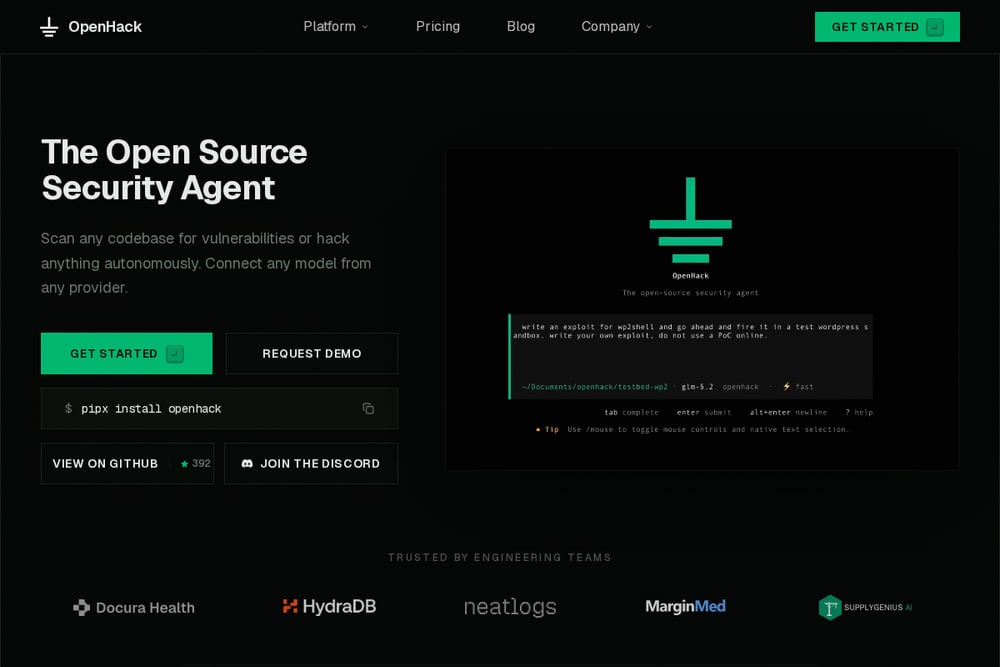 A screenshot of the OpenHack website.
OpenHack is the open-source security agent that hunts and verifies vulnerabilities across your entire stack. It offers autonomous pentesting, AI codebase scanning, vulnerability management, supply chain tracking, secret scanning, and SBOM generation—all in one platform. You can run the open-source CLI locally or let the platform run it across every repo. It connects to any model from any provider, including self-hosted open-source models, giving you full control. OpenHack is 40× cheaper than frontier agents, making it accessible for startups and enterprises alike. It's the only platform here that's fully open source and self-hostable.
#3 Strix
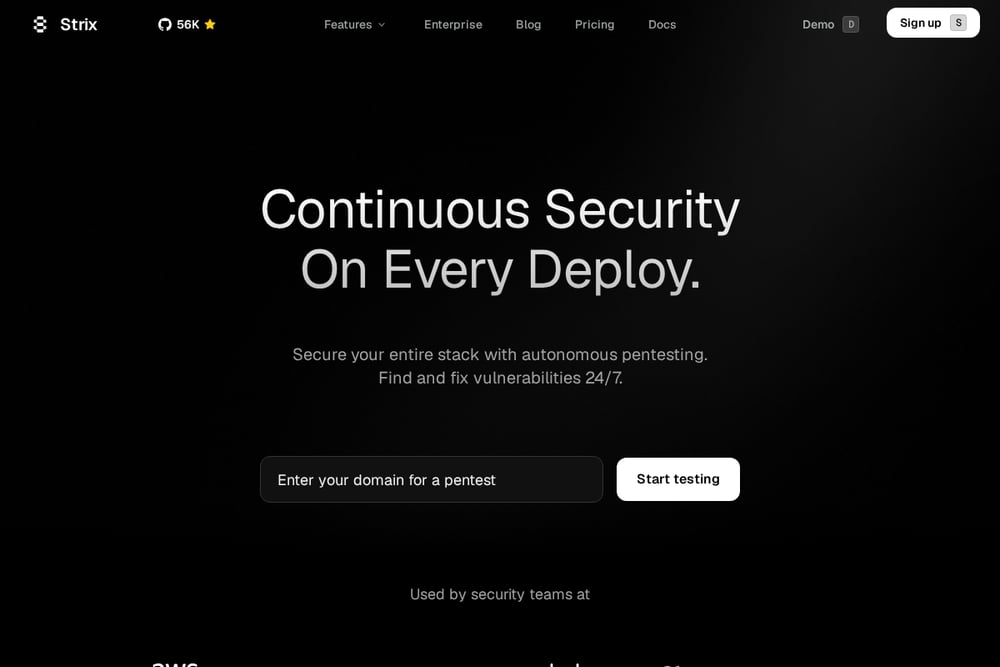 A screenshot of the Strix website.
Strix provides continuous autonomous pentesting on every deploy, securing your code, APIs, web apps, infrastructure, and cloud. It gives you proof-of-exploit for every finding, with suggested fixes and merge-ready PRs. You can see a live dashboard of pentest statuses and issues, making it easy to track progress. Strix is used by security teams at companies like Chegg, and it's praised for being fast and easy to configure. It also offers an open-source version, giving you flexibility in how you deploy it. If you want continuous security without the manual overhead, Strix is a solid choice.
#4 Synack AI Pentesting
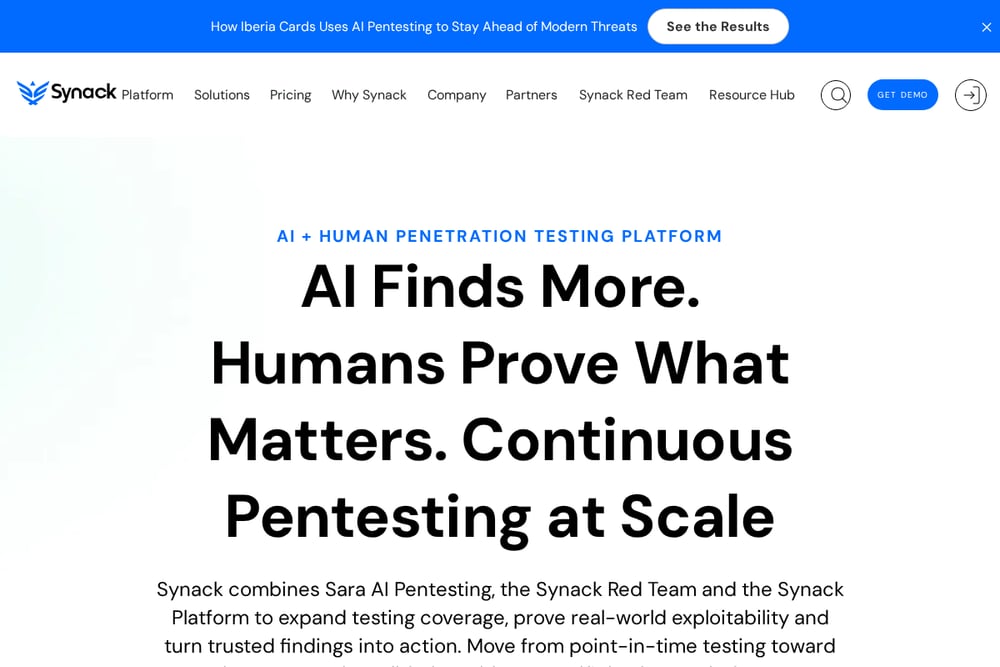 A screenshot of the Synack AI Pentesting website.
Synack combines human expertise with AI to deliver continuous, trusted security testing at scale. Its platform, Sara, is an autonomous red agent that identifies, validates, and prioritizes vulnerabilities across your attack surface. You get access to over 1,500 vetted security researchers who work alongside the AI, ensuring deep coverage. Synack is ideal for enterprises that need compliance-grade testing and integration with existing vulnerability management. It's a hybrid approach that leverages the best of both worlds. If you want human oversight with AI efficiency, Synack is a strong option.
#5 PentAGI
 A screenshot of the PentAGI website.
PentAGI is a fully autonomous AI agent system designed for complex penetration testing tasks. It's open-source and available on GitHub, making it a great choice for security researchers who want to customize their testing. You can run it locally and integrate it with your own tools and workflows. PentAGI focuses on performing end-to-end pentests with minimal human intervention. It's a community-driven project that's constantly evolving. If you're a hands-on security professional who wants full control, PentAGI is worth exploring.
How to Choose the Right Autonomous Pentesting Platform
Start by defining your scope: do you need to test live APIs, scan code, or both? Consider your team's technical expertise—open-source options like OpenHack and PentAGI require more setup but offer flexibility. If you need proof of exploitability for compliance, XBOW and Strix excel at that. For a hybrid human-AI approach, Synack is the way to go. Finally, think about your budget: OpenHack is 40× cheaper than frontier agents, making it a great entry point. Choose the one that fits your workflow and risk tolerance.
Automating Your Security Workflow
You can integrate these platforms into your CI/CD pipeline to automatically scan every code change. For example, OpenHack's CLI can be run locally or in a GitHub Action, while Strix offers merge-ready PRs for auto-fixing. XBOW can be pointed at staging environments to continuously probe for vulnerabilities. Synack provides APIs for seamless integration with your existing security tools. By automating pentesting, you free up your team to focus on fixing critical issues rather than manually testing.
The Future of Security Testing Is Autonomous
The days of annual pentests are over. Autonomous platforms are now capable of finding and proving vulnerabilities faster than any human team. Whether you choose the open-source flexibility of OpenHack, the proven track record of XBOW, or the hybrid approach of Synack, you're investing in continuous security. The key is to start small, test on your own systems, and scale as you build trust. Your attackers are already automated—it's time your defenses are too.