Authentication is the front door of every SaaS product, and the platform you pick shapes how fast you can ship, how easily enterprise buyers can onboard, and how much control you keep over your own user data. The options below take different approaches: some lean on prebuilt UI, some on headless APIs, some on open source. This list is a plain roundup of platforms worth a look for SaaS teams planning into 2026. It is not a ranking of quality, and no company here is presented as the best choice.
How We Picked These Tools
Each platform was included because its own homepage describes capabilities aimed at SaaS builders: sign-up and sign-in flows, multi-tenancy or organization support, enterprise features like SSO, and developer-facing tooling. Every claim below is drawn from the company's homepage text, with quotes reproduced exactly. Prices appear only where the source states them. The order is a simple list order, not a judgment of which platform is better.
| Provider | Best For |
|---|---|
| Auth0 | SaaS teams wanting a broad customer identity platform with B2B and B2C paths |
| Clerk | SaaS teams that want prebuilt auth and organization UI components |
| Stytch | SaaS teams selling to enterprises that need SSO, SCIM, and multi-tenancy |
| WorkOS | SaaS teams adding enterprise features like SSO and directory sync |
| SuperTokens | SaaS teams that want open source, self-hostable authentication |
The 5 Tools in Focus
#1 Auth0
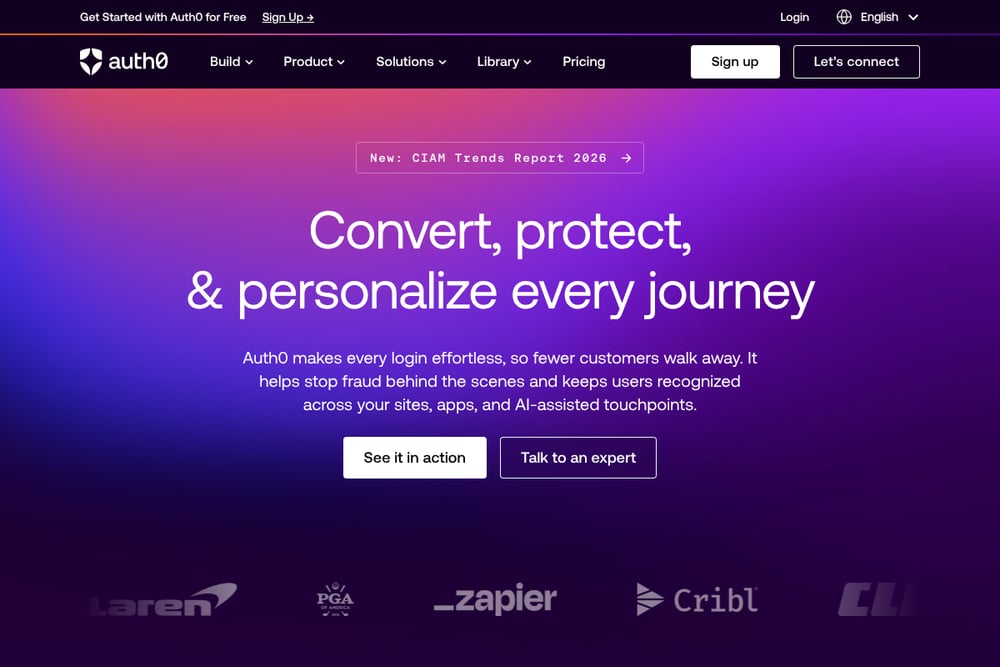 A screenshot of the Auth0 website.
Auth0 presents itself as an identity platform covering the full customer lifecycle, with separate paths for B2C and B2B SaaS. Its homepage frames the product around converting, protecting, and personalizing every login journey, and it lists capabilities such as Universal Login, passwordless, user management, breached password detection, and embedded login. For SaaS teams, it also highlights enterprise connectivity features like single sign-on, multifactor authentication, organizations, and fine-grained authorization. It suits teams that want a broad, feature-rich identity layer with both consumer and business-facing options.
#2 Clerk
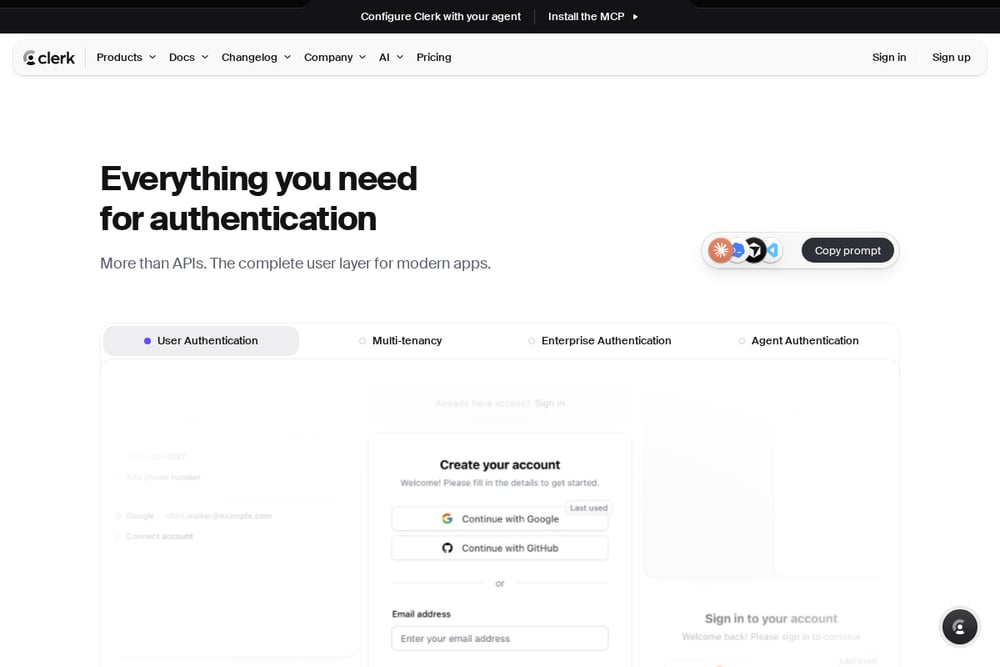 A screenshot of the Clerk website.
Clerk describes itself as a complete user layer for modern apps, going beyond APIs to include prebuilt components like Sign In, Sign Up, User Button, and User Profile. Its homepage emphasizes multi-tenancy for B2B SaaS, with custom roles and permissions, invitations, auto-join by email domain, and organization UI components. It also covers security features such as multifactor authentication, fraud and abuse prevention, session management, and bot detection. It suits SaaS teams that want to drop in ready-made auth UI and organization management rather than build it from scratch.
#3 Stytch
 A screenshot of the Stytch website.
Stytch describes itself as an identity platform for humans and AI agents, combining authentication, authorization, and security in one integration. Its homepage emphasizes enterprise readiness: SAML and OIDC single sign-on, SCIM, JIT provisioning, role-based access control, and turnkey multi-tenancy with per-organization auth settings. It also offers an embeddable admin portal so enterprise customers can self-serve SSO and SCIM setup. It suits SaaS teams selling to larger organizations that need enterprise auth features without building them in-house.
#4 WorkOS
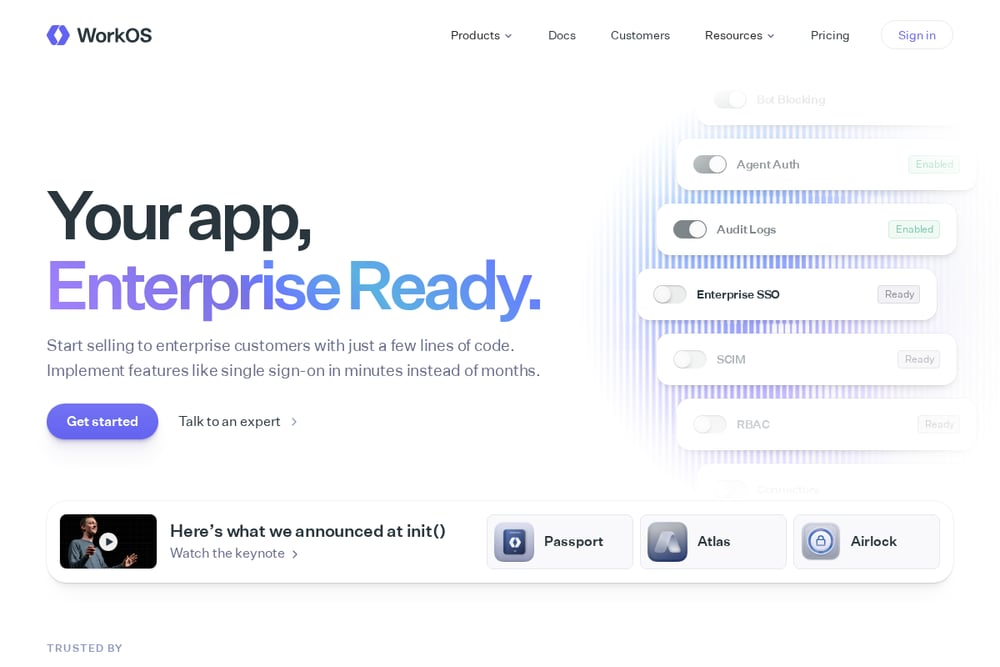 A screenshot of the WorkOS website.
WorkOS describes itself as a set of building blocks for quickly adding enterprise features to an app, with a focus on helping teams sell to enterprise customers. Its homepage lists products including AuthKit for auth and user management, Enterprise SSO, Directory Sync, Role-Based Access Control, Multi-Factor Authentication, and an Admin Portal for self-serve onboarding by corporate IT admins. It also advertises developer-first design with RESTful APIs, normalized objects, and SDKs across several languages. It suits SaaS teams whose roadmap is driven by enterprise deals and the features those buyers expect.
#5 SuperTokens
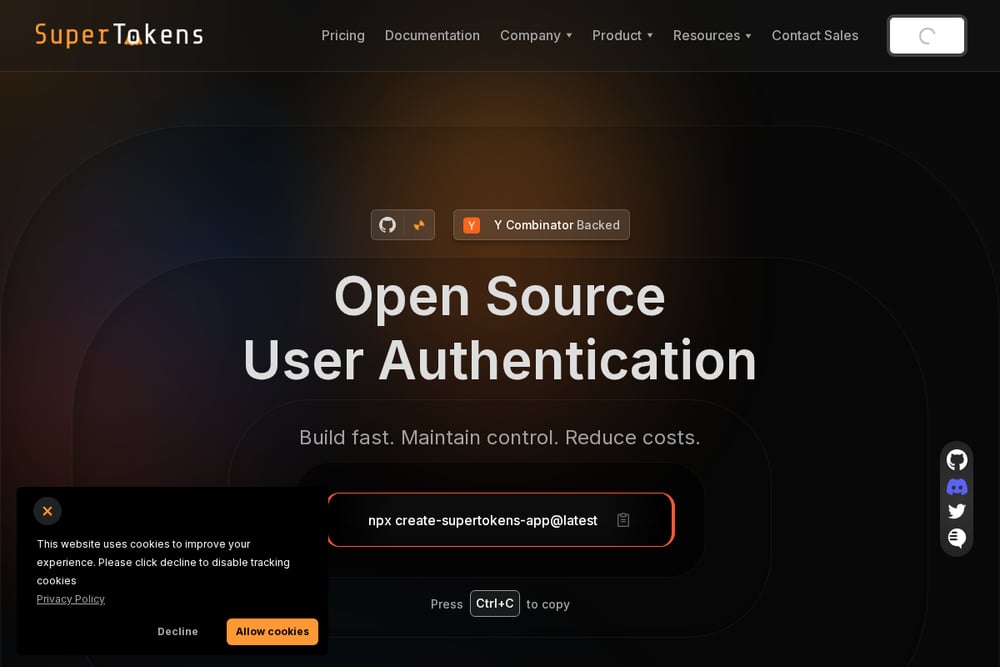 A screenshot of the SuperTokens website.
SuperTokens describes itself as open source user authentication built for speed and control, with a pitch of building fast, maintaining control, and reducing costs. Its homepage highlights prebuilt UI or frontend SDKs for custom login pages, hosted auth on your own domain without redirects, and configurable policies like password rules and session limits. It also lists plugins for tenant discovery, captcha protection, and user banning, plus support for magic links, social login, SSO, and multi-tenancy. It suits SaaS teams that want to self-host or keep tight control over their auth stack.
Which One Should You Choose?
Start with who your buyers are. If you sell mainly to enterprises, weigh the platforms whose homepages foreground SSO, directory sync, SCIM, and admin portals, since those are the features procurement teams ask about. If you sell to consumers or small teams, look at how much prebuilt UI and sign-up flow you get out of the box versus how much you want to design yourself. Consider control and hosting: some platforms are fully managed, while others emphasize open source and self-hosting. Check the security and compliance statements each company publishes, and confirm how multi-tenancy and organization management are handled if your product serves business customers. Finally, read the pricing pages directly, since the homepage summaries only hint at what each tier includes.
Final Thoughts
These five platforms overlap in the basics of sign-up, sign-in, and session handling, but they diverge in emphasis. Auth0 and Clerk lean toward broad, managed customer identity with strong prebuilt experiences. Stytch and WorkOS put enterprise readiness and multi-tenancy near the center of their messaging. SuperTokens offers an open source route for teams that want to keep control of the stack. None of these is inherently the right pick; the fit depends on your buyers, your hosting preferences, and how much of the auth experience you want to own. Use this list as a starting point for your own evaluation in 2026.
Know a company that belongs on this list? Email us at editorial@peekwire.com.