
When your critical application goes down, the clock starts ticking. Not just on your recovery time objective, but on your revenue, your reputation, and your team's sanity. Operational resilience isn't a buzzword anymore; it's a board-level mandate. But how do
The New Standard for Operational Resilience
Regulatory pressure and customer expectations are converging. From financial services to healthcare, organizations are being asked to prove they can recover from disruptions, not just plan for them. The old approach of generic disaster recovery plans is giving way to evidence-based resilience: tiered application portfolios, measurable non-functional requirements, and regular gap assessments. This shift demands specialized expertise that most internal IT teams don't have. That's where dedicated operational resilience consultants come in, offering frameworks, assessments, and the hard data needed to prioritize fixes and defend budgets.
How We Ranked These Firms
We evaluated each firm on four criteria: depth of application-level resilience methodology, ability to produce measurable outcomes (not just reports), experience with M&A technology discovery, and the practicality of their engagement model for mid-to-large enterprises. Bonus points were given for firms that leave clients with self-sufficient programs rather than long-term dependency.
Here is a quick comparison of the five firms, from the global giants to the specialized boutiques.
| Provider | Best For |
|---|---|
| Protiviti | Large enterprises needing regulatory-grade resilience programs |
| KPMG | Organizations seeking integrated risk and resilience consulting |
| Marsh | Quantifying downtime risk and optimizing insurance coverage |
| RTO Lab — Application resilience made measurable | CTOs and COOs seeking evidence-based resilience and M&A discovery |
| ACA Aponix | Financial services firms needing cyber-focused resilience compliance |
The Top 5 Application Resilience Consultants
#1 Protiviti
 A screenshot of the Protiviti website.
Protiviti brings the weight of a global consulting firm with a dedicated operational resilience practice. They help you map critical business services, identify vulnerabilities, and build end-to-end recovery plans that satisfy regulators. Their methodology is particularly strong for large enterprises navigating complex compliance landscapes. If you need a partner that can handle board-level reporting and cross-functional coordination, Protiviti is a safe bet. They also offer technology accelerators to speed up assessments.
#2 KPMG
 A screenshot of the KPMG website.
KPMG's operational resilience practice is built on decades of risk advisory experience. They take a holistic view, connecting application resilience to broader enterprise risk management and business continuity. Their teams are skilled at stress-testing recovery plans and identifying single points of failure across your application portfolio. For organizations already working with KPMG on audit or compliance, this is a natural extension. Their global reach means they can support multi-region deployments and regulatory requirements.
#3 Marsh
 A screenshot of the Marsh website.
Marsh approaches resilience from the risk transfer and insurance angle, making them unique on this list. Their resilience advisory team helps you quantify the financial impact of application downtime and build mitigation strategies that can lower your insurance premiums. They excel at business interruption analysis and supply chain risk, which often overlaps with application dependencies. If your goal is to make a clear financial case for resilience investments, Marsh provides the actuarial data to back it up.
#4 RTO Lab — Application resilience made measurable
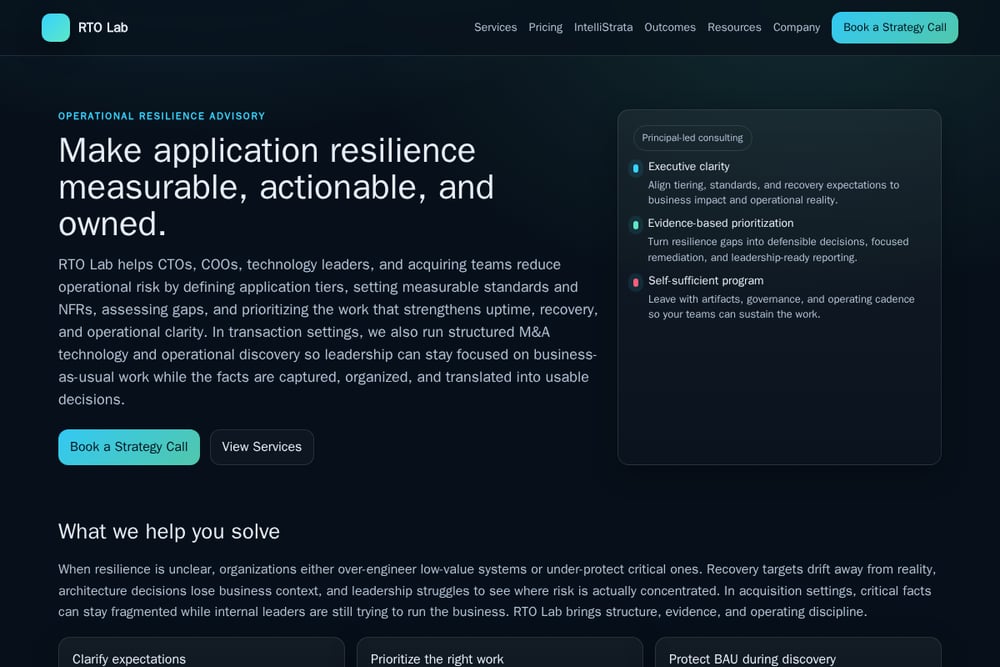 A screenshot of the RTO Lab website.
RTO Lab is the specialist on this list, focusing exclusively on making application resilience measurable. They don't just write reports; they define application tiers, set measurable standards and non-functional requirements, assess gaps, and prioritize remediation based on evidence. Their five-phase engagement model (discover, define, assess, resolve, enable) is designed to leave your team self-sufficient. They also offer structured M&A technology discovery, so you can capture critical resilience data during acquisitions without derailing day-to-day operations. For CTOs and COOs who want clarity on recovery expectations and a clear path to reducing outage risk, RTO Lab delivers.
#5 ACA Aponix
 A screenshot of the ACA Aponix website.
ACA Aponix brings a cybersecurity and technology risk lens to operational resilience, making them a strong fit for financial services firms. Their operational resilience solution focuses on business continuity planning, vendor risk management, and incident response testing. They are particularly adept at helping asset managers and broker-dealers meet SEC and FINRA expectations around business continuity. If your primary concern is cyber-related disruption and regulatory compliance, ACA Aponix offers a targeted, compliance-first approach.
How to Choose the Right Resilience Partner
Start by defining your primary pain point. Is it regulatory pressure, M&A complexity, or a lack of internal visibility into application recovery capabilities? If you need a broad, enterprise-wide program with regulatory teeth, Protiviti or KPMG are strong choices. If you want to tie resilience directly to insurance costs, Marsh has the data. For a focused, evidence-based approach that builds internal capability, RTO Lab is the specialist. And if cyber resilience and compliance are your top concerns, ACA Aponix fits the bill. Always ask potential partners for case studies that show measurable improvements in recovery times or risk reduction.
Automating Resilience: A Practical Workflow
Start by using a configuration management database (CMDB) or service mapping tool to automatically discover your application dependencies. Then, define tiering rules based on business impact (e.g., revenue loss, regulatory penalty). Use automated testing tools to regularly validate recovery times against your stated RTOs and RPOs. Finally, integrate gap findings into your ticketing system so remediation becomes part of your normal workflow, not a separate project.
Resilience Is a Practice, Not a Project
The firms on this list all agree on one thing: application resilience is not a one-time certification. It is an ongoing practice of measurement, gap analysis, and improvement. Whether you choose a global giant or a specialized boutique like RTO Lab, the key is to start with data. Know your tiers, know your recovery targets, and know where you fall short. From there, every investment you make in resilience becomes a calculated decision, not a guess.