
You've polished your manuscript for weeks, but a nagging doubt remains: what will a reviewer actually think? These five AI peer review services offer a pre-submission safety net, giving you actionable feedback before an editor ever sees your work.
The Rise of AI Peer Review
Academic publishing is notoriously slow, with peer review often taking months. In response, a new wave of AI-powered tools has emerged, promising to give authors rapid, detailed feedback on their manuscripts. These services analyze everything from structure and clarity to citation integrity and methodological soundness. They don't replace human reviewers but act as a pre-submission checkpoint, helping you catch issues early and increase your chances of acceptance. As AI becomes more sophisticated, these tools are becoming an essential part of the academic workflow.
How We Evaluated These Services
We looked at each service's core features, focusing on the depth of feedback, the speed of delivery, and the level of customization. We also considered how well each service addresses specific academic needs, such as discipline-specific calibration and privacy concerns. Each service was assessed on its ability to provide actionable, quote-grounded feedback that you can directly apply to your manuscript. We also noted the pricing structure and whether a free trial or free initial review is offered.
Here's a quick snapshot of the five services we're featuring, highlighting their primary strengths and ideal use cases.
| Provider | Best For |
|---|---|
| Reviewer3 | Authors seeking deep integrity checks and rigorous methodological review. |
| Refereely — AI peer review for your manuscript | Authors in social sciences and humanities who want quote-grounded, multi-perspective feedback. |
| CheckMyManuscript | Quick, free, and comprehensive technical checks before submission. |
| Review-it | Users seeking a versatile document review tool with AI capabilities. |
| ScholarsReview | Researchers looking for a dedicated AI peer review service for academic papers. |
The Five Services, Examined
#1 Reviewer3
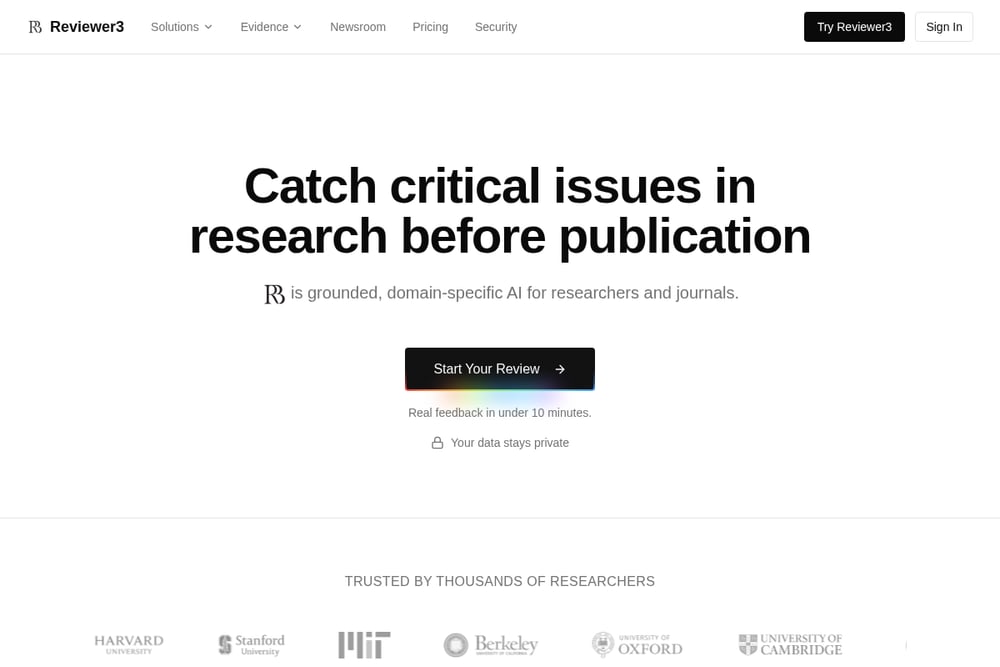 A screenshot of the Reviewer3 website.
Reviewer3 is a powerful AI peer review tool that focuses on catching critical issues before publication. It offers integrity checks for hallucinated, retracted, and self-citations, as well as AI-generated text detection and fatal flaw analysis. The platform provides rigorous review of data, code, and analysis, with evidence from over 145,000 review comments. It's trusted by thousands of researchers across 170+ countries, and its feedback is rated useful by 90% of users. Reviewer3 also offers unlimited revisions with its Premium plan, making it a comprehensive choice for serious authors.
#2 Refereely — AI peer review for your manuscript
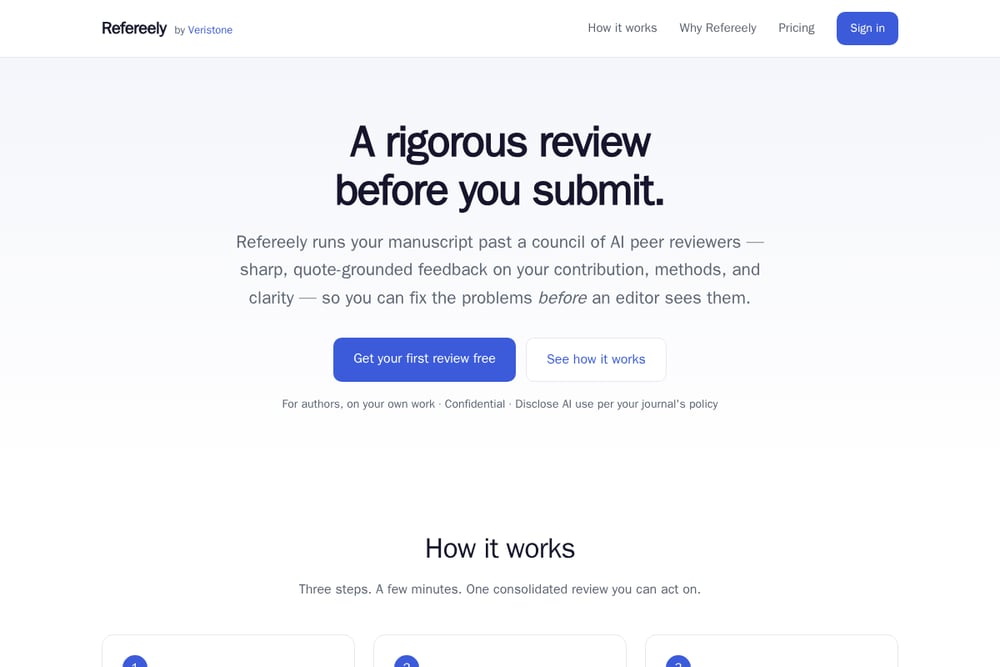 A screenshot of the Refereely website.
Refereely stands out with its council of AI peer reviewers who critique your manuscript from multiple angles and then cross-check each other to filter out mistakes. This adversarial verification pass ensures that only high-confidence findings are flagged, reducing false positives. Every concern is quote-grounded, pointing to the exact text in your paper, so you know precisely what to fix. It's discipline-aware, with strong performance in social sciences and humanities, including law, business, and economics. Refereely also provides readability metrics like Flesch and Gunning Fog, and it's confidential by design—your manuscript is never used to train AI models and is deleted after review. You can get your first review free, making it easy to try.
#3 CheckMyManuscript
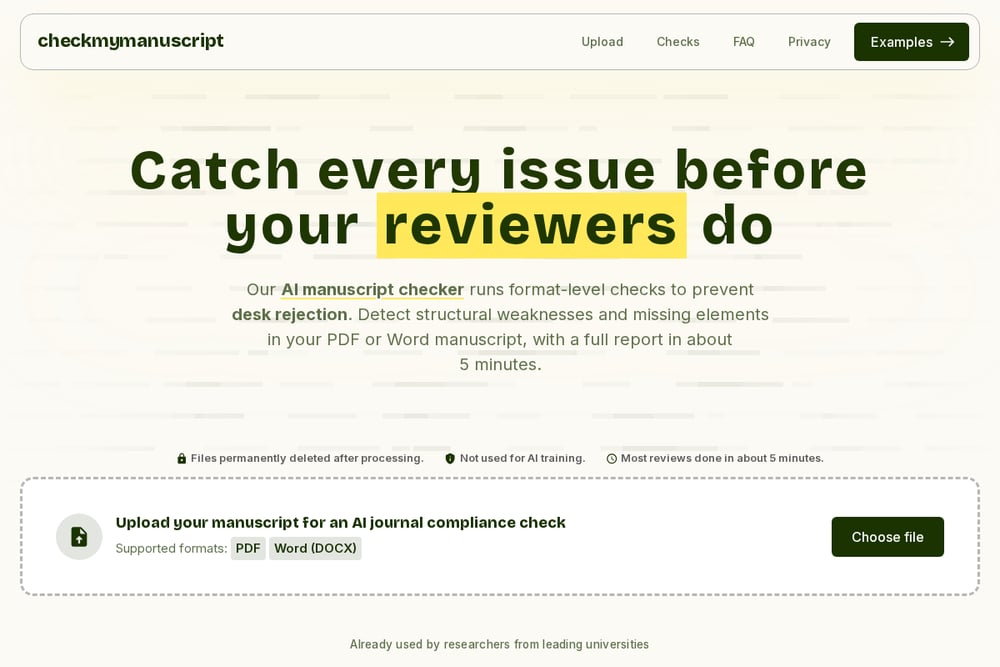 A screenshot of the CheckMyManuscript website.
CheckMyManuscript offers a fast, automated AI review with 95 checks covering structure, language, citations, metadata, and formatting. It's free to use, with no account required, and delivers results in about five minutes. The tool prioritizes findings by severity, so you know what to fix first, and provides actionable suggestions for each issue. It accepts both PDF and Word files, and processes your manuscript securely, deleting it immediately after review. This is a great option for a quick pre-submission quality check to catch technical issues that could lead to rejection.
#4 Review-it
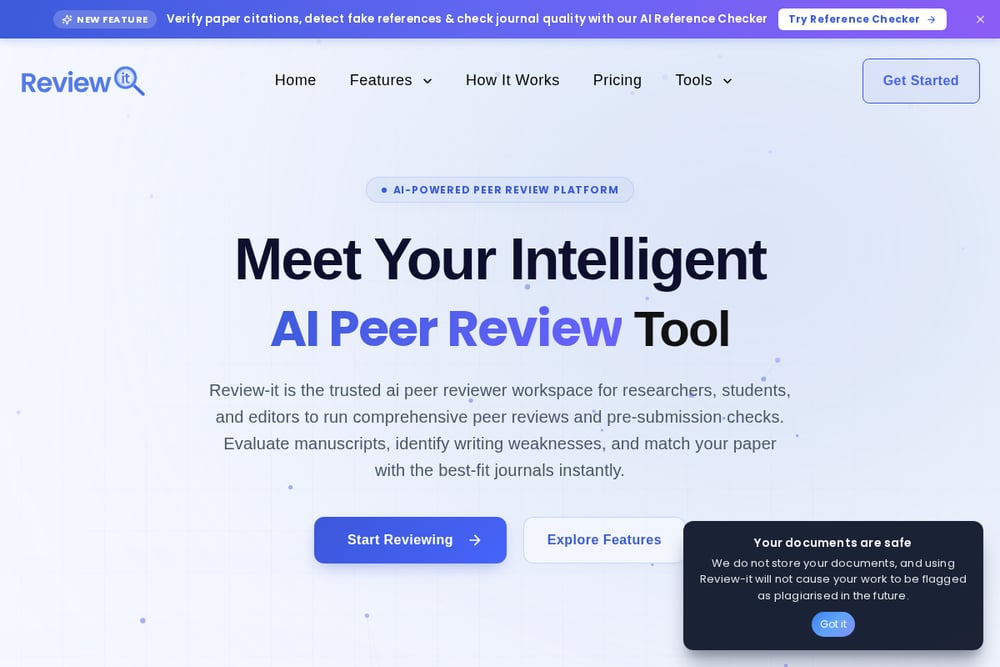 A screenshot of the Review-it website.
Review-it is an AI-powered peer review and document review tool that aims to streamline the review process. While the website content is sparse, it positions itself as a versatile tool for both manuscript and document review. It likely offers features similar to other AI review tools, such as automated feedback and analysis. However, due to limited public information, it's harder to assess its specific capabilities and pricing. If you're looking for a tool that can handle both academic and business documents, Review-it might be worth exploring, but you'll need to contact them for details.
#5 ScholarsReview
 A screenshot of the ScholarsReview website.
ScholarsReview is an AI peer review tool designed for researchers and academic writing. The website is currently loading, so detailed information is scarce, but the name suggests a focus on scholarly work. It likely provides AI-driven feedback on manuscripts, possibly with a focus on academic standards and rigor. Given the lack of accessible content, it's difficult to evaluate its features or pricing. If you're curious, you may need to visit the site directly to see what it offers.
How to Choose the Right AI Peer Review Service
Start by considering your specific needs: do you need deep methodological checks, or are you more concerned about language and formatting? Look for a service that offers a free trial or a free first review, so you can test its quality without commitment. Check whether the service is discipline-aware and can tailor feedback to your field and target journal. Also, consider the privacy policy—ensure your manuscript is handled confidentially and not used for training. Finally, think about the depth of feedback: quote-grounded, actionable comments are more valuable than generic suggestions.
Streamlining Your Pre-Submission Workflow
Integrating an AI peer review service into your workflow is straightforward. After you've completed your manuscript, upload it to the service and specify your field and target journal. The AI will analyze your paper and generate a report with prioritized concerns and suggestions. You can then revise your manuscript accordingly, addressing each point. Some services offer unlimited revisions, allowing you to re-run the review after making changes. This iterative process helps you refine your paper before you submit, saving you time and increasing your chances of acceptance.
The Bottom Line
AI peer review services are not a replacement for human feedback, but they are a powerful tool to strengthen your manuscript before submission. Each of these five services offers unique strengths, from Refereely's council approach and quote-grounded feedback to CheckMyManuscript's fast, free checks. By using one of these tools, you can catch issues early, improve your writing, and approach submission with confidence. Try a free review today and see the difference it makes.