
If you're a healthcare professional drowning in documentation, these five AI scribes are built to give you back your time and your focus.
The AI Scribe Revolution: From Burnout to Balance
The administrative burden on clinicians has reached crisis levels, with many spending more time on charts than with patients. Enter AI medical scribes: ambient listening tools that turn patient conversations into structured clinical notes in seconds. These systems are not just about convenience—they're about reducing burnout, improving documentation accuracy, and letting doctors be doctors again. As of 2026, the market has matured, with solutions ranging from general-purpose scribes to specialty-focused platforms. The best ones integrate seamlessly with EHRs, support coding, and even offer pre-visit intelligence. For any practice, choosing the right AI scribe is now a strategic decision that impacts workflow, revenue, and clinician satisfaction.
How We Evaluated These AI Scribes
We looked at each platform through the lens of a busy clinician: how well does it handle real-world documentation, how much does it cost, and how easily does it fit into your existing workflow? We considered the scope of features—from basic note generation to advanced coding and pre-visit summaries. We also weighed the clarity of pricing and the availability of free trials or demos. Finally, we considered the target user: independent practices, large health systems, or specialty clinics. Each of these five tools excels in different areas, and our goal is to help you find the one that matches your specific needs.
Here's a quick look at the five AI scribes we're covering, with their best use cases and standout features.
| Provider | Best For |
|---|---|
| Sunoh.ai | Clinicians seeking a widely adopted, reliable AI scribe with strong EHR integration. |
| Gosta Labs | Healthcare providers who prioritize regulatory compliance and evidence-based AI. |
| Freed | Independent clinics looking for an all-in-one AI scribe and front desk solution. |
| DeepScribe | Oncologists and specialty practices needing a highly specialized AI scribe. |
| Chartnote | Clinicians seeking a straightforward AI scribe with dictation and snippet features. |
The Deep Dive: Five AI Scribes That Are Changing Clinical Documentation
#1 Sunoh.ai
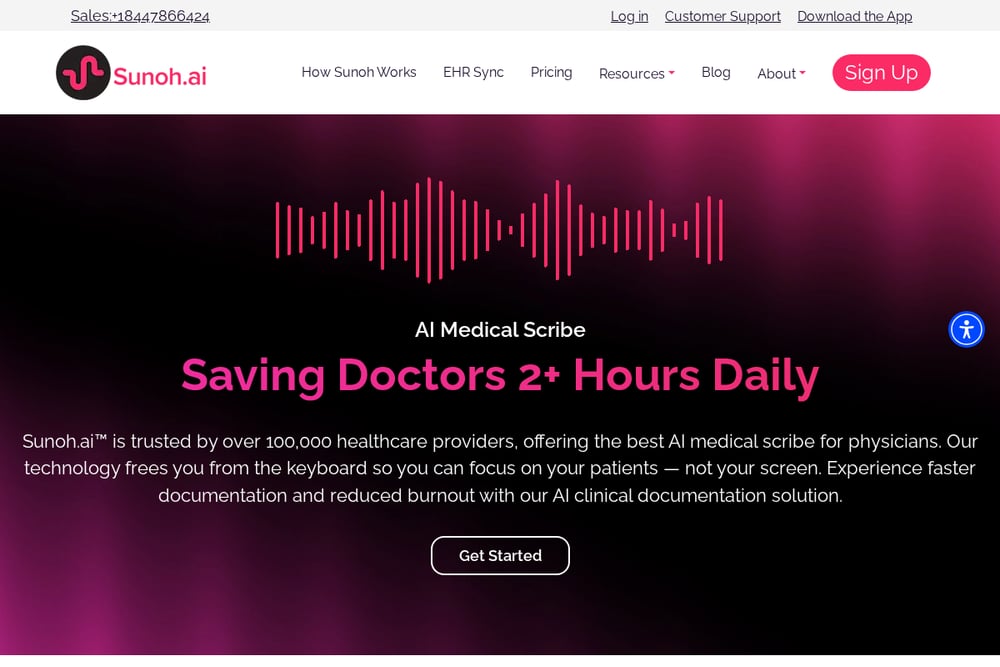 A screenshot of the Sunoh.ai website.
Sunoh.ai is trusted by over 100,000 healthcare providers, making it a proven choice for reducing documentation time. It listens to patient-provider conversations and generates accurate clinical notes in seconds, freeing you from the keyboard. The platform also assists with order entry, capturing labs, imaging, and medications effortlessly. With seamless EHR integration and a focus on reducing burnout, Sunoh.ai is a robust solution for any practice. Its pricing is transparent, and the sheer scale of adoption speaks to its reliability. If you want a scribe that's battle-tested and loved by doctors, Sunoh.ai is a strong contender.
#2 Gosta Labs
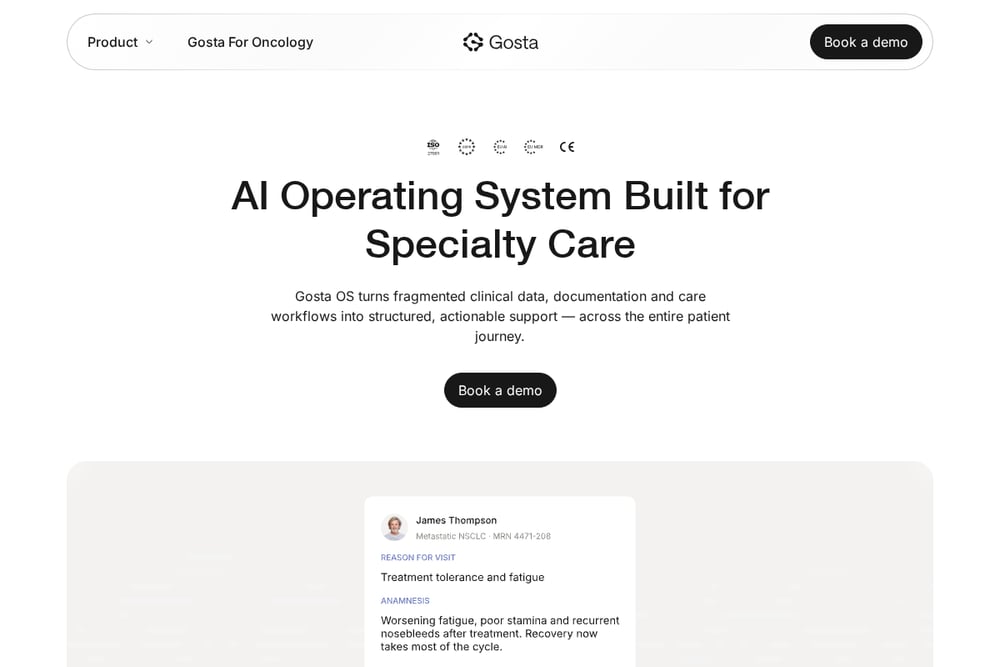 A screenshot of the Gosta Labs website.
Gosta Labs is building Europe's leading AI lab for healthcare, with a focus on safe, regulatory-compliant solutions. Their flagship product, Gosta Aide, acts as a personal AI assistant for healthcare professionals, automating note generation and structuring patient data. Used across tens of thousands of clinical appointments, Gosta reduces administrative work and supports real-time decision-making. What sets Gosta apart is its commitment to evidence-based AI and secure infrastructure, making it a trustworthy partner for public and private providers. If you're looking for a solution that prioritizes compliance and clinical accuracy, Gosta Labs is worth a close look. Their approach is particularly appealing for organizations that need to meet strict regulatory standards.
#3 Freed
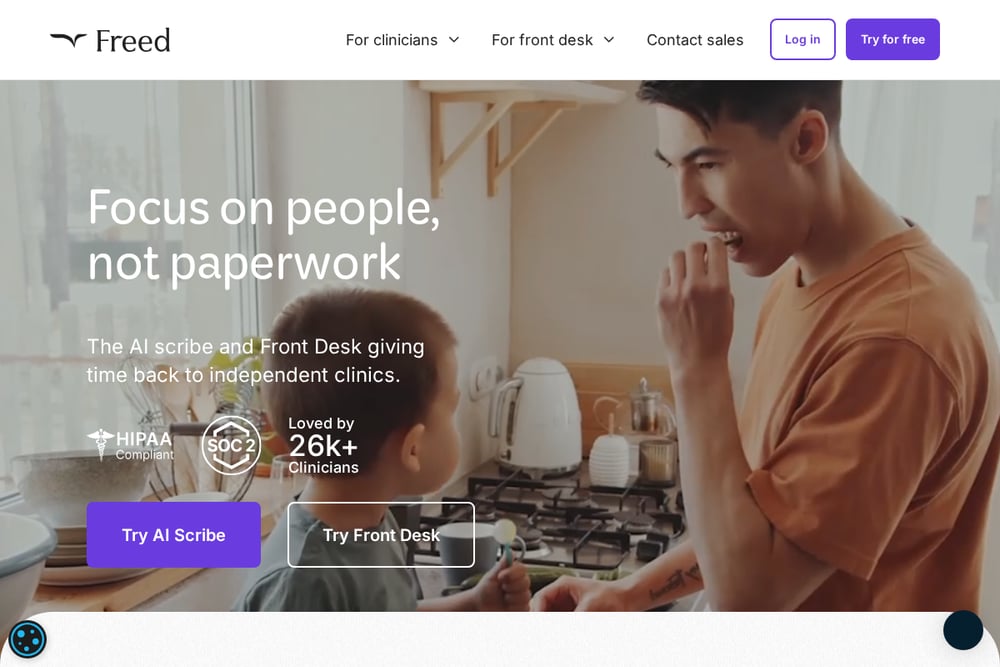 A screenshot of the Freed website.
Freed is designed for independent clinics, with a mission to bring focus back to community care. It offers an AI scribe that turns patient conversations into accurate, customized notes that sync with your EHR, saving you hours each week. Beyond scribing, Freed includes Clinical Evidence, which provides cited answers from 50+ trusted sources, and a Coding Assistant that suggests ICD-10 and CPT codes. The platform also offers an AI receptionist for front desk tasks, making it a comprehensive solution for small practices. With affordable plans starting at $39/mo, Freed is accessible for solo practitioners and small teams. If you run an independent clinic, Freed is built to give you time back.
#4 DeepScribe
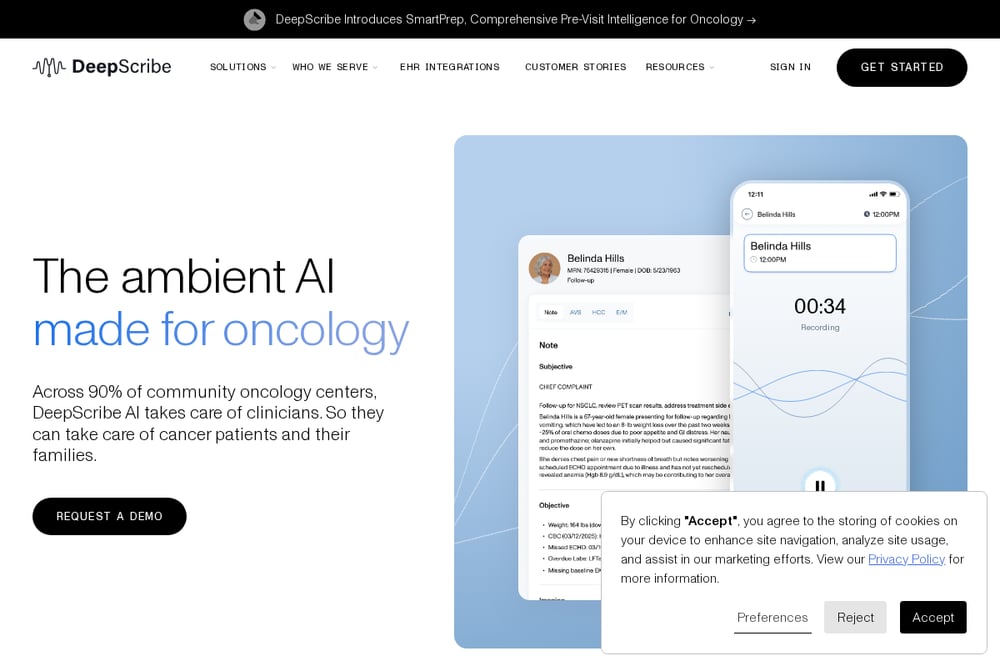 A screenshot of the DeepScribe website.
DeepScribe is purpose-built for specialty care, with a particular focus on oncology. It captures oncology conversations with extreme accuracy and offers SmartPrep, a pre-visit intelligence tool that surfaces relevant patient data before each appointment. The platform also includes AI Coding that captures oncology-specific codes, and a Customization Studio that learns your preferences to generate notes your way. DeepScribe integrates deeply with oncology EHRs like OncoEMR and iKnowMed, making it a must-have for cancer care teams. If you're in a complex specialty, DeepScribe's tailored approach can significantly reduce cognitive burden. It's not a one-size-fits-all tool, but for oncology, it's a game-changer.
#5 Chartnote
 A screenshot of the Chartnote website.
Chartnote offers AI scribe capabilities, medical dictation, and snippets, providing a flexible toolkit for clinical documentation. While the website is sparse on details, Chartnote has been a player in the AI documentation space for years. It's designed to help you create notes faster, whether through ambient listening or manual dictation. The platform is likely a good fit for clinicians who want a straightforward, no-frills scribe that gets the job done. However, with less public information available, you may need to contact them directly to understand their full feature set and pricing. If you're looking for a simple, reliable option, Chartnote is worth exploring.
How to Choose the Right AI Scribe for Your Practice
Start by identifying your biggest pain point: is it note-taking time, coding accuracy, or pre-visit prep? If you're in a specialty like oncology, a purpose-built tool like DeepScribe might be worth the investment. For independent clinics, Freed offers a comprehensive package that includes front desk support. If regulatory compliance is your top concern, Gosta Labs' European-built, evidence-based approach is compelling. Consider your EHR integration needs and whether you want a tool that also assists with coding and clinical evidence. Finally, take advantage of free trials and demos to see which platform feels most intuitive in your daily workflow. The right AI scribe should feel like a partner, not another piece of software to learn.
Automating the Note: How AI Scribes Work
Most AI scribes follow a similar workflow: they listen to the patient-provider conversation in real time, using ambient technology that doesn't require you to press record. The audio is processed by large language models that extract key clinical information, such as symptoms, diagnoses, and treatment plans. The system then generates a structured note, often in SOAP format, which you can review and edit before signing. Many platforms also integrate with your EHR, automatically pushing the note into the correct patient chart. Advanced tools go further by suggesting ICD-10 and CPT codes, flagging potential diagnoses, and even preparing pre-visit summaries from historical data. This automation not only saves time but also improves documentation accuracy and reduces cognitive load.
The Bottom Line: Your Time Is Too Valuable for Paperwork
The era of spending hours on charts after a long day of patient care is ending. Whether you choose Sunoh.ai for its scale, Gosta Labs for its compliance focus, Freed for its all-in-one approach, DeepScribe for specialty care, or Chartnote for simplicity, the key is to find a tool that fits your workflow. These five AI scribes are leading the charge in reducing administrative burden and bringing joy back to clinical practice. Take the time to evaluate your needs, try a few options, and make the switch. Your patients—and your sanity—will thank you.