
Medical bills are a maze of codes, jargon, and potential errors. Studies suggest up to 80% of bills contain mistakes, from simple duplicate charges to complex upcoding. You don't need to be a lawyer or a billing expert to fight
Why Medical Bill Errors Are So Common
The healthcare billing system in the US is notoriously complex. Hospitals use thousands of billing codes (CPT, HCPCS, DRG), and errors happen frequently. Common issues include upcoding (billing for a more expensive service than provided), unbundling (charging separately for services usually bundled), and duplicate charges. The No Surprises Act provides some protections against unexpected out-of-network bills, but enforcing your rights often requires action. AI tools are stepping in to automate the detection of these errors, giving patients a powerful, low-cost way to self-advocate.
How We Ranked These Services
We evaluated each tool on five key factors: accuracy of error detection (how well it catches common billing mistakes), ease of use (from upload to dispute letter), pricing transparency and value, privacy and data security, and the quality of the dispute materials generated (letters, scripts). We also considered whether the service handles the entire process or empowers you to do it yourself.
Here is a quick look at how the top five medical bill dispute tools compare, from full-service negotiation to DIY AI analysis.
| Provider | Best For |
|---|---|
| CareRoute | Hands-off, full-service negotiation with no upfront cost |
| BillGuard AI | Free initial scan with a low-cost, DIY dispute toolkit |
| Medispute | Privacy-first, pay-per-use AI analysis and letter generation |
| Review & Dispute Medical Billing Errors | FairMedBill | Flat-fee, no-data-retention analysis for single bills or families |
| Advocara | Nonprofit with both AI self-service and access to human advocates |
Detailed Reviews of the Top 5 Medical Bill Dispute Tools
#1 CareRoute
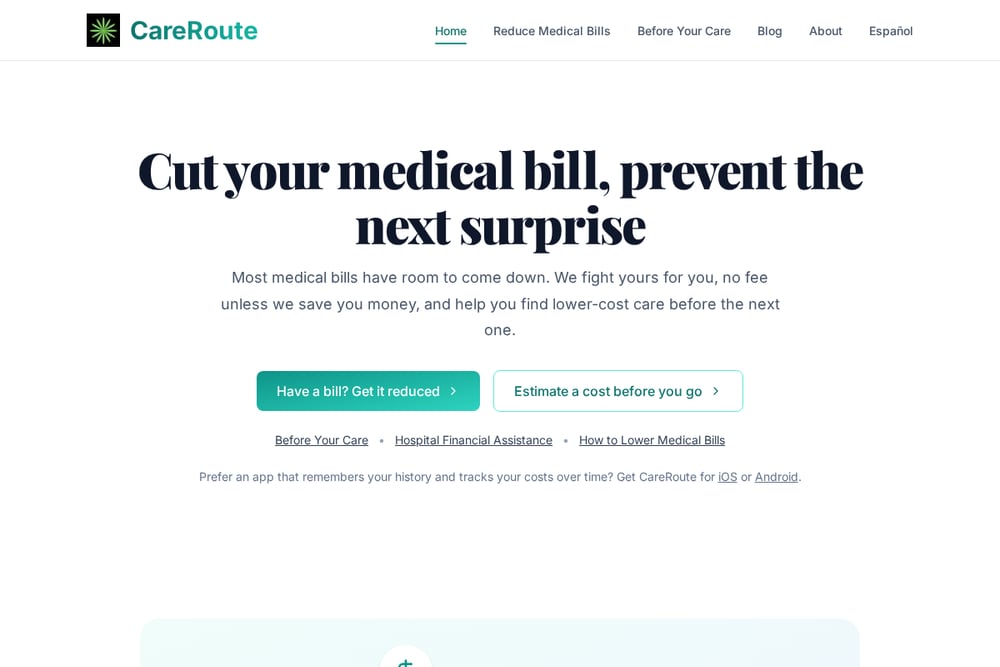 A screenshot of the CareRoute website.
CareRoute takes a full-service approach: you submit your bill, and their team handles everything from disputing insurance underpayments to negotiating directly with providers. Their 'no fee unless we save you' model is low-risk, with a hard cap of $1,000 on their fee. They report an average savings of 30% and work on any bill type, including those already in collections. This is the best option if you want to outsource the entire headache and only pay for results.
#2 BillGuard AI
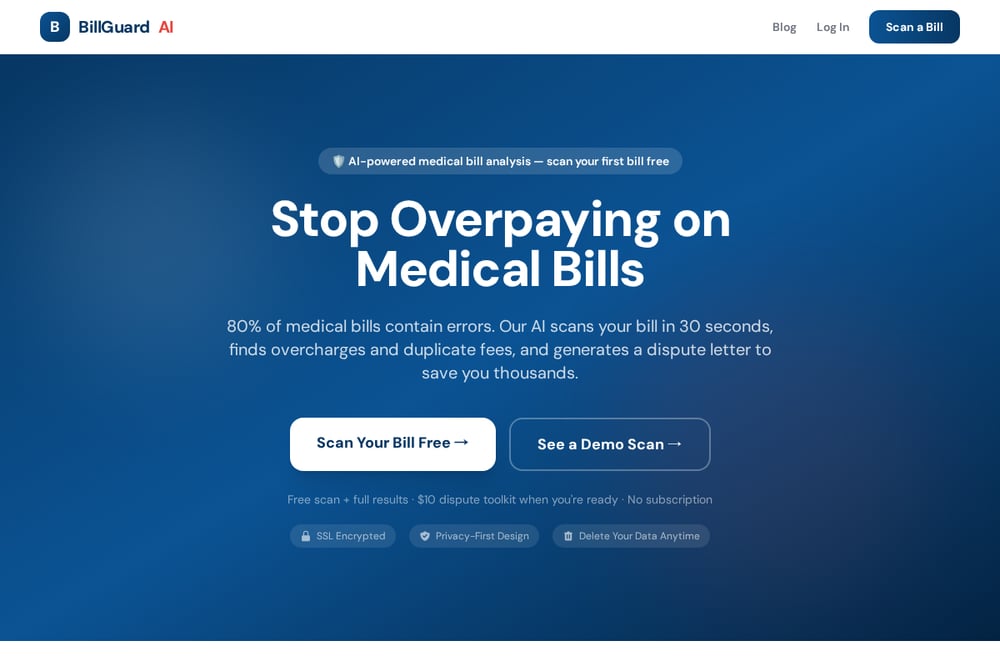 A screenshot of the BillGuard AI website.
BillGuard AI offers a free scan that shows you every error it finds, with no account required. If you want to take action, their $10 dispute toolkit includes a personalized letter, negotiation playbook, and phone script. The service emphasizes privacy with a 'delete anytime' policy and uses CMS Medicare benchmarks to spot overcharges. It is a great middle ground for those who want to see the evidence before paying anything.
#3 Medispute
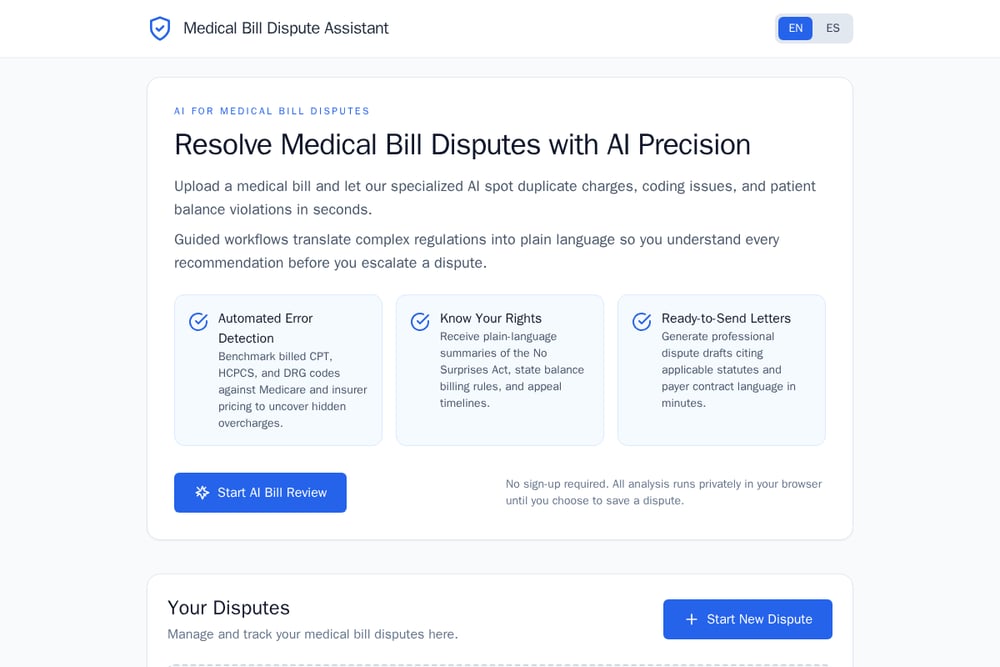 A screenshot of the Medispute website.
Medispute operates on a pay-per-use model: $1 for an AI analysis of your bill and $10 to generate a professional dispute letter. All analysis runs in your browser, meaning your data never touches their servers until you choose to save a dispute. The platform provides plain-language summaries of your rights under the No Surprises Act and other regulations. It is ideal for users who want maximum privacy and only want to pay for what they use.
#4 Review & Dispute Medical Billing Errors | FairMedBill
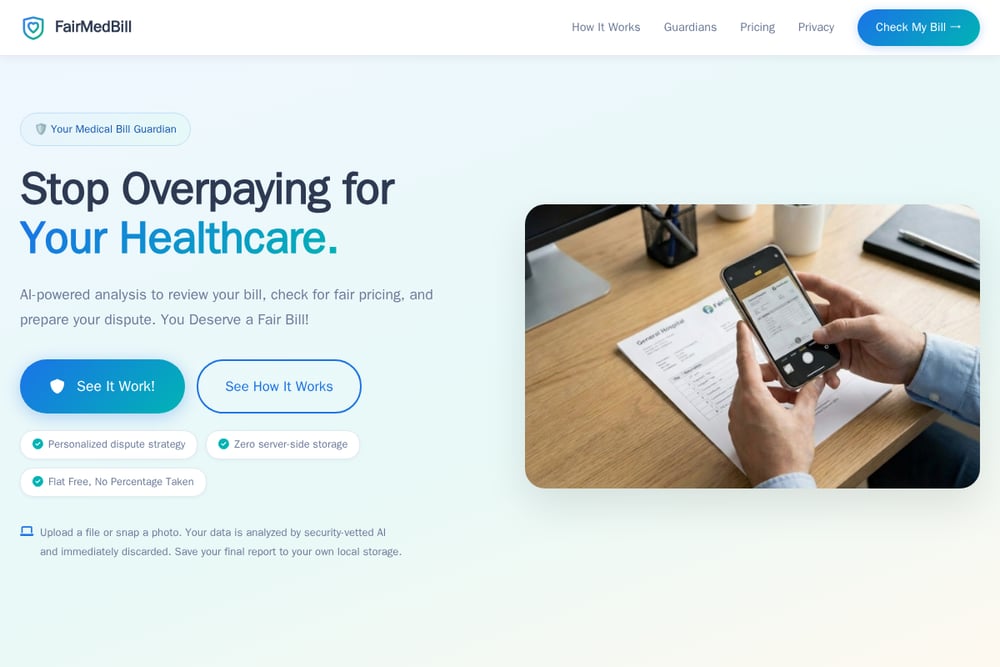 A screenshot of the FairMedBill website.
FairMedBill uses a patent-pending '10-Guardian' detection engine to scan your bill for upcoding, duplicate charges, and No Surprises Act violations. You upload a photo or PDF, and your data is encrypted, analyzed, and immediately discarded with no server-side storage. Pricing is a flat fee: $29 for a single bill or $79 for 30 scans, with no percentage taken from your savings. It is a solid choice for users who want a thorough, one-time analysis without any ongoing commitment or data retention.
#5 Advocara
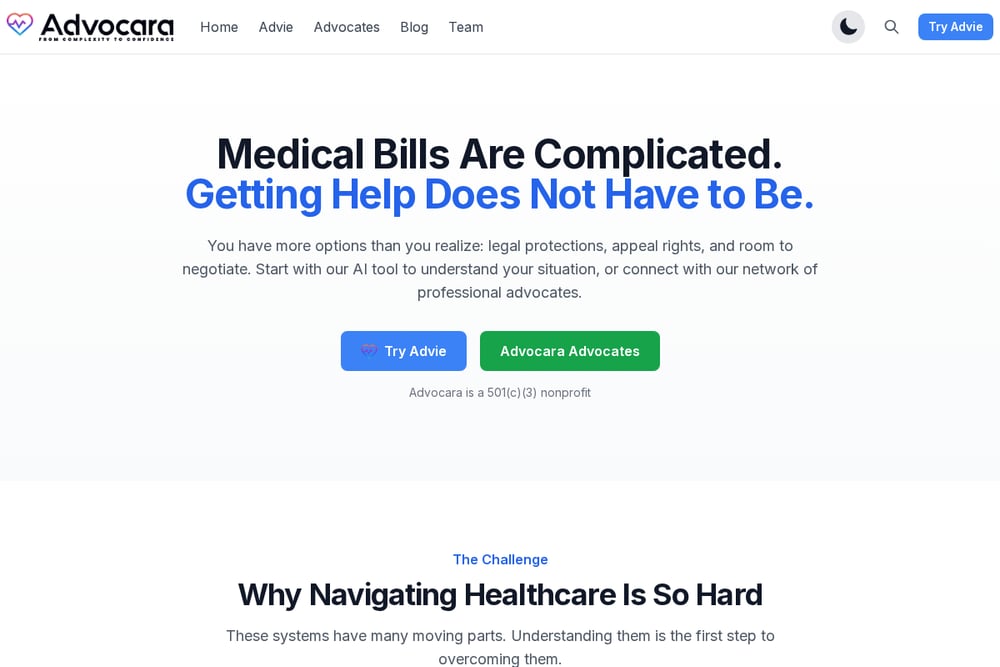 A screenshot of the Advocara website.
Advocara is a nonprofit that offers two paths: an AI tool called 'Advie' for instant bill analysis and plain-English guidance, and a network of professional advocates for complex cases. The AI tool helps you understand your rights and next steps, while the advocate network handles full-service negotiation and appeals. This dual approach makes it suitable for users who want to start with self-service but have the option to escalate to a human expert.
How to Choose the Right Medical Bill Dispute Tool
First, decide how involved you want to be. If you want to hand off the entire process, CareRoute's no-win-no-fee model is hard to beat. If you prefer a DIY approach, BillGuard AI and Medispute offer low-cost, pay-per-use options with strong privacy features. FairMedBill is a great middle ground with a flat fee and no data retention. If you think you might need a human advocate later, Advocara's hybrid model gives you that flexibility. Always check what types of bills the service accepts and whether they handle insurance disputes or just provider overcharges.
Automating Your Medical Bill Dispute Workflow
Start by requesting an itemized bill from your provider if you don't already have one. Upload it to your chosen tool for analysis. Review the identified errors and the generated dispute letter. Customize the letter with your personal details and send it via certified mail to the provider's billing department. Follow up with the phone script provided by the tool. Track all correspondence and deadlines in a simple spreadsheet to ensure you don't miss any appeal windows.
Your Next Step to Lower Medical Bills
You don't have to accept a confusing medical bill at face value. These five tools put the power back in your hands, whether you want a full-service negotiator or a simple AI scan. Start with a free scan from BillGuard AI or Medispute to see what errors might be hiding in your bill. From there, you can decide whether to handle the dispute yourself or bring in a service like CareRoute or Advocara. The key is to act quickly, as dispute deadlines are often tight.