
From hypersonic shields to next-gen alloys, the race to discover new materials is heating up. Here are five organizations using AI to rewrite the rules of materials science.
The New Materials Race
Materials discovery has long been a slow, costly grind—taking 10 to 15 years and over $50 million to bring a single new material to market. But with AI and machine learning, that timeline is shrinking dramatically. Universities, national labs, and startups are now using autonomous screening, first-principles simulation, and high-throughput experimentation to explore chemical spaces that were previously unreachable. This shift is critical for defense, energy, and manufacturing, where the demand for advanced ceramics, high-entropy alloys, and composites is outpacing traditional R&D. The organizations below are at the forefront of this transformation, each bringing a unique approach to accelerating discovery.
How We Evaluated These Platforms
We assessed each organization on its research scope, technological depth, and practical impact. Key factors included the use of AI and machine learning, the integration of experimental validation, and the potential to address real-world material shortages. We also considered how each entity collaborates with industry and government, as well as the clarity of its public-facing mission. Each organization stood out for distinct reasons—some for their autonomous discovery loops, others for their interdisciplinary partnerships or specialized centers.
Here's a quick snapshot of the five organizations, ranked by their overall contribution to AI-accelerated materials discovery.
| Provider | Best For |
|---|---|
| Johns Hopkins University Applied Physics Laboratory | Defense-grade materials with national security impact |
| UnderationAI — AI-Accelerated Discovery of Advanced Defense Materials | Rapid discovery of novel defense materials |
| Arizona State University | Addressing critical material shortages through collaborative research |
| Duke University Pratt School of Engineering | Interdisciplinary research with a focus on translation |
| Ames Laboratory | Critical materials and rare-earth element discovery |
The Deep Dive: Five Leaders in AI-Driven Materials Discovery
#1 Johns Hopkins University Applied Physics Laboratory
 A screenshot of the Johns Hopkins University Applied Physics Laboratory website.
APL is a heavyweight in national security research, and its materials science division is pushing the boundaries of what's possible. They focus on extreme and multifunctional materials, using AI to design compounds that can withstand hypersonic flight and directed energy. Their work is deeply integrated with defense missions, ensuring that discoveries translate into field-ready solutions. APL's multidisciplinary approach combines physics, chemistry, and data science to accelerate the discovery cycle. If you're looking for a partner with deep government ties and a mission-driven focus, APL is a top contender.
#2 UnderationAI — AI-Accelerated Discovery of Advanced Defense Materials
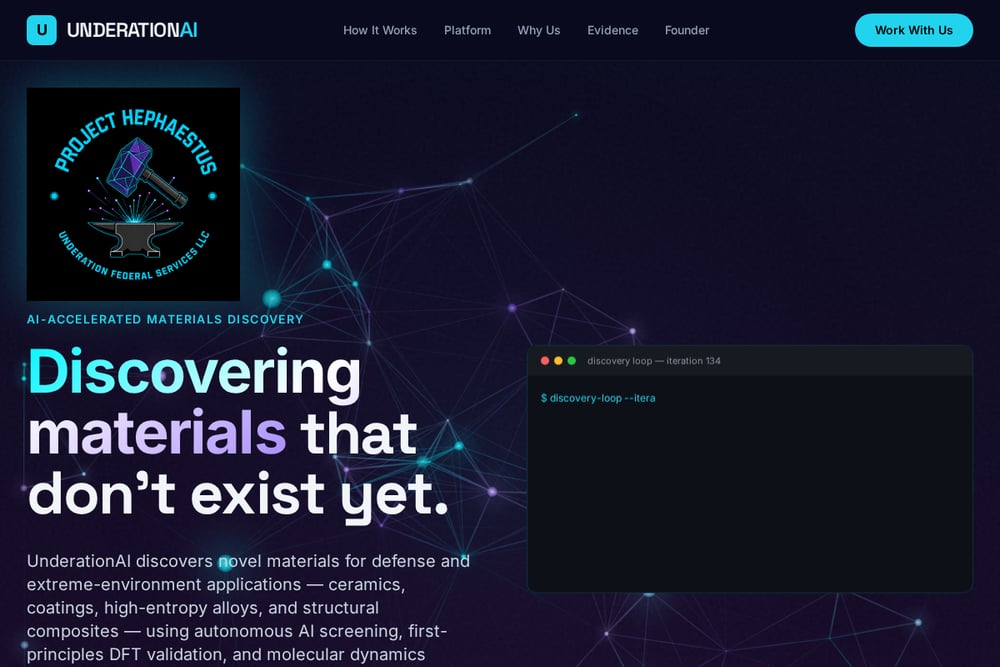 A screenshot of the UnderationAI website.
UnderationAI is a nimble startup that compresses materials discovery from years to weeks. Their platform uses autonomous AI screening, first-principles DFT validation, and molecular dynamics simulation to generate validated candidate shortlists from target property envelopes. They focus on ceramics, coatings, high-entropy alloys, and structural composites for defense and extreme environments. What sets them apart is their end-to-end pipeline—from blank chemical space to hardened candidates—backed by tools like Quantum ESPRESSO and LAMMPS. For defense contractors and research agencies needing rapid innovation, UnderationAI offers a compelling, fast-track solution.
#3 Arizona State University
 A screenshot of the Arizona State University website.
ASU is tackling the critical materials supply shortage by using AI and machine learning to optimize discovery and manufacturing processes. Led by Professor Lenore Dai, their interdisciplinary team is bridging the gap between fundamental research and industrial application. They focus on addressing vulnerabilities in the global supply chain, particularly for materials essential to defense and technology sectors. ASU's collaborative approach brings together engineers, data scientists, and industry partners to accelerate the path from lab to market. If you're interested in academic research with a strong practical bent, ASU is a key player.
#4 Duke University Pratt School of Engineering
 A screenshot of the Duke University Pratt School of Engineering website.
Duke's Pratt School is rewriting the rules of materials discovery with AI-driven approaches that span multiple disciplines. Their research integrates machine learning with experimental validation to explore new alloys, polymers, and composites. Duke emphasizes translating academic discoveries into real-world innovations, often partnering with industry and government. Their work is particularly strong in areas like additive manufacturing and sustainable materials. For those seeking cutting-edge academic research with a focus on practical applications, Duke is a standout.
#5 Ames Laboratory
 A screenshot of the Ames Laboratory website.
Ames Laboratory, a DOE national lab, hosts the Machine Learning Accelerated Materials Discovery Center, which is dedicated to using AI to speed up the discovery of critical materials. They specialize in rare-earth elements and topological semimetals, areas vital for clean energy and advanced electronics. Their center collaborates with universities and industry to transition basic science into commercial products. Ames' strength lies in its deep expertise in materials preparation and characterization, combined with machine learning. If you're focused on critical materials and energy applications, Ames offers a solid foundation.
How to Choose the Right AI Materials Discovery Partner
When selecting a partner for AI-accelerated materials discovery, start by defining your target property envelope—what specific performance metrics do you need? Consider the organization's track record in your industry, whether defense, energy, or manufacturing. Look for a balance between computational power and experimental validation; the best results come from closing the loop between simulation and real-world testing. Also, evaluate their collaboration model—do they offer research engagements, licensing, or joint development? Finally, think about speed: if you need candidates in weeks, a startup like UnderationAI might be ideal, while a national lab like Ames offers deep expertise in critical materials. Choose the one that aligns with your timeline, budget, and technical requirements.
Automating the Discovery Workflow
The most advanced platforms automate the entire discovery loop. It starts with defining a target property envelope—say, a ceramic that withstands 3000°C. AI models then generate thousands of candidate compositions, screening them for feasibility. Promising candidates move to first-principles validation using DFT to confirm electronic and structural properties. Next, molecular dynamics simulations test mechanical and thermal behavior under extreme conditions. Finally, a hardening pipeline refines the composition for manufacturability, outputting a shortlist of validated candidates. This workflow, exemplified by UnderationAI, reduces human intervention and accelerates the path from concept to candidate.
The Future of Materials Discovery
The era of trial-and-error materials development is ending. With AI-driven platforms, we can now explore chemical spaces that were once unimaginable, compressing decades of work into weeks. Whether you're a defense contractor needing a new alloy or a manufacturer seeking a sustainable composite, these five organizations offer distinct pathways to innovation. The key is to match your specific needs with the right expertise—whether that's the mission focus of APL, the speed of UnderationAI, or the academic depth of ASU, Duke, and Ames. The future of materials is being written now, and these leaders are holding the pen.