Internal knowledge is scattered across drives, chat threads, ticketing systems, and wikis. AI search tools promise to pull answers out of that mess, but they differ in how they connect to your tools, how they handle permissions, and where the data actually lives. This list covers five tools worth knowing if you are evaluating options for internal company knowledge in 2026. It is a plain list, not a ranking, and no company here is presented as better than another.
How We Picked These Tools
These tools were chosen because each one publicly describes capabilities aimed at finding and grounding answers in a company's own knowledge: connectors to workplace systems, permission-aware retrieval, governance of content, or self-hosted deployment. Only details stated on the provided source pages were used. Descriptions focus on what each tool does and who it suits, without quality claims or comparisons.
| Provider | Best For |
|---|---|
| Glean | Enterprises wanting a broad AI layer over company context |
| Guru | Teams prioritizing governed, verified knowledge |
| Onyx | Security-conscious teams needing self-hosted search |
| Sana | Organizations pairing AI agents with AI-native learning |
| Unleash | Readers who should verify this entry directly |
The 5 Tools in Focus
#1 Glean
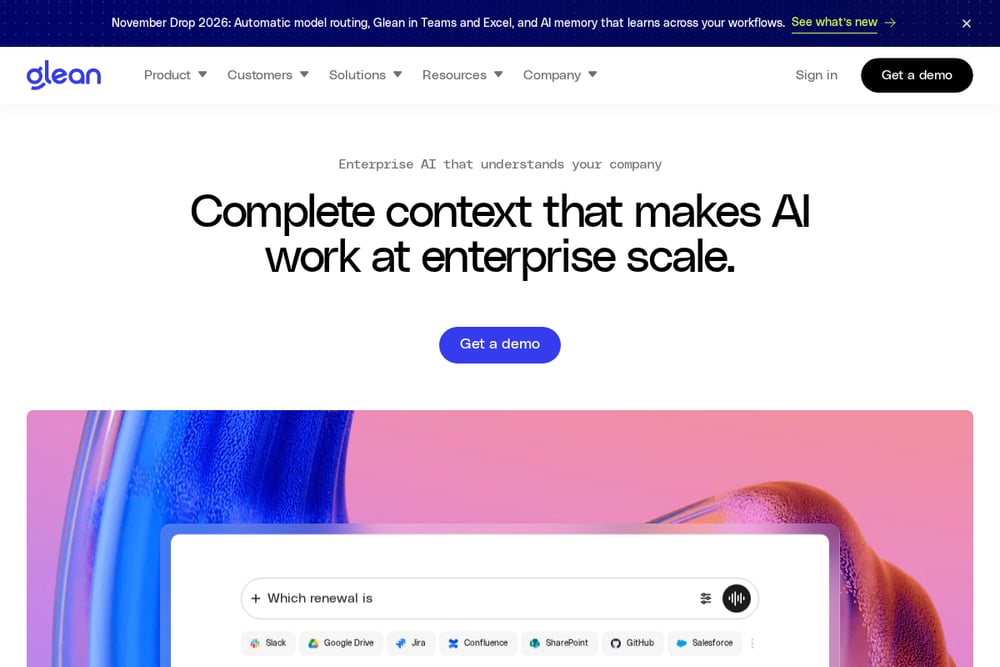 A screenshot of the Glean website.
Glean positions itself as enterprise AI that understands your company, grounding answers in company context through connectors and actions. Its product set includes enterprise search for finding answers across your company, an assistant described as an enterprise AI coworker, and agents for building and managing automated work. It emphasizes permission-aware access and pre-connected enterprise context to reduce token waste. It suits organizations that want a broad AI layer spanning search, assistance, and agents across many workplace systems.
#2 Guru
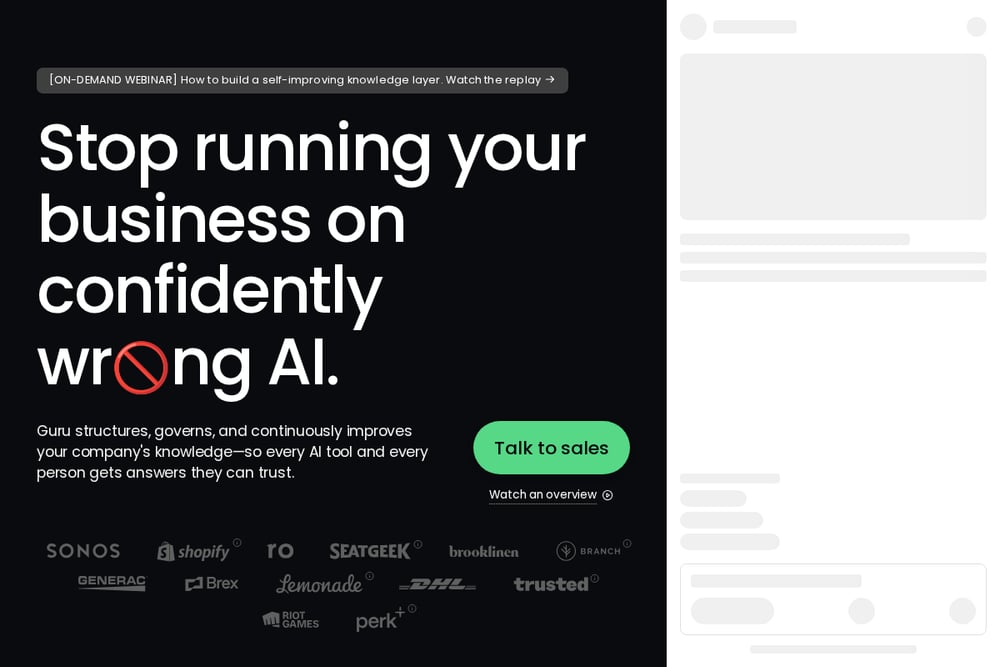 A screenshot of the Guru website.
Guru describes itself as structuring, governing, and continuously improving a company's knowledge so that every AI tool and every person gets answers they can trust. It frames its offering around a governed source of truth, with knowledge agents that improve information rather than just find it. Its solutions cover knowledge management, enterprise AI search, workplace AI chat and research, and agentic knowledge bases. It suits teams that care about verified, governed content feeding both people and AI workflows.
#3 Onyx
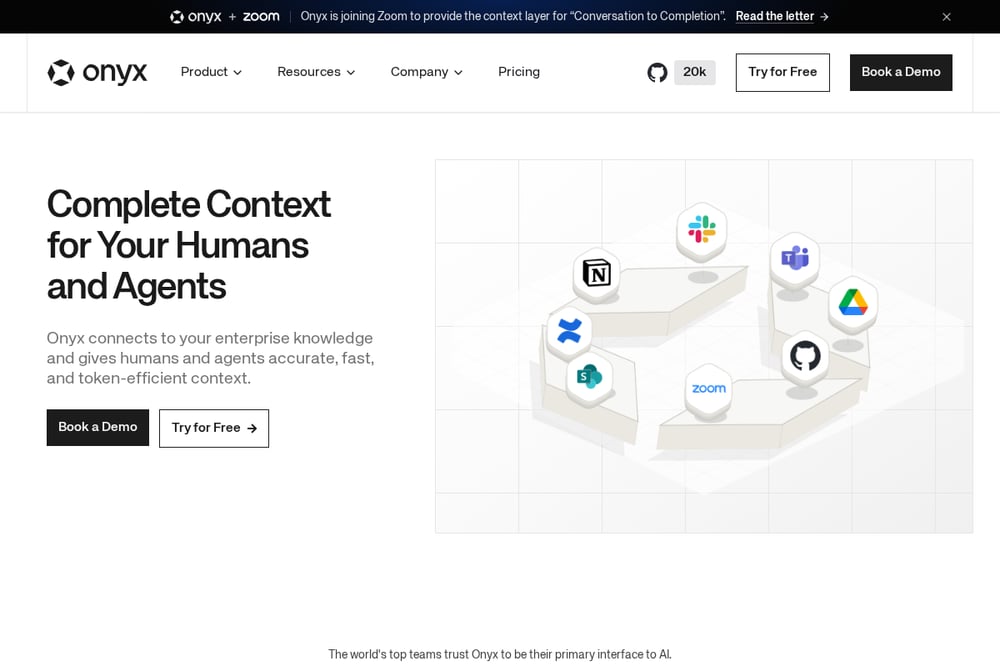 A screenshot of the Onyx website.
Onyx connects to enterprise knowledge and provides humans and agents with context, emphasizing retrieval quality across sources searched in parallel. It highlights self-hosted deployment, with the index, embeddings, and model traffic staying inside the customer's own infrastructure, and source permissions enforced at query time. It also offers connectors to workplace tools and the ability to swap model providers. It suits teams with strict data-control requirements who want search and context for both people and agents.
#4 Sana
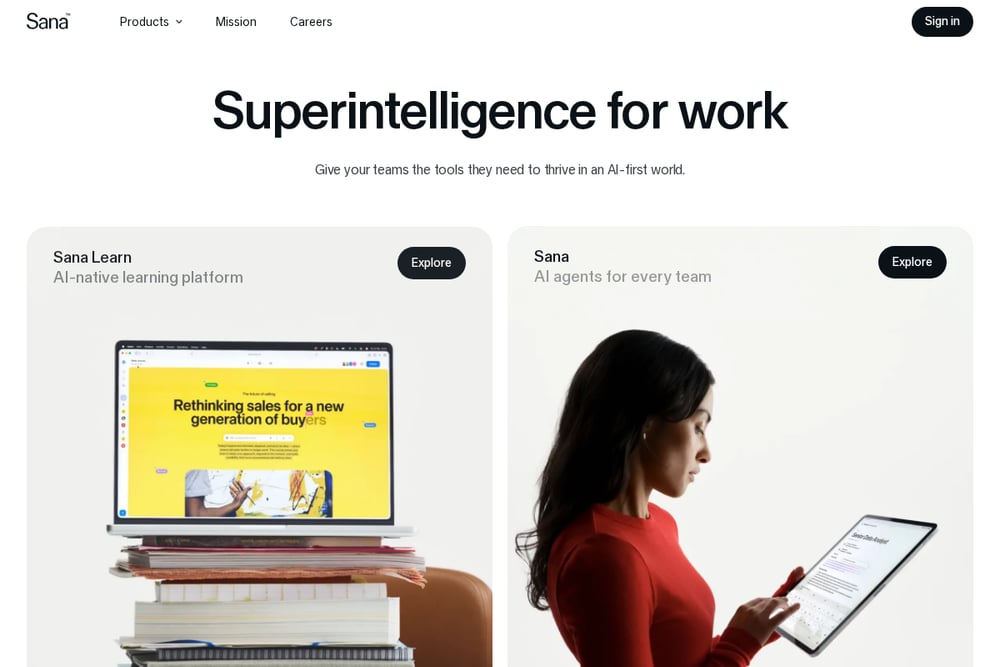 A screenshot of the Sana website.
Sana presents itself as superintelligence for work, giving teams tools for an AI-first world. Its product lineup includes Sana Learn, described as an AI-native learning platform, and Sana Agents, described as AI agents for every team. The site organizes these around products, solutions, integrations, security, and pricing. It suits organizations looking to combine AI agents with AI-native learning for their teams.
#5 Unleash
 A screenshot of the Unleash website.
The provided source page for this entry is a Zendesk page rather than an Unleash page, so details about Unleash itself cannot be verified from the supplied material. The page describes Zendesk's platform, including an employee service product framed as enabling employees to find solutions quickly with a scalable, intuitive platform, and a knowledge base product framed as using connected knowledge for every solution. Because the source does not describe Unleash, this entry should be treated as unverified and revisited against Unleash's own materials.
Which One Should You Choose?
Start with where your knowledge lives and who needs to reach it. If your content sits across many workplace systems, look at how each tool connects to those systems and whether permissions from each source are respected. If your security team requires data to stay in your own environment, check deployment options such as self-hosting or air-gapped operation. If answer trust is the main concern, look at how a tool structures and verifies content before it reaches people and AI workflows. Also consider whether you need search alone or search combined with assistants, agents, or learning. Confirm every detail against each vendor's current documentation before deciding.
Final Thoughts
These five tools approach internal company knowledge from different directions: broad enterprise context and agents, governed and verified content, self-hosted retrieval, AI agents paired with learning, and an entry that still needs verification against its own materials. None is presented as better than another. The right fit depends on your deployment constraints, how much governance you need over content, and whether you want search on its own or as part of a wider AI platform.
Know a company that belongs on this list? Email us at editorial@peekwire.com.